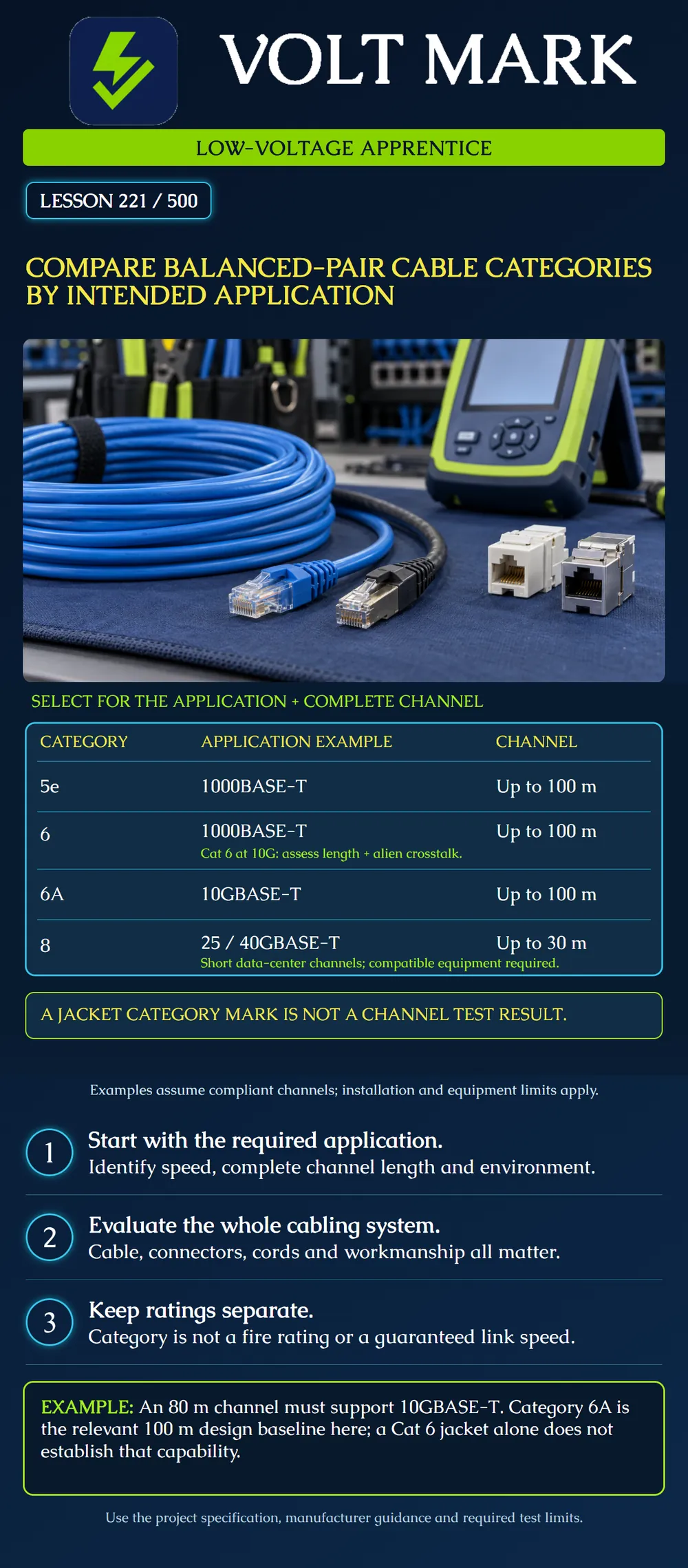
Compare common balanced-pair categories using the required Ethernet application and complete channel length. Distinguish a component label from verified installed performance.
For compliant channels under their applicable design conditions: Category5e supports1000BASE-T over up to100m. Category6 also supports1000BASE-T over up to100m. Category6A supports10GBASE-T over up to100m. Category8 targets25GBASE-T and40GBASE-T over up to30m in a specified two-connector channel, principally for short data-center connections.
These are selected examples, not each category's complete application list or a promise about every installed cable. Matching equipment is required. A higher-category patch cord does not turn a100Mb/s camera into a gigabit camera.
Existing Category6 needs application-specific assessment for10GBASE-T. Fluke's field-testing guidance explains that length and alien crosstalk influence suitability; the commonly cited37–55m region is conditional, not an unconditional pass distance. Testing must address the required in-channel and alien-crosstalk performance. For a new100m10GBASE-T design, Category6A is the relevant baseline in this comparison.
Do not promise that every short Cat6 run passes or that a particular jacket mark establishes10G performance. The cited Fluke article discusses a historical TIA technical bulletin; the actual project must identify the applicable current specification and test limits.
The fictional project needs an80m complete copper channel for10GBASE-T. A supplier offers a box marked Category6, while the approved design calls for Category6A.
Record the application,80m channel requirement and specified Category6A system. Do not accept the substitute solely because the cable has four pairs, fits the connector or is said to be fast. Ask the designer to resolve any proposed substitution using the complete performance evidence.
In a second exercise, an existing70m compliant Category5e channel serves a1000BASE-T device. That length and application are within the example's100m envelope. The conclusion remains conditional on the actual installed-channel requirements and evidence; it is not certification based on two numbers.
In a third exercise, a30m Category8 channel is proposed for40GBASE-T. Verify the supported topology, components and compatible active equipment. The30m value includes the channel's cords; it is not30m of fixed cable plus unlimited patching.
A channel includes the relevant installed cable, connections and equipment/patch cords in its defined topology. A permanent link is a different test boundary, explored in Lesson222. Do not compare a channel result against a permanent-link requirement without recognizing that difference.
A box label identifies the cable product's claimed category. It does not certify the connectors, field terminations or installed route. Mixed components and poor workmanship can prevent the intended channel from meeting its requirement. Conversely, one passing connectivity check does not replace the specified certification report.
Assume an example channel has90m of fixed cabling and two5m cords: 90 +5 +5 =100m.
If both cords are changed to8m: 90 +8 +8 =106m.
The second total exceeds the100m example envelope. This arithmetic is not a complete length-design method: cord construction, conductor size, temperature, connection count and the relevant standard/manufacturer design can require additional limits or derating. Do not use90+10 as a universal permission for any cord type or topology.
Frequency characterization in MHz is not the same quantity as Ethernet data rate in Mb/s or Gb/s. Do not translate one into the other by matching numbers. Similarly, category does not tell you whether a jacket is permitted in a particular building space or outdoor environment.
PoE requirements, temperature, cable bundling, shielding/bonding design, mechanical conditions and product listings need their own review. A category-selection chart is not a nationwide code approval. The installer follows the adopted requirements, project specification and manufacturer instructions.
The poster concentrates on commonly encountered TIA categories. ISO categories/classes, including Category7/7A systems, have their own component and connector requirements; they should not be inferred from a generic marketplace RJ45 label. Existing Category5e/6 multigigabit applications also need their relevant assessment. Neither topic changes the importance of testing the intended application and topology.
Record the required application, endpoint capabilities, complete channel length, chosen category/system, environment, power requirements, connector/cord details, applicable test limit and report reference. Mark unknown items as unresolved. Keep the actual results tied to the installed cable identifier.
Do not claim a successful link light proves the intended10G or40G application. Save the prescribed performance evidence and verify the required equipment operation separately.
1.No. 2.No; application assessment and conditions matter. 3.No;30m is the specified channel envelope in this example. 4.106m. 5.No.
Mistake: Approving the offered Cat6 box for the 80 m 10GBASE-T channel because the connectors fit. Correction: Compare the proposed complete system with the specified Cat6A design and refer the substitution with its performance evidence to the designer.
Mistake: Keeping a 100 m channel record after replacing both 5 m cords with 8 m cords. Correction: Update the total to 106 m and resolve the design before acceptance; also check applicable cord and environmental limits.
Mistake: Using the cable category as evidence that its jacket is suitable for the route. Correction: Check the product's separate jacket/environment ratings against the actual spaces and project requirements.
Fluke Networks, Network Engineer Tools and Troubleshooting Guide: https://www.flukenetworks.com/expertise/role/network-engineers Primary application/category comparison.
Fluke Networks,10GBASE-T field testing requirements: https://www.flukenetworks.com/knowledge-base/applicationstandards-articles-copper/10gbase-t-field-testing-requirements Primary technical explanation of existing Category6 assessment and alien crosstalk; historical bulletin context retained.
Fluke Networks, Learn About Network Fundamentals: https://www.flukenetworks.com/solutions/learn-about Category8 section specifies the30m two-connector application context.
Siemon, Advanced Copper Cabling Solutions: https://www.siemon.com/en/solutions/copper-systems/ Primary manufacturer overview of end-to-end systems and Category8.2 application context, consulted through indexed content.
Texas journeyman, 15 questions, scored by topic against the 70% mark. No card, and no account needed to start.
Free study material for low-voltage apprentices. This is a national foundation course: requirements differ by state and by local jurisdiction, and a practice that is common in one place is not a rule everywhere. Nothing here is a licence, a certification, or authority to work unsupervised, and completing it does not count as apprenticeship hours or continuing-education credit. Check the codes adopted where you are working, the licensing authority for that work, and your employer's safety programme. VoltMark is not affiliated with, endorsed by, or sponsored by NFPA, OSHA, NICET, BICSI, FOA, or any state or local licensing authority.

Electrician licensing exam prep: practice questions, timed exam simulations, and step-by-step help finding every answer in the NEC.