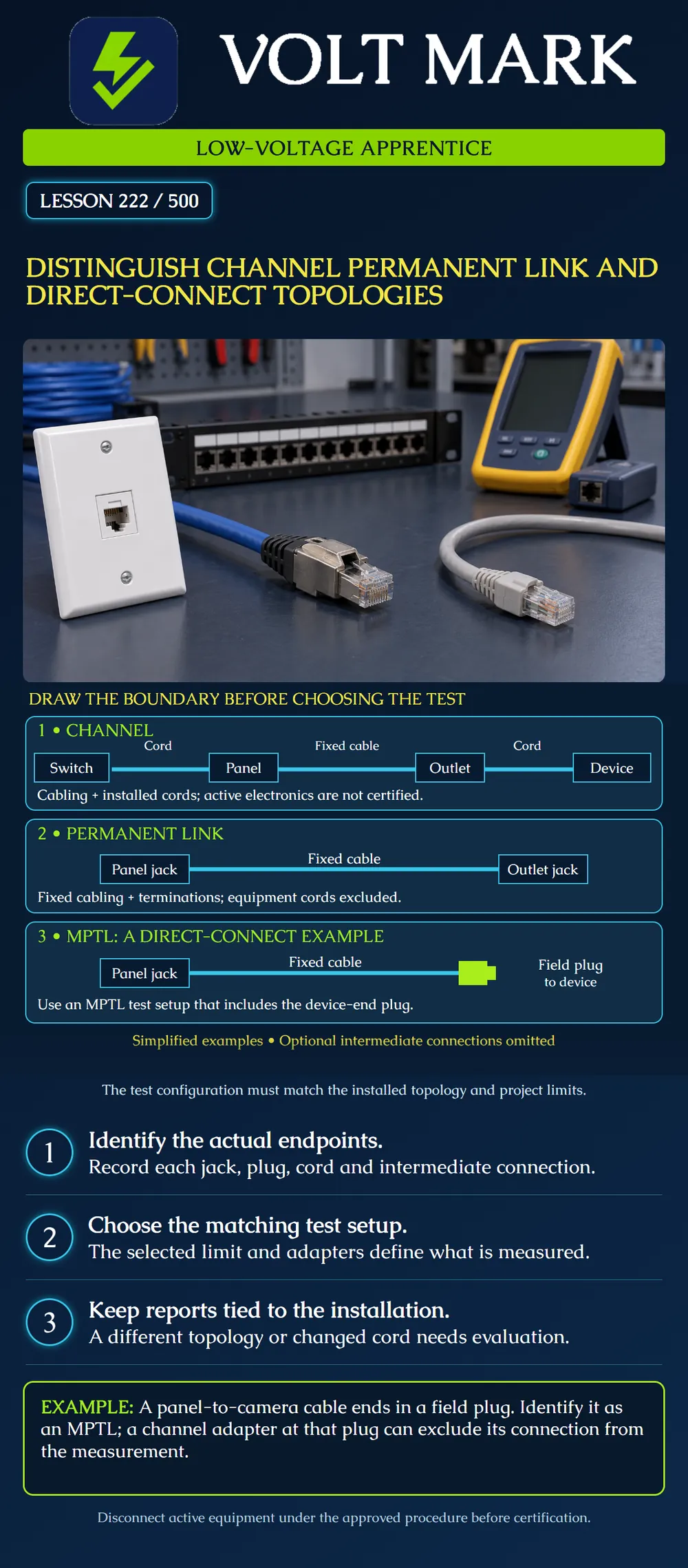
Given an installation drawing, identify the cabling topology, mark the intended measurement endpoints, and request the correct certification configuration. This lesson describes copper balanced-pair cabling. It does not authorize a live-service interruption or certify any installation.
A channel contains the installed cabling and equipment/patch cords between active devices. Those devices are contextual endpoints, not electronics certified by the cable test. A permanent link is the fixed cabling and its terminations, without the equipment cords at its ends. The MPTL example has a panel jack at one end and a field-terminated plug at the device end, eliminating the outlet-and-equipment-cord arrangement there. The drawing omits optional intermediate connections to make the boundaries clear. It is not a connector-count permission for every design. [1]
Ask the person using that phrase to draw both ends. A panel-to-plug arrangement and a plug-to-plug industrial assembly are not automatically the same certification model. Record the actual connector types and construction before selecting a test. Do not use a familiar report name to disguise an unfamiliar installation. Obtain the applicable project specification and manufacturer instructions when the arrangement differs from the approved design.
Fluke's DSX MPTL guidance uses a permanent-link adapter at the jack end and a category-appropriate patch-cord adapter at the plug end, with the correct MPTL limit. An ordinary channel adapter at the far end can leave the final mated plug connection outside the measurement. A displayed PASS under that setup does not establish the required MPTL result. Adapter selection is specific to the tester, connector and category; follow its supported configuration. This is not an instruction to buy an arbitrary adapter or select any limit containing the word MPTL. [2]
The work order says: “Certify the new camera cable.” The apprentice sees a panel jack in TR-A and a cable emerging above the ceiling with a field plug. There is no outlet and no short equipment cord at the camera. Write a clarification: “Observed panel jack to field plug. Please confirm the specified MPTL category/limit and approved test adapter combination before testing.” Do not quietly create a conventional permanent-link record because that was used on yesterday's office outlets. Do not temporarily add an outlet merely to make the tester fit and then present that result as the original installation. Before disconnecting the camera, coordinate the service impact, identify the exact cable and get the approved work window. The teaching drawing is not authorization to take security coverage offline.
The project has a panel-to-outlet fixed run and separate equipment cords. A saved permanent-link record exists. Later, an unrecorded cord is installed at the workstation. Questions for the apprentice: Which record describes the fixed run? Which item was changed? What evidence is needed under this project's acceptance plan? The old record remains evidence for the tested fixed installation, subject to its identity and validity. It is not evidence that the newly selected cord has been inspected, documented or included in a channel acceptance test. Avoid declaring the entire installation defective or accepted solely from the existence of one report. [1]
For each training sample, fill in:
Use “unknown—confirm before testing” for missing facts. An empty box must not silently become an assumed compliant value. Keep a drawing with the record so another technician can understand the test boundary without guessing from the cable nickname.
Do not turn the three sketches into one universal length rule. Apply the selected topology, cabling category, application and installation requirements. Category 8's short-channel applications from Lesson 221 illustrate why a remembered 100-meter number is not enough. This poster intentionally has no numeric maximum. It teaches which parts belong to the model before teaching test interpretation.
A supplied drawing shows a panel jack, fixed cable and field plug at camera C-222. The saved report says channel; the far-end adapter was a channel adapter. No equipment has been disconnected. Write the observed topology, the unresolved measurement boundary and the next authorized step.
Suggested response: The drawing shows the panel-to-plug MPTL example. The saved setup does not demonstrate inclusion of the final mated plug connection under the required MPTL method. Request the project limit and supported tester/adapter configuration, then arrange an authorized test window. Retain the old report as historical evidence rather than changing its label.
Mistake: Selecting a permanent-link test simply because yesterday's panel-to-outlet jobs used it. Correction: Draw both ends of C-222 and confirm the panel-to-plug topology and supported MPTL setup before testing.
Mistake: Renaming a channel PASS report to MPTL to satisfy the work order. Correction: Retain the actual report identity and obtain the required measurement with the correct boundary, limit and adapters.
Mistake: Treating D-222's permanent-link result as proof of the replacement workstation cord. Correction: Identify the changed cord separately and obtain the cord or channel evidence required by the acceptance plan.
[1] Fluke Networks, Channel, Permanent Link, Patch Cords, MPTL, E2E… Oh My! https://www.flukenetworks.com/blog/cabling-chronicles/channel-permanent-link-patch-cords-mptl-e2e-oh-my [2] Fluke Networks, What Is the Right Way to Test an MPTL? https://www.flukenetworks.com/blog/cabling-chronicles/right-way-to-test-MPTL These manufacturer references describe the testing concepts. Their historical references do not establish the latest adopted standards edition. Use the applicable project specification and current tester instructions for field work.
Texas journeyman, 15 questions, scored by topic against the 70% mark. No card, and no account needed to start.
Free study material for low-voltage apprentices. This is a national foundation course: requirements differ by state and by local jurisdiction, and a practice that is common in one place is not a rule everywhere. Nothing here is a licence, a certification, or authority to work unsupervised, and completing it does not count as apprenticeship hours or continuing-education credit. Check the codes adopted where you are working, the licensing authority for that work, and your employer's safety programme. VoltMark is not affiliated with, endorsed by, or sponsored by NFPA, OSHA, NICET, BICSI, FOA, or any state or local licensing authority.

Electrician licensing exam prep: practice questions, timed exam simulations, and step-by-step help finding every answer in the NEC.