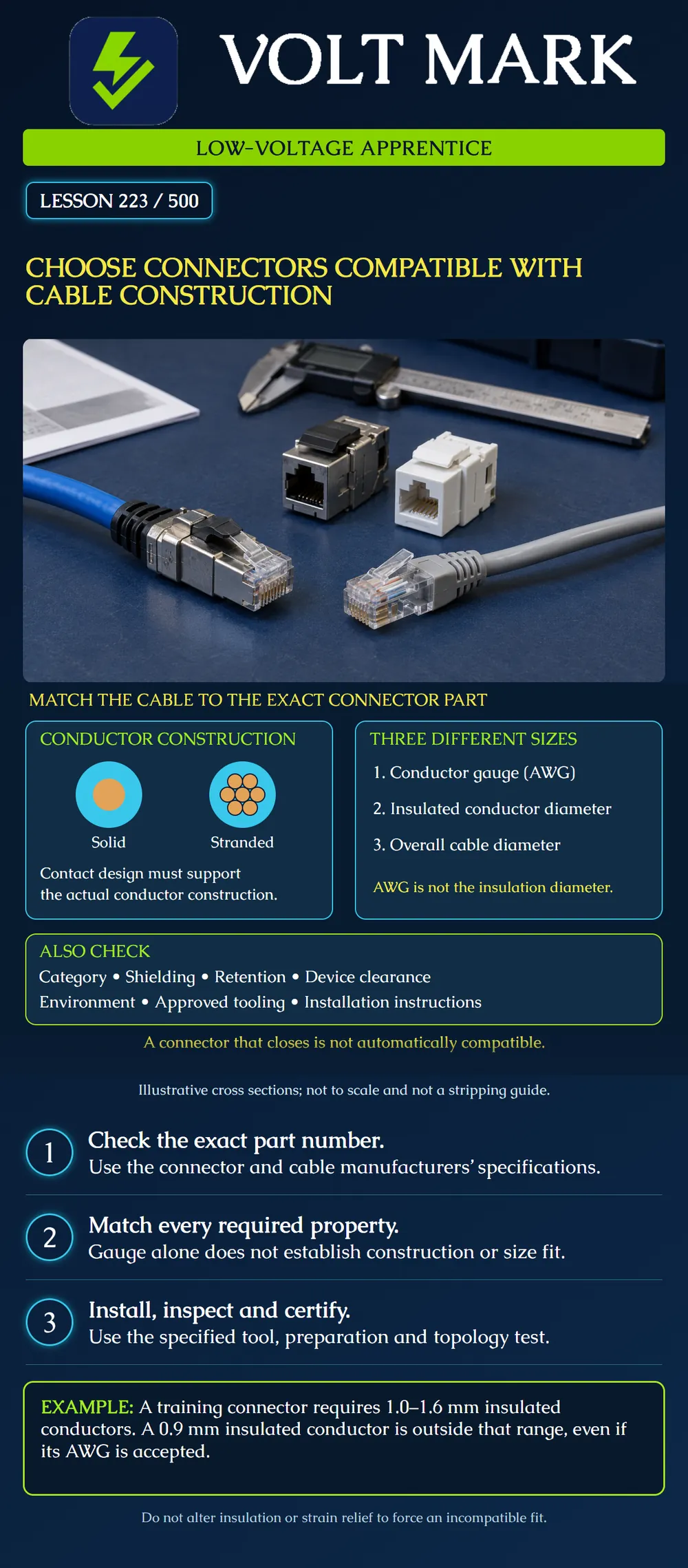
Compare a cable specification with an exact connector part's compatibility information. Identify a supported candidate, an explicit mismatch, or missing information before cutting cable. This lesson covers balanced-pair copper plugs and jacks; it is not a universal termination procedure.
“Category 6A” on two packages is only a starting point. Use the exact connector part number and applicable instructions. A representative Panduit shielded field plug specification lists 22–26 AWG solid or stranded shielded cable, insulated-conductor diameters of 1.0–1.6 mm, and overall cable diameters of 5.8–9.0 mm. These are separate conditions for that product, not generic RJ45 dimensions. The same sheet specifies termination tooling. [1]
The poster's round cross sections illustrate one solid conductor versus multiple strands within insulation. The strands are schematic, not a claim that every stranded conductor has seven strands. A gauge number does not tell you the insulation thickness or the cable's outer diameter.
Siemon's Z-PLUG documentation identifies support for both shielded and unshielded cable, and solid and stranded construction. It also describes device-space options and a dedicated termination tool. That is evidence about the specified product family, not permission to use every metal-bodied connector on every cable. Follow the exact part's instructions, including allowed boot or clip configurations, rather than transferring a feature from a different manufacturer's product. [2]
The fictional training cable card lists:
A second fictional cable has the same gauge and overall diameter, but its insulated conductors are 0.9 mm across. It misses the example's 1.0 mm minimum by 0.1 mm. Selecting a plug because the jacket fits its clamp would ignore this mismatch. Record the conflict and find a manufacturer-supported combination. Do not wrap conductors with tape, add loose packing, crush the retention clamp or modify the contact arrangement to make the product seem compatible. This is a selection exercise, not an approved repair method. [1]
The jacket is readable, but the package with the connector part number is missing. The technician says, “These always work.” The apprentice's response should identify the missing evidence: connector part identification and instructions. Keep the parts separate until their identity can be established. Do not invent dimensional specifications from appearance. A photograph may help document the question, but it does not replace a manufacturer's identification.
In a practice camera enclosure, the assembled connector can latch into the port, but the cover cannot close without pushing the cable into a sharp bend. Do not treat successful latching as approval of the installation. Compare the completed connector/boot envelope with the device's approved cable entry and bend requirements. Escalate the combination for an approved alternative. Product-specific options may exist; improvising removal of protection is not a general solution. [2]
Create one row per intended cable/connector combination: Cable manufacturer and part: Connector manufacturer and exact part: Required category/system: Conductor material and solid/stranded construction: Conductor gauge: Insulated-conductor diameter: Overall cable diameter: Shield arrangement and required termination: Tool and instruction revision: Device clearance and environment: Approved / rejected / pending, with reason:
Use the manufacturer's stated dimensions and tolerances. If measurement is needed, use an approved method on a permitted sample and document it; do not damage an installed conductor merely to obtain a number. A single measurement does not replace product specifications across a batch.
A compatible selection still requires correct preparation, pair handling, contact seating, jacket retention and inspection under the product instructions. Lesson 222 explains why the topology determines the certification setup. Retain the cable ID, connector identity and applicable test report. A connector label alone is not an installed-link test result.
For fictional Cable B, 23 AWG solid construction and a 7.2 mm outside diameter meet the example product's listed construction and outside-diameter ranges. Its 0.9 mm insulated conductor does not meet the 1.0 mm minimum: 1.0 - 0.9 = 0.1 mm below the stated range. Record the combination as rejected on that criterion, even though the jacket fits. Request a supported connector/cable combination; meeting two conditions does not cancel the third mismatch.
Mistake: Approving Cable B because its gauge and jacket diameter match the connector sheet. Correction: Compare insulated-conductor diameter as a separate condition and reject the documented 0.9 mm versus 1.0 mm minimum mismatch.
Mistake: Treating a familiar metal plug as the missing identified part for Cable C. Correction: Resolve the exact part number and applicable instructions before using its claimed compatibility ranges.
Mistake: Accepting the camera connector because it latches, despite pressure from the closed cover. Correction: Check the assembled plug and boot clearance and cable bend requirements with the device instructions; obtain an approved alternative if the combination does not fit.
[1] Panduit TX6A Shielded Field Term RJ45 Plug, COSP460--SA-ENG, 4/2019, pages 1–2. https://www.panduit.com/content/dam/panduit/en/website/landing-pages/documents/tx6a-shielded-field-term-plug-specification-sheet-cosp460-sa-eng.pdf [2] Siemon Z-PLUG Field-Terminated Plug specification. https://files.siemon.com/en/specsheet/siemon-z-plug-field-terminated-plug_spec-sheet.pdf Panduit's dated sheet is a documented teaching example, not a replacement for current product instructions. Confirm the applicable revision for procurement and installation. The fictional cable examples do not approve a real product combination.
Texas journeyman, 15 questions, scored by topic against the 70% mark. No card, and no account needed to start.
Free study material for low-voltage apprentices. This is a national foundation course: requirements differ by state and by local jurisdiction, and a practice that is common in one place is not a rule everywhere. Nothing here is a licence, a certification, or authority to work unsupervised, and completing it does not count as apprenticeship hours or continuing-education credit. Check the codes adopted where you are working, the licensing authority for that work, and your employer's safety programme. VoltMark is not affiliated with, endorsed by, or sponsored by NFPA, OSHA, NICET, BICSI, FOA, or any state or local licensing authority.

Electrician licensing exam prep: practice questions, timed exam simulations, and step-by-step help finding every answer in the NEC.