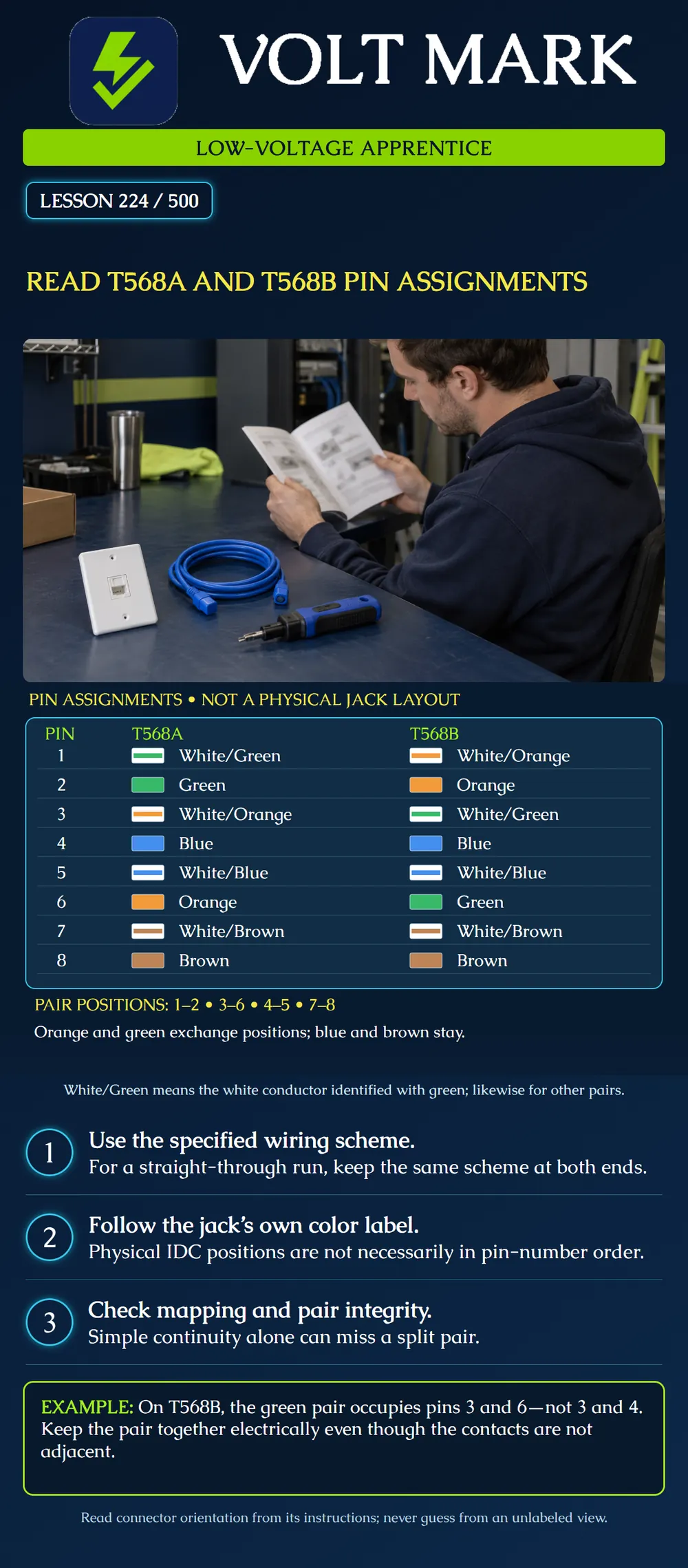
Read the pin assignments, preserve pair membership and distinguish a pin table from the physical wire-entry layout of a jack. Practice with disconnected training materials under supervision.
Pin | T568A | T568B 1 | White/Green | White/Orange 2 | Green | Orange 3 | White/Orange| White/Green 4 | Blue | Blue 5 | White/Blue | White/Blue 6 | Orange | Green 7 | White/Brown | White/Brown 8 | Brown | Brown
These assignments were checked against Leviton's connector instructions. White/Green identifies the white conductor associated with green, and similarly for the other white/color entries. The manufacturer notes that some nominally solid-color conductors may also carry a white stripe. Identify the pair from the cable's markings and construction. [1]
The electrical pair positions are 1–2, 3–6, 4–5 and 7–8. T568A and T568B exchange the orange and green assignments. The blue and brown assignments stay in place. Pins 3 and 6 belong to one pair despite being separated by two other contacts. A split pair can retain matching pin-to-pin continuity while using conductors from different physical pairs. A simple DC continuity indication is therefore insufficient to establish correct pairing. Use an appropriate tester and the required certification process. Wire mapping alone does not prove category bandwidth performance. [2]
The fictional work card for trainer T-224 specifies T568B. Write answers without touching a live installation:
A learner sees labels for both A and B. They choose orange from one row and green from the other because the colors appear closer to the wire-entry slots. Stop the exercise before termination. Ask them to identify the work card's scheme and trace that same scheme across the entire label. If the printed label is unclear or damaged, obtain the correct instructions or an identifiable replacement part instead of guessing.
A fictional fixed run is wired T568A at one end and T568B at the other. It is not the intended straight-through assignment: the orange and green pairs cross between the corresponding contact groups. Record the mismatch and correct it under the approved work plan. Do not accept it simply because a connected device establishes a link. Device compensation features do not change the required project wiring. This is not a universal recipe for crossover cables across all Ethernet applications.
The trainer has matching conductor positions at both ends, and a basic continuity display lights in order. The instructor asks whether the run is accepted. The correct answer is to identify the tester's capabilities and the specified acceptance tests first. The visible display alone does not show what was measured. Use this case to separate a continuity observation from a complete cabling certification record.
Record trainer ID, cable and connector identifiers, chosen scheme, instruction revision, both endpoint locations and the test instrument used. Keep “observed” separate from “assumed.” Before any correction on installed work, identify the service, get authorization for the interruption and use the required isolation procedure. This lesson is a pin-reading exercise, not permission to disconnect production cameras, access systems or other equipment.
Mistake: Copying the numbered pin table straight across an unfamiliar jack's wire-entry slots. Correction: Use the exact jack instructions to locate the IDC positions for the selected scheme; the table lists logical contacts, not physical slot order.
Mistake: Pairing contact 3 with contact 4 because their numbers are adjacent. Correction: Identify contacts 3 and 6 as a pair and preserve the cable's actual twisted-pair membership when following the selected color assignment.
Mistake: Accepting A at one end and B at the other because the connected equipment shows a link. Correction: Compare both ends with the specified straight-through assignment, document the mismatch and correct it under the authorized work plan before the required retest.
[1] Leviton, EXTREME Cat 6 and Cat 5e QUICKPORT jacks, 61110-XX6 / 5G110-XX5, PK-93268-10-02-0K-W, 2025, Table 1 and installation labeling instructions. https://leviton.com/content/dam/leviton/network-solutions/product_documents/instruction_sheet/Leviton_IST_5G110_61110_eXtreme_Cat5e_Cat6_Jacks.pdf [2] Fluke Networks, Wire Map Testing: It’s Not All About Color. https://www.flukenetworks.com/blog/cabling-chronicles/wire-map-testing-it-s-not-all-about-color Actual jack placement follows the exact product instructions. The A/B choice follows the project requirements; this lesson does not prescribe one scheme nationwide.
Texas journeyman, 15 questions, scored by topic against the 70% mark. No card, and no account needed to start.
Free study material for low-voltage apprentices. This is a national foundation course: requirements differ by state and by local jurisdiction, and a practice that is common in one place is not a rule everywhere. Nothing here is a licence, a certification, or authority to work unsupervised, and completing it does not count as apprenticeship hours or continuing-education credit. Check the codes adopted where you are working, the licensing authority for that work, and your employer's safety programme. VoltMark is not affiliated with, endorsed by, or sponsored by NFPA, OSHA, NICET, BICSI, FOA, or any state or local licensing authority.

Electrician licensing exam prep: practice questions, timed exam simulations, and step-by-step help finding every answer in the NEC.