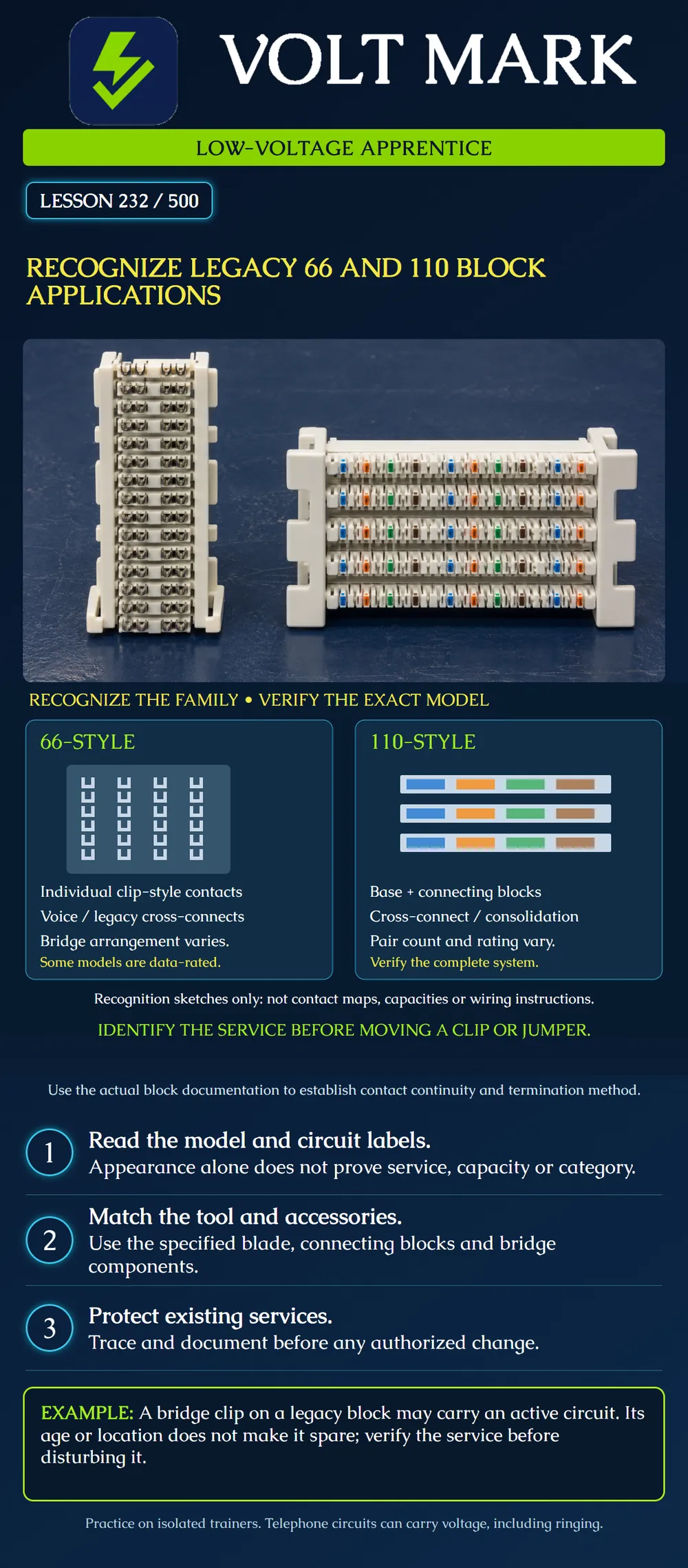
Recognize two common cross-connect hardware families, identify what their appearance cannot establish, and gather the information needed before authorized work.
The exposed clip-style terminals often seen on legacy voice cross-connects are a useful recognition clue. Leviton's 40066-M50 is a documented 66-style product for voice, security and data cross-connections. [1] The service on an installed block still has to be identified. Do not assume every 66 block is voice-only or has the same performance rating. Siemon's S66M1-50 is specifically described as Category 5e hardware and has documented compatible bridging accessories. [2] That product rating does not upgrade an unidentified older block or prove the performance of its installed cabling.
A 110 connection system uses a wiring base and connecting blocks that organize conductor terminations. Siemon's S110 documentation identifies cross-connect and consolidation-point applications, with different connecting-block pair counts and specified Category 5e performance. [3] The number “110” also appears in descriptions of termination tools and contacts. Seeing it on a tool or panel does not establish that all products share the same capacity, cable compatibility or data rating.
A bridge clip is a conductive accessory at designated contact positions; a cross-connect jumper routes a circuit between documented termination points. Both can be part of an active service path. Removal may interrupt that path. Do not install an unfamiliar clip as a convenient shorting link. Identify the correct accessory, circuit, contact arrangement and approved purpose. Never infer “spare” from an empty neighboring position or faded handwriting.
The instructor supplies an isolated 66 sample and an isolated 110 sample with manufacturer documentation. For each, the learner records:
No termination is required for this recognition exercise. The learner must explain why a familiar shape is a starting clue, not a complete specification.
A technician sees a clip on an old block and suggests removing it to make the cabinet neater. The circuit label is unreadable. Record the location and consult the service records and responsible owner. Determine the circuit and interruption requirements before any change. The age of the block does not establish abandonment. An apparently ordinary legacy pair could support an important service. Do not infer the application from the block family alone.
A project calls for a verified data cabling system. Someone sees a 110 block and writes “data compliant” without identifying its part number. Mark the rating unverified. Check the complete combination of base, connecting blocks, cable, cross-connect components, installation method and required test evidence. Likewise, do not reject every 66 product solely because that family is associated with older telephone installations. Use the documented product and actual system performance.
Use the correct blade and accessories for the particular block. A similar-looking impact tool is not permission to use any blade. Siemon's S66 installation guidance identifies its tool method and warns that twisting the tool during termination can damage the clips. [4] This lesson intentionally does not give one universal conductor preparation dimension, punch-down setting or untwist allowance. Follow the current instructions for the exact hardware and cable. Keep service identification separate from tool selection: having the right tool does not authorize changing the circuit.
Practice on disconnected trainers. Telephone circuits can carry voltage, including ringing; exposed communication contacts are not automatically safe to touch. Installed work requires the appropriate service authorization, identification and isolation process. Do not attach arbitrary test equipment to unknown circuits. Before an authorized change, save the circuit record and intended endpoint mapping. Afterward, perform the specified verification and update the record. A label change alone does not establish that the electrical path was restored.
Mistake: Removing an old bridge clip because the block looks abandoned. Correction: Identify the circuit, contact arrangement and interruption requirements with the service owner before an authorized change.
Mistake: Writing data compliant because the hardware looks like a 110 block. Correction: Identify the complete model and component combination, its documented rating and the required installed-system test evidence.
Mistake: Assuming all contacts across a 66 row are electrically common. Correction: Use that model's contact diagram and documented bridging arrangement instead of inferring connections from the row shape.
Why can a Category 5e S66 product example neither approve nor reject an unidentified older block?
Answer: Its rating belongs to that documented product; appearance alone does not establish the other block's construction or condition.
Why does possession of the correct blade not authorize a jumper change?
Answer: Tool compatibility answers the workmanship question, while service identification and permission determine whether the circuit may be changed.
[1] Leviton 40066-M50 product description. https://leviton.com/products/40066-m50 [2] Siemon S66M1-50 Block specification, Rev. L 2/22. https://files.siemon.com/en/specsheet/siemon-s66m1-50-block_spec-sheet.pdf [3] Siemon S110 Connection System specification, Rev. L 4/22. https://files.siemon.com/en/specsheet/siemon-s110-connection-system_spec-sheet.pdf [4] Siemon S66M1-50 Installation Instructions, Rev. G 2/15. https://files.siemon.com/en/instruction/66_s66m1-50_ii.pdf Historical standards references are not presented as current adopted local requirements. The S66 installation PDF's extracted untwist number conflicts with the specification-sheet value; no numeric allowance is reproduced here. Obtain current clarified instructions before using such a value in field work.
Texas journeyman, 15 questions, scored by topic against the 70% mark. No card, and no account needed to start.
Free study material for low-voltage apprentices. This is a national foundation course: requirements differ by state and by local jurisdiction, and a practice that is common in one place is not a rule everywhere. Nothing here is a licence, a certification, or authority to work unsupervised, and completing it does not count as apprenticeship hours or continuing-education credit. Check the codes adopted where you are working, the licensing authority for that work, and your employer's safety programme. VoltMark is not affiliated with, endorsed by, or sponsored by NFPA, OSHA, NICET, BICSI, FOA, or any state or local licensing authority.
Electrician licensing exam prep: practice questions, timed exam simulations, and step-by-step help finding every answer in the NEC.