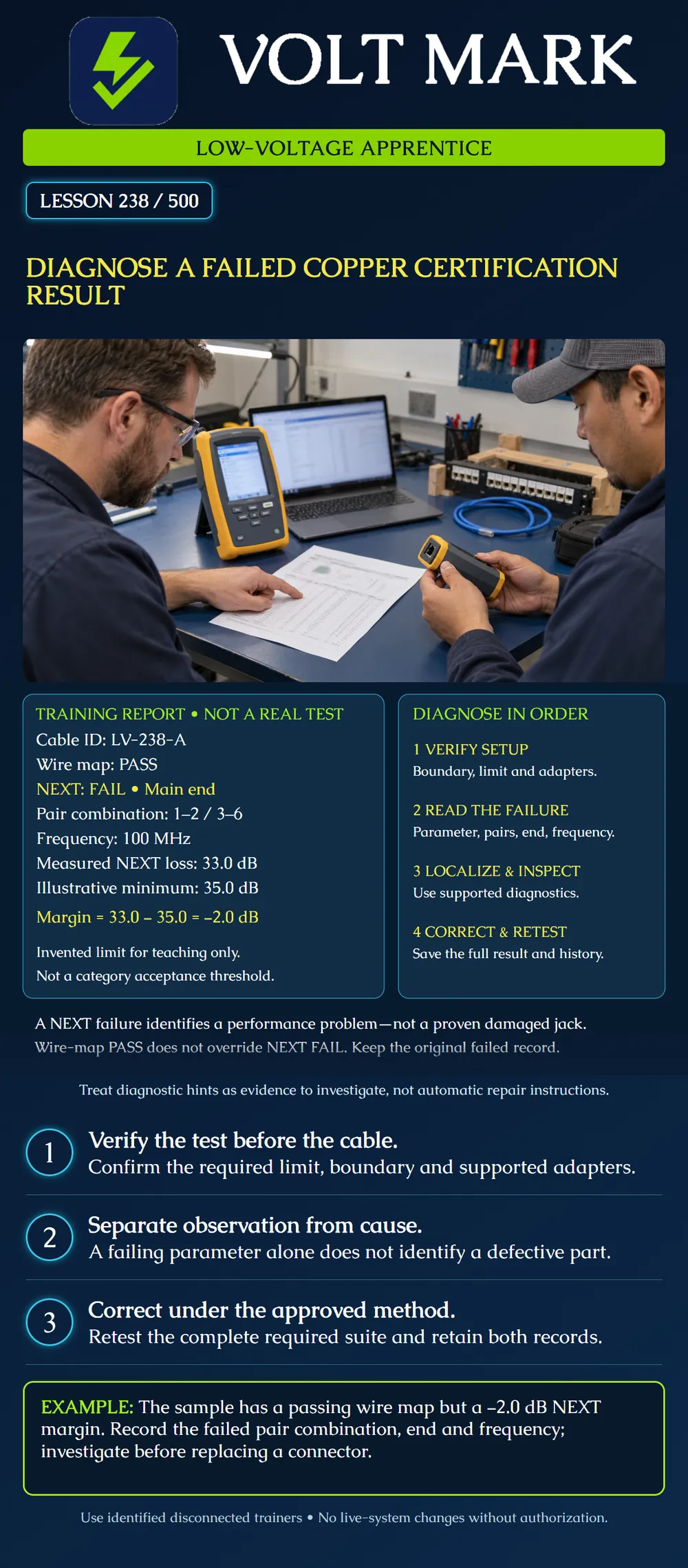
Read a failed result accurately, verify whether the measurement setup is valid, and plan an evidence-based investigation. Preserve the original record and distinguish a suspected cause from a confirmed finding.
Cable ID: LV-238-A. Wire map: PASS. Failing parameter: NEXT. Measurement end: Main. Pair combination: 1–2 / 3–6. Frequency: 100 MHz. Measured NEXT loss: 33.0 dB. Illustrative minimum: 35.0 dB. Margin: 33.0 - 35.0 = -2.0 dB.
These numbers are invented. The 35.0 dB minimum is not a category requirement. The panel is a teaching extract, not a reproduction of a tester screen or a complete acceptance report. Its missing setup information is deliberately part of the exercise.
Retrieve the actual boundary, exact test-limit name and version, cable identification and adapter arrangement. Confirm the project requirement and instrument instructions. A Cable Type selection is not the same thing as the Test Limit selection. An incompatible adapter/limit combination cannot be treated as valid certification merely because the tester allows a diagnostic measurement.
Do not weaken a correctly selected requirement to make a failure disappear. If the original setup was wrong, document that fact, preserve the record and perform the required test with the correct setup.
In this example the measured NEXT loss is 2.0 dB below the invented minimum at the listed frequency. A passing wire map only answers the tested conductor-mapping question. It does not cancel a transmission-performance failure. “Main end” identifies the measurement end; it does not by itself prove that the nearest jack is defective.
Record the parameter, pair combination, end, frequency, value, limit and margin before opening a termination. Also determine whether the full report contains additional failures. One screenshot may hide the result that changes the diagnosis.
Supported time-domain or fault-location features can help identify where to inspect. Fluke describes FAULT INFO as a guide and notes that some cases require further analysis. Feature availability and interpretation depend on instrument, software, adapter and test configuration. Use the current instructions for that system. A colored fault marker is a clue, not permission to replace hardware without checking the evidence.
After setup verification, choose a branch based on the evidence supplied by the instructor:
Branch A: The saved record used a channel adapter with a permanent-link limit. Stop the acceptance interpretation. Record the mismatch and correct the measurement method. The existing result does not establish that the installed cable is defective.
Branch B: The setup is valid and a diagnostic trace suggests a connection region. Inspect that identified region under the component instructions. Record actual findings, such as a documented termination discrepancy. If no defect is found, retain uncertainty and seek further analysis rather than inventing a cause.
Branch C: Results vary when a test lead is moved. Inspect and verify the test equipment using its prescribed checks before disturbing installed cabling. Variation is a reason to investigate; it is not conclusive proof that either the lead or the cabling is bad.
Branch D: Several results remain unexplained after supported checks. Preserve the report and diagnostic traces for the responsible technical reviewer or manufacturer support process. Replacing every jack is not a substitute for a diagnosis.
On an identified disconnected trainer, perform only the authorized corrective action under the product instructions. Keep track of what changed. Retest the complete required suite with the proper configuration, rather than stopping after the originally failing parameter looks better. A successful retest is new evidence; it does not erase the failed record.
Use this format: Observed failure: ______ Setup verified against: ______ Diagnostic evidence: ______ Physical finding, if any: ______ Authorized corrective action: ______ Retest record ID and complete result: ______ Remaining uncertainty: ______
Example wording: “Original report LV-238-A showed NEXT below the selected limit. Adapter/limit setup was verified. Inspection found a termination inconsistent with the connector instructions. The termination was corrected under those instructions. Full retest record LV-238-A-R1 is attached.” Use this wording only when those events actually occurred. This lesson does not claim that they did.
Answer: -2.0 dB.
Answer: No.
Answer: Preserve it with the corrective-work and retest history.
Answer: No.
Answer: Recover that information before claiming a valid certification result or diagnosis.
Mistake: Replacing the nearest jack because the NEXT report identifies the Main end. Correction: Record Main as the measurement end, verify the setup and use supported diagnostic evidence plus inspection to identify the actual defect.
Mistake: Lowering the test limit to turn the sample's -2.0 dB margin into PASS. Correction: Confirm the project's required limit; document any setup error and retest correctly without weakening a valid requirement.
Mistake: Closing the repair after the originally failing NEXT value improves. Correction: Repeat the complete required test suite, retain the full retest report and keep the initial failure linked to the correction history.
Fluke Networks, Choosing the Test Limit – DSX CableAnalyzer (2020): https://www.flukenetworks.com/support/knowledge-base/dsx-cableanalyzertm-series/choosing-test-limit-dsx-cableanalyzer Supports distinction between cable type and test limit, project requirements and adapter compatibility.
Fluke Networks, FAULT INFO – DSX CableAnalyzer (2014): https://www.flukenetworks.com/knowledge-base/dsx-cableanalyzer-series/fault-info-dsx-cableanalyzer Supports diagnostic guidance and limitations. Historical supported-model lists and numeric detection criteria are not generalized to every current instrument.
Texas journeyman, 15 questions, scored by topic against the 70% mark. No card, and no account needed to start.
Free study material for low-voltage apprentices. This is a national foundation course: requirements differ by state and by local jurisdiction, and a practice that is common in one place is not a rule everywhere. Nothing here is a licence, a certification, or authority to work unsupervised, and completing it does not count as apprenticeship hours or continuing-education credit. Check the codes adopted where you are working, the licensing authority for that work, and your employer's safety programme. VoltMark is not affiliated with, endorsed by, or sponsored by NFPA, OSHA, NICET, BICSI, FOA, or any state or local licensing authority.
Electrician licensing exam prep: practice questions, timed exam simulations, and step-by-step help finding every answer in the NEC.