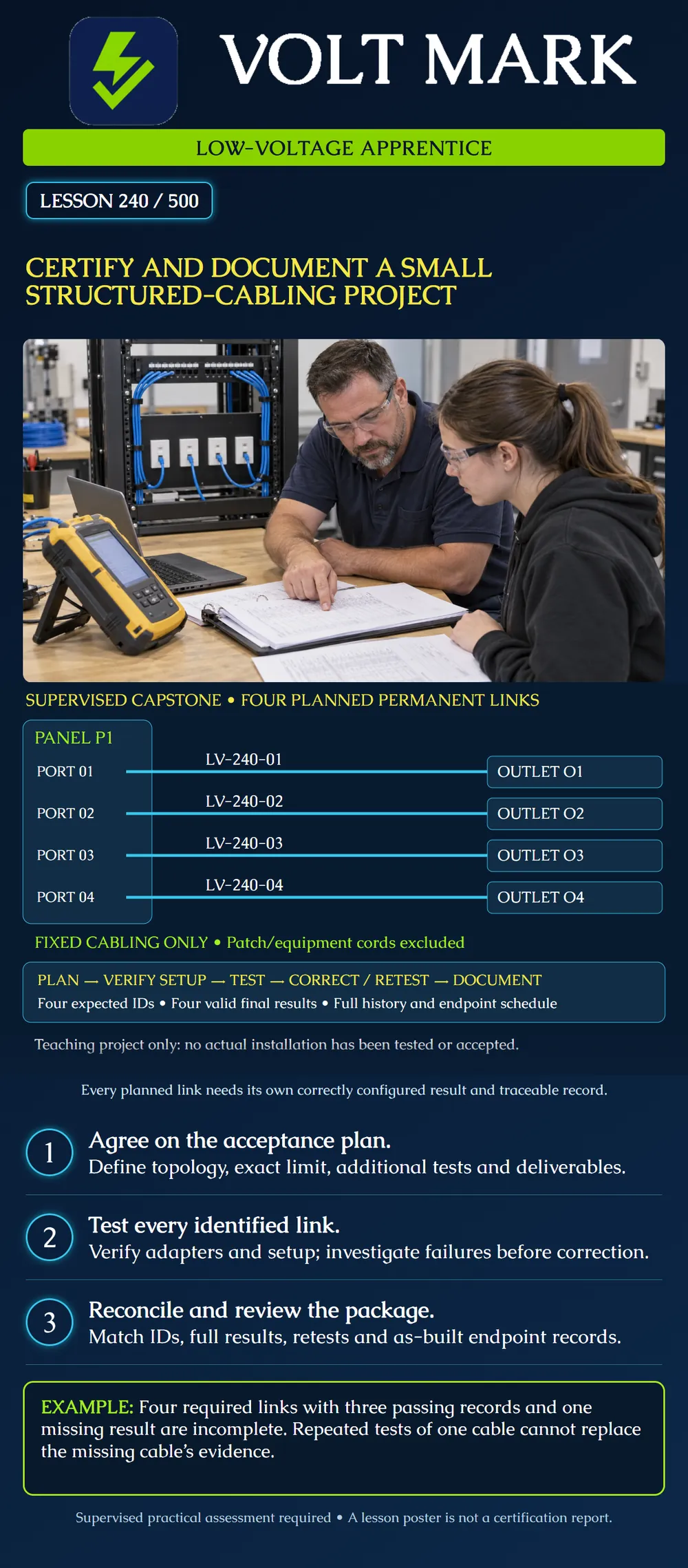
Combine the copper lessons into a supervised project: identify every link, verify the acceptance setup, obtain the required results, investigate discrepancies and produce a traceable closeout package.
This fictional training project has four panel-to-outlet permanent links:
The illustration shows fixed cabling, not active equipment or a physical routing plan. Patch and equipment cords at the ends are outside this permanent-link scope. It provides no cable-length allowance, installation permission or proof of actual certification.
The instructor supplies the component documentation and a written requirement for Category 6A permanent-link certification under the specified standard and edition. Copy the exact applicable instrument limit into the setup sheet. Confirm any additional required measurements, warranty conditions and report format. Resolve contradictions before starting.
The choice of Cat 6A is part of this training work order, not a nationwide requirement for every installation. A cable jacket label does not establish that every installed component and connection satisfies the project.
Prepare the endpoint schedule and label both ends consistently. The supervisor verifies that each trainer is disconnected from active equipment and suitable for the intended test. Follow the instrument and site procedures rather than treating “low voltage” as permission to connect anything anywhere.
Select the approved permanent-link adapters and compatible main/remote units. Check adapter condition, required calibration status, software/limit support and manufacturer setup/reference instructions. Record the equipment identifiers and the exact test configuration.
Fluke distinguishes the Cable Type field from the Test Limit field. The latter determines how the test is evaluated. An adapter/limit mismatch is not a valid certification setup. Do not accept a convenient PASS from a different boundary or lesser limit as the requested evidence.
Run the complete required test suite for each unique ID. Save each result under the correct physical cable identity. Record operator and time information and retain the detailed results available from the instrument.
If any required result is missing, incomplete or failing, keep that link open on the project tracker. Do not fill the gap with a duplicate record from another cable. A working network connection is not a substitute for the specified certification evidence.
Use Lesson 238's sequence: verify setup, read the failing parameter and associated details, use supported diagnostics, inspect the indicated area and record actual findings. On the supervised trainer, make only an authorized correction under the component instructions.
Retest the complete required suite after correction. Retain the original failure and the new result with a correction note. If the cause remains uncertain, record that uncertainty and request the responsible technical review rather than inventing a successful repair story.
Review the supplied packet against the four-link schedule. Identify the missing link, count unique tested links separately from runs, and explain what evidence must be added before the project can be considered complete. The first packet contains:
There are four test-run records but only three unique tested cables. Three final passes do not complete the four-link scope. If LV-240-04 later receives one valid passing test, the packet contains five runs and four unique final results. Acceptance still depends on correct setup, required details and reviewer checks; arithmetic alone does not establish compliance.
Include the endpoint schedule/as-built identification, approved test setup, native results, detailed readable reports, corrections/retests and a manifest. State whether a report contains current results only or full test history. Reopen the saved files and reconcile every expected cable ID against the actual results. Check the known retest case and verify that its earlier failure remains accessible.
Fluke's LinkWare PC guidance calls for saving the imported data as a native .FLW project. Do that in addition to producing the required readable reports. An exported summary and a saved native dataset serve different review purposes.
The practical is complete only when the instructor observes and verifies:
An unresolved required result means the project remains incomplete. Never mark an exercise complete just because the poster or worksheet has been read. Actual field acceptance, qualifications and local requirements remain separate.
Answer: Yes, when one cable has a retest.
Answer: LV-240-04.
Answer: No; the scope is permanent links.
Answer: No.
Answer: The responsible instructor/supervisor using the practical evidence.
The packet contains one run for LV-240-01, two for LV-240-02, one for LV-240-03 and none for LV-240-04. Thus 1 + 2 + 1 + 0 = 4 runs, but only three physical links have evidence. Compare the tested ID set with the four-link schedule: LV-240-04 is missing. The project remains incomplete. If its required valid test later passes, five runs describe four tested links; retain the earlier failed run for LV-240-02. Record counts support completeness review but cannot validate the test setup or replace instructor assessment.
Mistake: Marking the four-link project complete because the packet contains four test runs. Correction: Reconcile unique link IDs and final results against all four scheduled links; leave LV-240-04 open until its required evidence exists.
Mistake: Substituting a convenient lower-category PASS for the specified Cat 6A permanent-link result. Correction: Verify the prescribed limit and fixed-link adapter setup, then obtain the complete required test for that physical link.
Mistake: Removing LV-240-02's failed run when preparing the final passing report. Correction: Preserve the failed run, correction note and full retest together, clearly distinguishing current results from historical attempts.
Fluke Networks, Choosing the Test Limit – DSX CableAnalyzer: https://www.flukenetworks.com/support/knowledge-base/dsx-cableanalyzertm-series/choosing-test-limit-dsx-cableanalyzer Supports project requirements, test-limit selection and adapter compatibility.
Fluke Networks, Permanent Link definition – DSX CableAnalyzer: https://www.flukenetworks.com/knowledge-base/dsx-cableanalyzer-series/permanent-link-definition-dsx-cableanalyzer Supports the fixed-link test boundary and treatment of test interfaces.
Fluke Networks, Saving a .FLW File – LinkWare PC: https://www.flukenetworks.com/knowledge-base/linkwaretm-pc-10x/saving-flw-file Supports saving imported native results.
Texas journeyman, 15 questions, scored by topic against the 70% mark. No card, and no account needed to start.
Free study material for low-voltage apprentices. This is a national foundation course: requirements differ by state and by local jurisdiction, and a practice that is common in one place is not a rule everywhere. Nothing here is a licence, a certification, or authority to work unsupervised, and completing it does not count as apprenticeship hours or continuing-education credit. Check the codes adopted where you are working, the licensing authority for that work, and your employer's safety programme. VoltMark is not affiliated with, endorsed by, or sponsored by NFPA, OSHA, NICET, BICSI, FOA, or any state or local licensing authority.
Electrician licensing exam prep: practice questions, timed exam simulations, and step-by-step help finding every answer in the NEC.