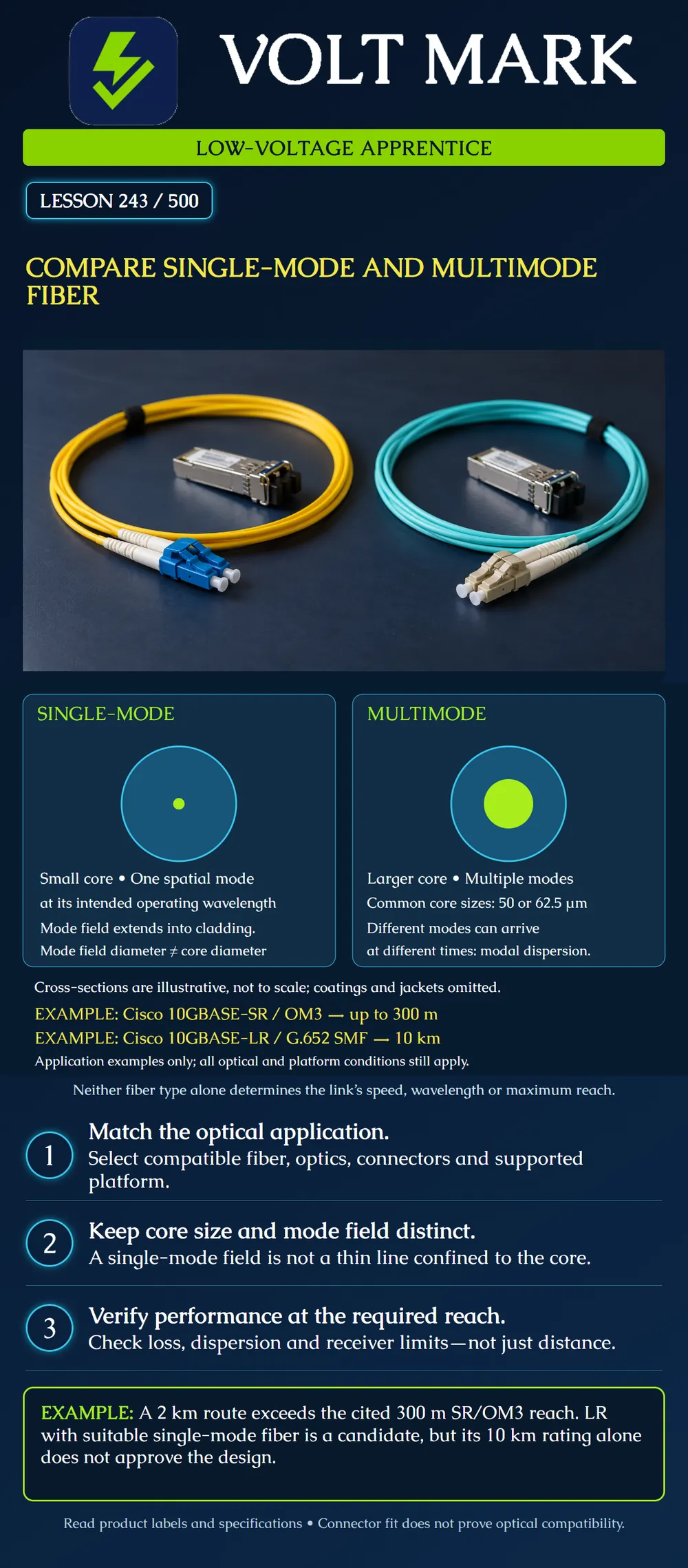
Compare the two fiber families and explain why a design must match the complete optical application rather than relying on core size, jacket color or connector fit.
At its intended operating wavelength, single-mode fiber supports one guided spatial mode. Its small core and refractive-index design support that behavior. The light is an electromagnetic field distribution that extends into the cladding; it is not a literal straight wire or a single pencil-thin ray.
Mode field diameter describes the optical field, not the physical core diameter. When a product specification gives a mode field diameter at a stated wavelength, do not relabel that number as a measured glass-core diameter. The left poster circle indicates only a comparatively small core; it is not a dimensional drawing.
Multimode fiber supports multiple guided modes. Common communications-fiber core diameters are 50 µm and 62.5 µm, with common 125 µm cladding. These dimensions identify physical geometry; they do not alone establish bandwidth or application reach.
Modes can have different travel times, spreading a pulse through modal dispersion. Common graded-index multimode designs reduce the timing differences compared with a simple step-index design. Multiple modes do not automatically mean multiple independent user data channels.
Cisco's 10GBASE SFP+ data sheet lists 10GBASE-SR operation over OM3 multimode fiber up to 300 m, and 10GBASE-LR operation over G.652 single-mode fiber to 10 km. Those are named equipment/application examples, not universal limits for all multimode or single-mode systems. The listed SR and LR examples use different nominal wavelengths, 850 nm and 1310 nm respectively.
All applicable optical, connector, platform and installation conditions still have to be satisfied. A longer-reach label is not an instruction to ignore minimum/maximum receiver input, cable-plant loss or supported host compatibility.
A planner has a 2 km campus route. Convert it to meters: 2 x 1,000 = 2,000 m. Compare it with the cited SR/OM3 reach: 2,000 m > 300 m. That example does not meet the stated distance need. Adding a single-mode patch cord to an otherwise multimode/SR arrangement does not transform it into a supported LR system.
The cited LR/G.652 example has a listed reach longer than the route, so it may be investigated as a candidate. It is not yet an approved design. Obtain the exact equipment specifications, actual plant details and supported optical budget before deciding.
A 150 m installation has compatible multimode cabling already documented. A learner says single-mode must always be selected because it can serve longer links. Identify the missing reasoning.
Answer: The actual data rate, supported optics, measured/allowed plant performance, future requirements and project economics must be considered. “Longer potential reach” alone does not decide every short-link project. Conversely, a short route does not forbid single-mode.
For an assigned link, write: Required application and data rate: ______ Exact transceiver model at each end: ______ Host platform support: ______ Fiber family and documented category/specification: ______ Actual route and cable-plant length: ______ Wavelength arrangement: ______ Connector and polish compatibility: ______ Supported reach and optical limits: ______ Required tests and acceptance evidence: ______
Use actual product records, not appearance. Identical-looking connector shells can be used with different fibers or optical requirements. Category designations and identification practices are developed in the next lesson.
“Multimode means more bandwidth than single-mode because it has more modes.” Mode count is not an application-speed rating. “Single-mode works at any distance.” It remains constrained by the application and complete link. “Both are fiber, so mixing them is harmless.” Unplanned mismatches can prevent acceptable operation. “Core diameter and mode field diameter are interchangeable.” They describe different properties. “Passing light proves the link is acceptable.” Visible continuity is not full application verification.
Answer: The single-mode fiber design.
Answer: Differences in propagation time among modes.
Answer: 2,000 m.
Answer: No.
Answer: No.
Corning, Optical Fiber Glossary of Terms: https://www.corning.com/optical-communications/in/en/home/products/fiber/optical-fiber-resource-center/glossary-of-terms.html Supports single-mode/multimode distinction and mode field distribution.
Corning, Optical Fiber Product Portfolio: https://www.corning.com/content/dam/corning/catalog/coc/documents/brochures/OFC-006-AEN.pdf Supports 50/125 and 62.5/125 µm multimode product families and graded-index terminology.
Cisco, Cisco 10GBASE SFP+ Modules Data Sheet: https://www.cisco.com/c/en/us/products/collateral/interfaces-modules/transceiver-modules/data_sheet_c78-455693.html Supports the specific SR/OM3 and LR/G.652 examples and nominal wavelengths. These are examples, not an endorsement or equipment purchase recommendation.
Texas journeyman, 15 questions, scored by topic against the 70% mark. No card, and no account needed to start.
Free study material for low-voltage apprentices. This is a national foundation course: requirements differ by state and by local jurisdiction, and a practice that is common in one place is not a rule everywhere. Nothing here is a licence, a certification, or authority to work unsupervised, and completing it does not count as apprenticeship hours or continuing-education credit. Check the codes adopted where you are working, the licensing authority for that work, and your employer's safety programme. VoltMark is not affiliated with, endorsed by, or sponsored by NFPA, OSHA, NICET, BICSI, FOA, or any state or local licensing authority.

Electrician licensing exam prep: practice questions, timed exam simulations, and step-by-step help finding every answer in the NEC.