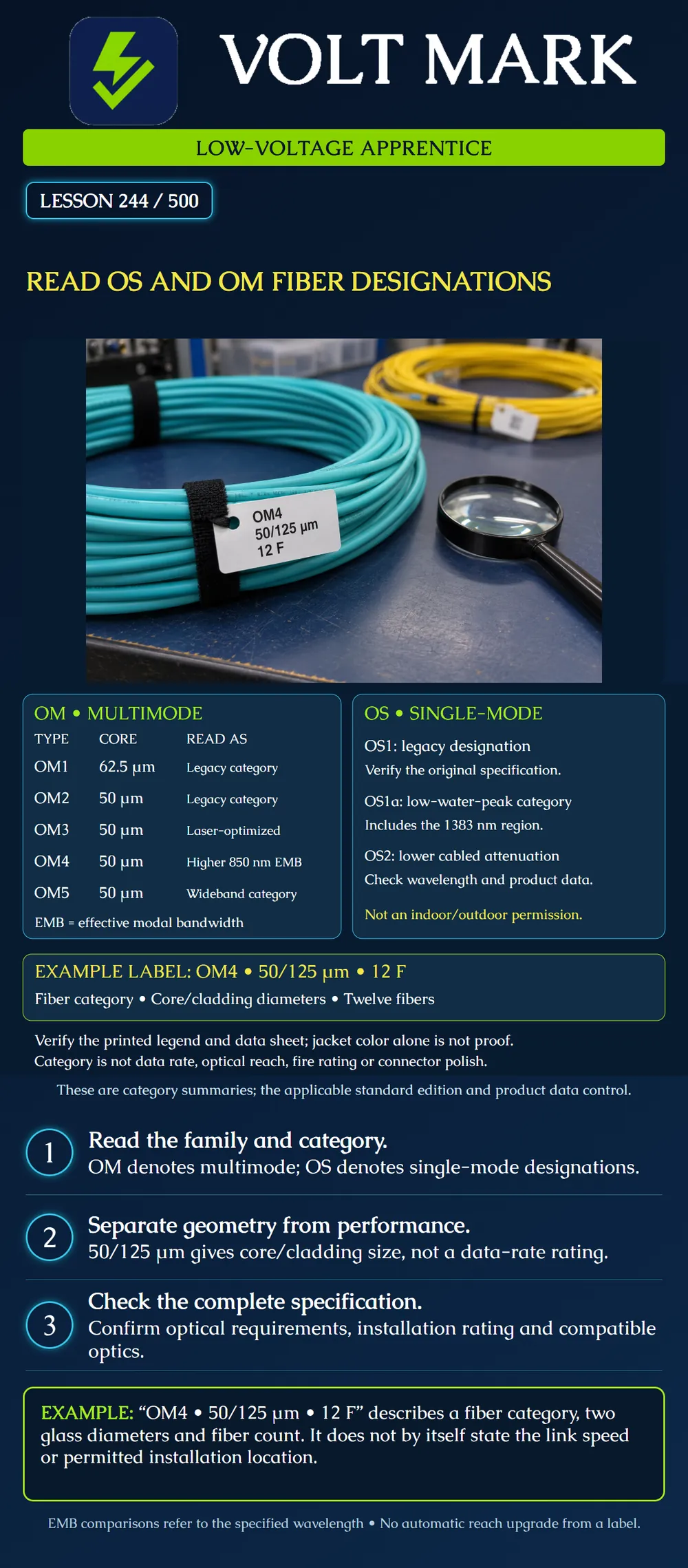
Decode fiber designations and distinguish category, geometry and fiber count from optical application and installation requirements.
OM identifies multimode category designations; OS identifies single-mode designations. A number following either prefix is not a speed in gigabits per second, a strand count or a maximum distance. The required standard edition and manufacturer's product declaration determine the precise category specifications.
OM1 uses a 62.5 µm core. OM2, OM3, OM4 and OM5 use 50 µm cores in the categories discussed here. Common cladding diameter is 125 µm. OM1 and OM2 commonly appear in legacy records; recognizing them does not automatically approve them for a new project.
OM3 and OM4 are laser-optimized categories. At 850 nm, OM4 has a higher specified minimum effective modal bandwidth than OM3. OM5 adds wideband performance for appropriate multiwavelength applications. A larger OM number does not promise a longer link for every optical interface. The application and installed cable plant still control.
EMB stands for effective modal bandwidth. Do not confuse it with optical carrier wavelength, Ethernet bit rate or overfilled-launch bandwidth. When comparing data sheets, keep the measurement type and wavelength together with the value.
OS1 is a legacy designation encountered in older specifications. OS1a includes low-water-peak characterization, including the 1383 nm region. OS2 specifies lower cabled attenuation than OS1a in the cited standards guidance. These category descriptions must not be collapsed into “OS1 is indoor and OS2 is outdoor.” Products must be evaluated for their actual installation ratings and construction.
For example, Corning lists an OS2 option in its indoor/outdoor FREEDM One tight-buffered riser cable family. That demonstrates why fiber category alone cannot define permitted location. This is an identification example, not permission to install that product in any pathway.
Different documents can present fiber properties, cabled-fiber limits or field-test allowances. Their numbers may answer different questions. An older table may also use legacy terminology. Record the standard and edition named by the project, the product data sheet and the relevant wavelength instead of copying an isolated attenuation number into a design.
This lesson does not supply a universal attenuation table or declare every historical fiber category acceptable for new work. Project and adopted installation requirements must be checked separately.
The poster shows an invented descriptive label: OM4 • 50/125 µm • 12 F
Decode it: OM4: multimode category. 50 µm: nominal core diameter. 125 µm: nominal cladding diameter.
Neither diameter is the overall cable-jacket diameter. “12 F” is not a 12 Gb/s rating. The label fragment contains no complete cable fire classification, environmental suitability, connector polish, transceiver model or acceptable channel loss. Those facts must come from the rest of the product documentation and the project.
A patch cord looks aqua, while the schedule says OM4. The print legend is unreadable and no product record is available. A learner proposes recording OM4 based only on color. Better response: record the uncertainty and locate reliable manufacturer identification or project records. Color is a useful visual clue, but it is not enough to invent a category declaration. Mixed or undocumented inventory needs resolution before use or acceptance.
A supplier offers OM5 in place of specified OM4 and promises an automatic speed upgrade. List what must be checked before any authorized substitution:
A category label does not modify active electronics or certify the resulting channel. Do not claim an upgraded data rate merely because a newer category is present.
Printed product identification: ______ Fiber family/category: ______ Core/cladding information: ______ Fiber count: ______ Product and standard edition references: ______ Attenuation/bandwidth values with wavelengths: ______ Cable installation/environmental ratings: ______ Compatible application/optics: ______ Unresolved identification questions: ______
Answer: No; it is multimode.
Answer: 125 µm.
Answer: No; it indicates fiber count in this example.
Answer: No.
Answer: No.
Answer: No.
Mistake: Interpreting the label's 12 F as a 12 Gb/s performance rating. Correction: Record twelve fibers as the count and obtain the supported data rate from the application and optical equipment specifications.
Mistake: Recording OM4 from an aqua jacket when its identity is undocumented. Correction: Mark the category unresolved and locate reliable product or project records before declaring the fiber type.
Mistake: Accepting an OM5 substitution as an automatic speed upgrade over specified OM4. Correction: Check the intended optics, application, cable-plant and installation requirements through the project's substitution process; the category does not change the active electronics.
Fluke Networks, OM1, OM2, OM3, OM4, OM5 and OS1, OS2 Fiber: https://www.flukenetworks.com/knowledge-base/copper-testing/om1-om2-om3-om4-om5-and-os1-os2-fiber Supports multimode geometry and bandwidth distinctions. Its historical loss tables are not copied as universal limits.
Corning, ClearCurve Multimode Fiber: https://www.corning.com/optical-communications/in/en/home/products/fiber/optical-fiber-products/clearcurve-multimode-fiber.html Supports laser-optimized and wideband product distinctions.
TIA Fiber Optics Tech Consortium, IEEE 802.3 Single-mode Optical Fiber Ethernet Standards: https://www.tiafotc.org/ieee-802-3-ethernet-standards-update/singlemode-standards-update/ Supports OS1a/OS2 cabled attenuation and low-water-peak distinctions.
Corning, FREEDM One Tight-Buffered Cable, Riser: https://ecatalog.corning.com/optical-communications/US/en/Fiber-Optic-Cables/Indoor-Outdoor/Indoor-Outdoor-Riser-Cables/FREEDM%C2%AE-One-Tight-Buffered-Cable%2C-Riser/p/freedm-one-tight-buffered-cable-riser?variant=fiber-count-6 Supports the example of an indoor/outdoor cable family with an OS2 option.
Texas journeyman, 15 questions, scored by topic against the 70% mark. No card, and no account needed to start.
Free study material for low-voltage apprentices. This is a national foundation course: requirements differ by state and by local jurisdiction, and a practice that is common in one place is not a rule everywhere. Nothing here is a licence, a certification, or authority to work unsupervised, and completing it does not count as apprenticeship hours or continuing-education credit. Check the codes adopted where you are working, the licensing authority for that work, and your employer's safety programme. VoltMark is not affiliated with, endorsed by, or sponsored by NFPA, OSHA, NICET, BICSI, FOA, or any state or local licensing authority.

Electrician licensing exam prep: practice questions, timed exam simulations, and step-by-step help finding every answer in the NEC.