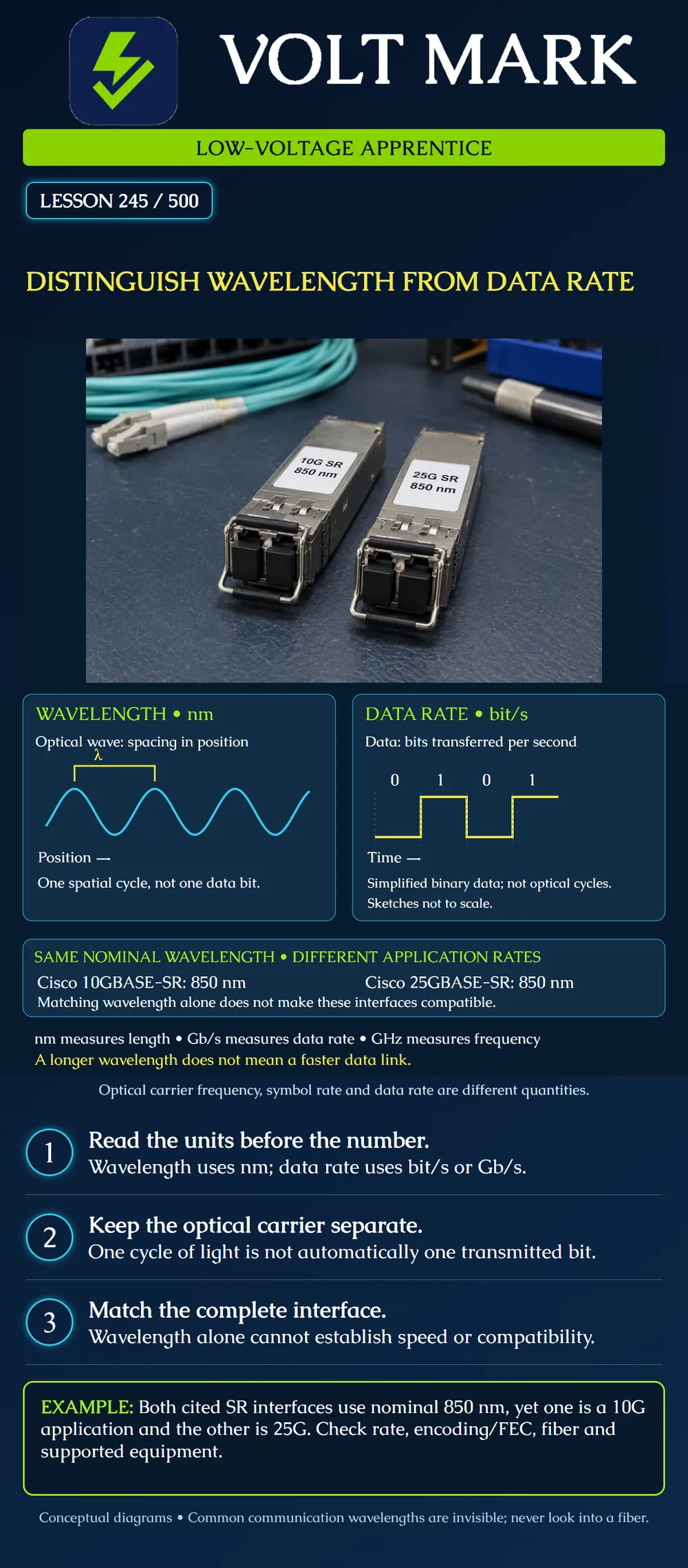
Read wavelength and data-rate specifications as different quantities and explain why matching wavelength alone does not establish a working link.
Wavelength is the distance over which an optical wave repeats its phase. Fiber communication specifications commonly express it in nanometers (nm). One nanometer is one-billionth of a meter. Product wavelengths conventionally refer to the nominal free-space wavelength; light's wavelength inside glass differs.
The left sketch is a spatial snapshot, with position increasing to the right. The bracket spans two successive peaks and represents one wavelength. It is not a bit interval, a cable length or a scale drawing of an actual fiber.
Data rate describes bits per unit time, commonly bit/s, Mb/s or Gb/s. The right sketch shows an illustrative binary sequence over time. Its horizontal axis is time, not position. The levels represent data values, not the rapid oscillation of the optical carrier.
Modulation conveys information using changes in the optical signal. One optical cycle is not automatically one data bit. Symbol rate and bit rate are also distinct: some modulation methods convey more than one bit per symbol, while coding and error-correction overhead affect the relationship between a physical line rate and useful information rate.
Cisco's 10GBASE SFP+ data sheet lists SFP-10G-SR as a nominal 850 nm multimode interface. Its 25GBASE SFP28 data sheet lists SFP-25G-SR-S as a nominal 850 nm multimode interface. These are different Ethernet application rates sharing the same nominal optical wavelength.
Do not connect a 10G interface to a 25G interface and assume that wavelength matching makes them compatible. Supported rate, host platform, optical limits, fiber, encoding and FEC requirements must also agree. A device explicitly supporting multiple rates must be configured and used within its documented modes.
“10G” and “25G” identify the application classes in this example. They should not be treated as a complete specification of serial line rate, symbol rate or payload throughput. Those details depend on the exact interface. The poster intentionally does not calculate a physical bit interval from these product names.
Classify the following without trying to rank them: 850 nm: optical wavelength. 10 Gb/s: data rate. 1 GHz: frequency. 50 µm: a length, potentially a fiber dimension if the label says so. 300 m: a length, potentially a supported route reach if the specification says so.
Units establish the kind of quantity; the label and context establish what the number describes. A distance in nanometers is not interchangeable with a distance in meters just because both are lengths in the same table.
1 µm = 1,000 nm. 850 nm = 0.850 µm. 1,310 nm = 1.310 µm.
This conversion does not change a device's data rate. An 850 nm optic has not become an “850-speed” module. Likewise, 1,310 nm is not automatically a faster communication link than 850 nm.
For light in vacuum, frequency and wavelength are related by f = c / wavelength. That relation concerns the optical carrier. It is not a formula for Ethernet throughput. Avoid dividing a speed of light by a listed wavelength and presenting the result as the number of data bits carried per second.
A parts list contains two optics labeled 850 nm. The apprentice is asked whether they form a matched link. Write “insufficient information,” then request the exact model numbers, supported application/rate, host compatibility, fiber requirements, connector arrangement, optical power limits and any FEC configuration.
Finding the same wavelength is one useful fact. It is not the complete compatibility decision.
Record each specification in a separate field: Nominal wavelength and permitted wavelength range: ______ Application and supported rate(s): ______ Physical line/symbol rate if required: ______ Fiber and reach conditions: ______ Transmit/receive optical limits: ______ Encoding/FEC and host requirements: ______
Answer: Position.
Answer: Time.
Answer: No; both use 850 nm.
Answer: No.
Answer: 0.850 µm.
Answer: No.
Mistake: Approving a 10G and a 25G optic as peers because both list 850 nm. Correction: Compare their supported application/rate, host and optical requirements; record shared wavelength as only one matching field.
Mistake: Reading the larger wavelength number as the faster link. Correction: Keep wavelength in nm and data rate in bit/s in separate fields; converting 850 nm to 0.850 micrometers changes neither the optic nor its rate.
Mistake: Using carrier frequency from c divided by wavelength as Ethernet throughput. Correction: Label that result optical carrier frequency; obtain line rate, modulation and useful throughput information from the actual interface specification.
Cisco, 10GBASE SFP+ Modules Data Sheet: https://www.cisco.com/c/en/us/products/collateral/interfaces-modules/transceiver-modules/data_sheet_c78-455693.html Supports the 10GBASE-SR nominal 850 nm example.
Cisco, 25GBASE SFP28 Modules Data Sheet: https://www.cisco.com/c/en/us/products/collateral/interfaces-modules/transceiver-modules/datasheet-c78-736950.html Supports the 25GBASE-SR nominal 850 nm example. Product-specific configuration and compatibility conditions remain applicable.
Texas journeyman, 15 questions, scored by topic against the 70% mark. No card, and no account needed to start.
Free study material for low-voltage apprentices. This is a national foundation course: requirements differ by state and by local jurisdiction, and a practice that is common in one place is not a rule everywhere. Nothing here is a licence, a certification, or authority to work unsupervised, and completing it does not count as apprenticeship hours or continuing-education credit. Check the codes adopted where you are working, the licensing authority for that work, and your employer's safety programme. VoltMark is not affiliated with, endorsed by, or sponsored by NFPA, OSHA, NICET, BICSI, FOA, or any state or local licensing authority.

Electrician licensing exam prep: practice questions, timed exam simulations, and step-by-step help finding every answer in the NEC.