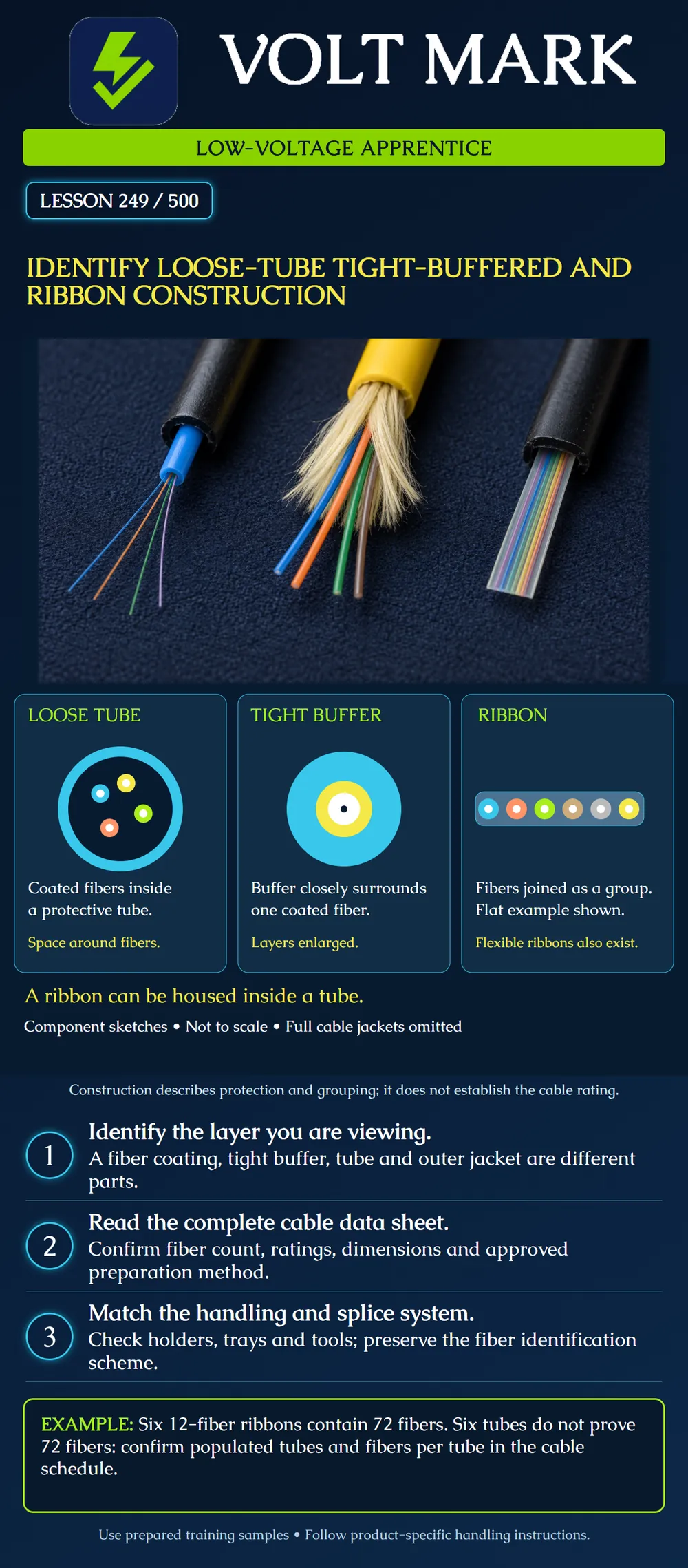
Recognize three ways optical fibers are protected or grouped. Identify the actual layer in a drawing, then use the exact product data sheet to determine the cable's construction and preparation requirements.
The poster shows components rather than complete cables. The outer jacket, strength members, water-blocking materials and other parts are intentionally omitted. Shapes and layer thicknesses are enlarged for teaching, not dimensional specifications. Colors separate parts; they are not a complete fiber identification chart.
A loose tube contains coated fibers with space between the fibers and the tube. A tight buffer adds protection closely around an individual coated fiber. A ribbon groups fibers together. A ribbon can itself be enclosed within a tube, so these terms do not form three mutually exclusive categories.
The loose-tube sketch contains four illustrative coated fibers. The tight-buffer sketch enlarges the layers around one fiber: cyan outer buffer, yellow coating, white glass cladding, small dark core. The ribbon sketch shows six illustrative fibers in a common flat grouping. None of those illustrated counts prescribes a real cable product.
FOA describes loose tubes, added tight buffering, strength members and jackets as distinct cable components. It also explains that ribbon designs can use periodic bonds to make flexible groups. This supports looking at both the fiber grouping and the enclosing cable structure, rather than deciding from one label alone.
AFL's Wrapping Tube Cable with SpiderWeb Ribbon demonstrates a flexible bonded ribbon construction. The manufacturer describes both ribbon splicing and individual-fiber breakout splicing options, with the ribbon able to roll and conform. Compatibility still depends on the exact fiber, holder and equipment; a product-family description is not a universal preparation procedure.
Corning's product listings include an SST-Ribbon design with ribbon stacks in a buffer tube and an indoor/outdoor FREEDM One tight-buffered design. These are useful counterexamples to “ribbon means no tube” and “tight-buffered means indoor only.” Treat these as construction examples and verify the exact current product sheet before specifying either.
For a campus route, industrial enclosure or building backbone, record the manufacturer's full part number. Keep construction separate from optical category, environmental suitability and installed-use requirements. A specimen that looks familiar does not establish its approved location.
Use a worksheet with separate spaces for:
Do not fill blank fields from memory. A common dimension from a different cable is not evidence for this cable. Likewise, water-blocking design and jacket appearance do not independently establish building-use approval. Lesson 250 covers rating distinctions.
Cable A has six populated tubes, each containing twelve fibers: 6 × 12 = 72 fibers.
Cable B has six ribbons, each containing twelve fibers: 6 × 12 = 72 fibers.
These equal totals do not make their internal structures identical. Their preparation, organization and splice hardware can differ.
Cable C has six tube positions, but the schedule identifies two as filler positions. The remaining four tubes each contain twelve fibers: 4 × 12 = 48 fibers. Counting six visible positions and assuming seventy-two would overstate the available fiber count by twenty-four.
Cable D has one tube containing six twelve-fiber ribbons: 1 × 6 × 12 = 72 fibers. This original example demonstrates why “tube count” and “ribbon count” belong in separate worksheet fields.
Use prepared, disconnected teaching samples supplied by the instructor. This exercise does not call for cutting open a working cable.
For an instructor-led later preparation activity, use the specified tools, fiber-shard controls and approved procedure. Do not improvise ribbon separation or stripping methods from this conceptual drawing.
Complete a paper construction record for Cable C. Six visible positions are listed, but two are fillers, so populated tubes = 6 - 2 = 4. At twelve fibers per populated tube, total fibers = 4 x 12 = 48. Record six positions, four populated tubes, two fillers and 48 fibers as separate fields. Do not label a filler as a spare twelve-fiber tube.
For Cable D, the schedule explicitly places six twelve-fiber ribbons inside one tube: 1 x 6 x 12 = 72 fibers. Record both ribbon grouping and the enclosing tube. Neither count supplies coating dimensions, stripping instructions or tray compatibility; those remain tied to the exact product documentation.
Mistake: Counting all six tube positions as populated in Cable C. Correction: Use the schedule: two positions are fillers, leaving four times twelve, or 48 fibers.
Mistake: Rejecting a ribbon description because the product drawing also shows a tube. Correction: Record ribbon grouping and tube enclosure separately; Cable D has six twelve-fiber ribbons inside one tube.
Mistake: Copying a familiar strip length into the new cable's preparation worksheet. Correction: Obtain the exact cable's preparation document and compatible tooling; a construction family or similar diameter does not supply those dimensions.
FOA, Fiber Optic Cable: https://www.thefoa.org/tech/ref/basic/cable.html AFL, Wrapping Tube Cable with SpiderWeb Ribbon: https://www.aflglobal.com/en/products/fiber-optic-cable/high-density/wrapping-tube-cable/wrapping-tube-cable-wtc-with-swr Corning SST-Ribbon product listing: https://ecatalog.corning.com/optical-communications/US/en/Fiber-Optic-Cables/Outdoor/Outdoor-Direct-Buried-Cables/SST-Ribbon-Single-Tube%2C-Gel-Free%2C-Armored-Cable/p/sst-ribbon-single-tube-gel-free-armored-cable?variant=fiber-count-36 Corning FREEDM One product listing: https://ecatalog.corning.com/optical-communications/US/en/Fiber-Optic-Cables/Indoor-Outdoor/Indoor-Outdoor-Riser-Cables/FREEDM%C2%AE-One-Tight-Buffered-Cable%2C-Riser/p/freedm-one-tight-buffered-cable-riser?variant=fiber-category-mm-om2
No universal bend multiplier, preparation dimension or installation approval is asserted.
Texas journeyman, 15 questions, scored by topic against the 70% mark. No card, and no account needed to start.
Free study material for low-voltage apprentices. This is a national foundation course: requirements differ by state and by local jurisdiction, and a practice that is common in one place is not a rule everywhere. Nothing here is a licence, a certification, or authority to work unsupervised, and completing it does not count as apprenticeship hours or continuing-education credit. Check the codes adopted where you are working, the licensing authority for that work, and your employer's safety programme. VoltMark is not affiliated with, endorsed by, or sponsored by NFPA, OSHA, NICET, BICSI, FOA, or any state or local licensing authority.

Electrician licensing exam prep: practice questions, timed exam simulations, and step-by-step help finding every answer in the NEC.