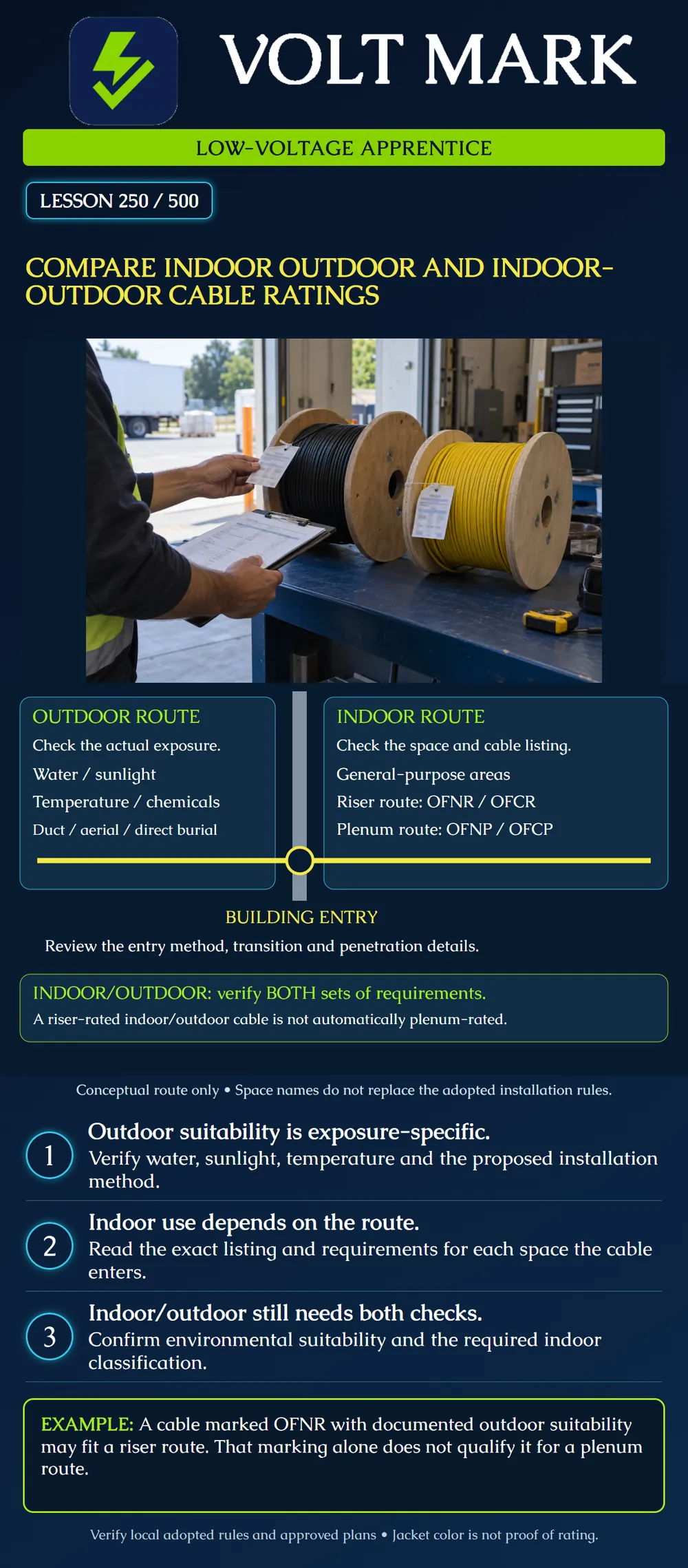
Separate environmental suitability from indoor fire classification. Follow a proposed fiber route through each environment and identify the evidence needed before choosing cable.
First ask what physical conditions the cable must withstand. Then ask which installed-use requirements apply to each portion of the route. “Outdoor” and “plenum” answer different questions. A familiar jacket color, fiber category or tube construction is not enough to answer either question.
The poster's yellow line represents a conceptual route through a building wall. The highlighted entry is a review point, not a depicted firestop design, splice closure or approved entry assembly. Actual penetrations and transitions require the project's approved details.
The published UL 1651 scope groups OFNP/OFCP as plenum types, OFNR/OFCR as riser types, and OFN/OFNG/OFC/OFCG as general-purpose types. N identifies nonconductive construction; C identifies construction with non-current-carrying conductive members. The scope separates plenum smoke-and-flame testing from riser flame-propagation testing. These classifications do not establish optical performance.
Use those labels to organize questions about the route. Do not treat this short list as an installation substitution table or an exception to the adopted code. A ceiling void must be classified from its actual use and approved plans; its position above a ceiling alone does not establish an environmental-air space.
For each outdoor segment, document the expected water exposure, sunlight, installation and operating temperatures, mechanical conditions and installation method. Direct burial, duct placement and aerial support are different applications. Ask for evidence supporting the actual one proposed.
Corning describes indoor/outdoor products as combining outdoor environmental protection with indoor flame-rating capabilities. Its product range distinguishes riser and plenum options. That combination can allow an appropriately selected cable to continue indoors without changing to a different cable at the entrance. It does not make every indoor/outdoor product suitable for every indoor space or outdoor exposure.
Do not infer resistance to a particular industrial chemical from an outdoor designation. Obtain a documented suitability decision for the actual environment. Likewise, do not infer a direct-burial application from a statement that a product is suitable for an outdoor duct.
UL's historical cable-marking guidance identifies cable type, manufacturer identification and certification information as evidence to examine. That 2010 document warns that later changes may exist. Use it for the identification principle, then confirm current certification and product documentation rather than applying its historical marking details as present-day universal requirements.
Photograph the supplied cable and reel labels for the project record. Match the manufacturer's exact part number to the submitted data sheet. A similarly named product in another region or with a different suffix is not automatically the supplied product.
An instructor provides this fictional route: Segment A: 180 metres in an outdoor campus duct with documented water exposure. Segment B: 12 metres inside an ordinary equipment-room route. Segment C: 18 metres along a route identified on the approved plans as a riser application. Segment D: 9 metres in a space identified as an environmental-air plenum.
Total instructional route length: 180 + 12 + 18 + 9 = 219 metres. This total is for route accounting only; it is not an optical reach calculation or a code allowance.
Candidate X has manufacturer documentation for the outdoor duct conditions and an OFNR listing. That evidence may support considering A and C, subject to the complete requirements. It does not by itself establish acceptance for D. Record the missing plenum evidence instead of stretching the meaning of OFNR.
Candidate Y has an OFNP listing but no supplied outdoor environmental documentation. The plenum label does not fill that gap for A. Request the missing evidence or a reviewed alternative.
Candidate Z has documented suitability for the specified outdoor conditions and the required indoor classification. It remains a candidate until the designer confirms the complete route, mechanical limits, optical requirements and approved entry details. This lesson does not approve any real product.
Mark every entrance, space change and penetration on the drawing. Identify whether the approved plan uses a continuous suitably rated cable, a transition, a permitted raceway method or another accepted arrangement. Apply the locally adopted code and amendments with the responsible designer or authority having jurisdiction.
No universal outdoor-cable indoor-entry distance is stated here. Do not apply a remembered distance without verifying the exact adopted provision, starting point, cable type and installation conditions.
Fill a decision row for Candidate X against the four supplied route segments. The route total is 180 + 12 + 18 + 9 = 219 m. Its documented outdoor-duct suitability addresses the stated conditions in A, and its OFNR classification supplies riser evidence relevant to C. The row for D, explicitly identified as a plenum application, remains unsupported by the supplied OFNR evidence.
Record the decision as HOLD for the whole-route selection, with the designer responsible for resolving D and the complete route/entry requirements. Do not convert the 219 m total into an allowable indoor-entry distance. Candidate Y's OFNP evidence reverses neither problem: it still lacks the stated outdoor evidence for A. This compares supplied documents, not actual product approvals.
Mistake: Approving the whole route from an indoor/outdoor label. Correction: Check each segment's environmental evidence and required indoor classification, including the entry arrangement, with the responsible designer.
Mistake: Using OFNP as proof that Candidate Y suits the wet outdoor duct. Correction: Request the actual outdoor exposure and installation-method evidence; the plenum classification does not supply it.
Mistake: Calling every ceiling void a plenum from its physical location. Correction: Use the approved space classification and actual environmental-air use, resolving uncertainty through the designer or authority having jurisdiction.
UL Standards & Engagement, UL 1651 public scope; page identifies revision April 13, 2023: https://shopulstandards.com/ProductDetail.aspx?UniqueKey=29520 Corning, Indoor/Outdoor Fiber Optic Cables: https://www.corning.com/optical-communications/emea/en/home/products/fiber-optic-cable/indoor-outdoor-cables.html UL Code Authority, Optical Fiber Cable Markings, 2010 historical guidance: https://code-authorities.ul.com/wp-content/uploads/2014/04/ul_OpticalFiberCable.pdf
This national fundamentals lesson does not claim a single code edition is adopted throughout the United States.
Texas journeyman, 15 questions, scored by topic against the 70% mark. No card, and no account needed to start.
Free study material for low-voltage apprentices. This is a national foundation course: requirements differ by state and by local jurisdiction, and a practice that is common in one place is not a rule everywhere. Nothing here is a licence, a certification, or authority to work unsupervised, and completing it does not count as apprenticeship hours or continuing-education credit. Check the codes adopted where you are working, the licensing authority for that work, and your employer's safety programme. VoltMark is not affiliated with, endorsed by, or sponsored by NFPA, OSHA, NICET, BICSI, FOA, or any state or local licensing authority.

Electrician licensing exam prep: practice questions, timed exam simulations, and step-by-step help finding every answer in the NEC.