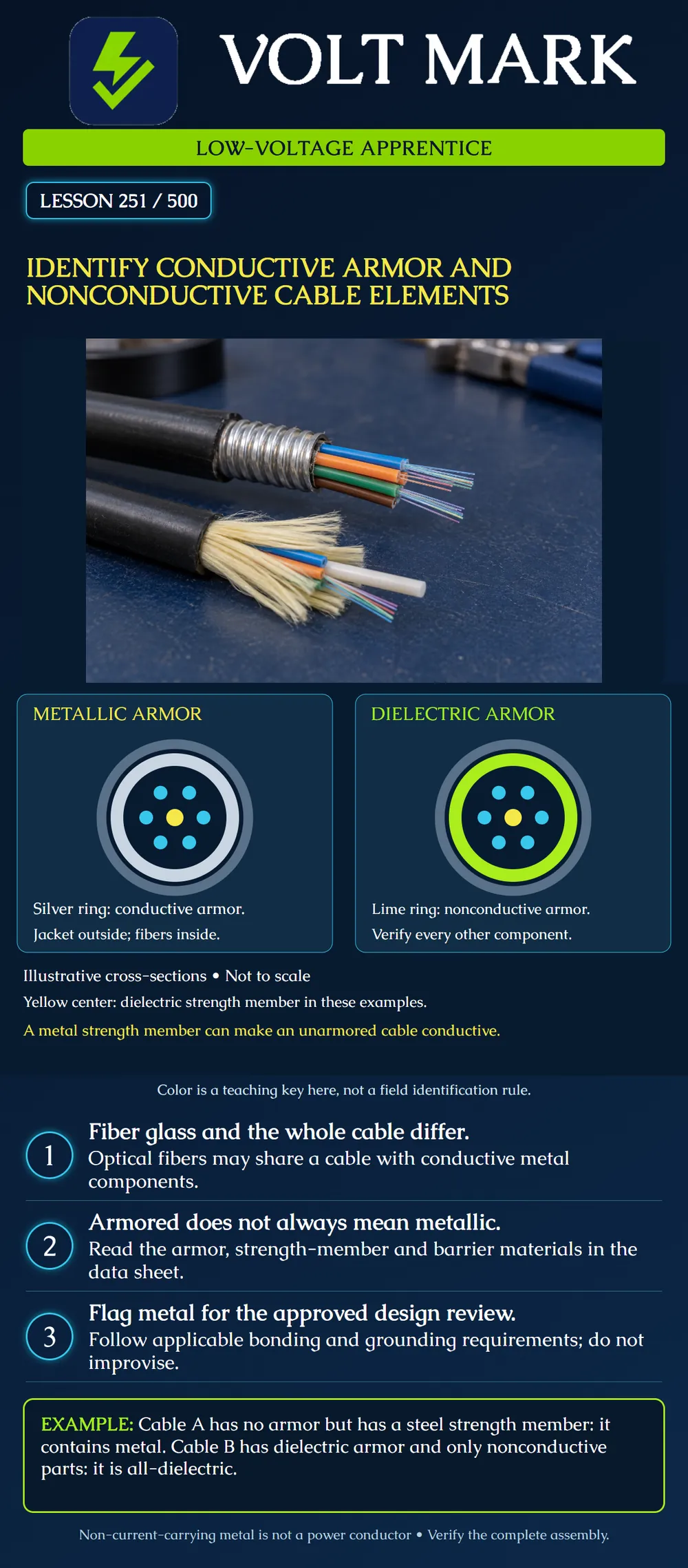
Identify which cable components are electrically conductive and distinguish an optical signal path from the complete cable assembly. Use documented materials, not jacket color or the word “fiber,” to support the identification.
Both conceptual cross-sections show six cyan optical-fiber elements, a yellow dielectric center strength member and a gray outer jacket. The left silver ring represents metallic armor. The right lime ring represents dielectric armor. The drawing is simplified and not to scale; it is not a manufacturer's cable design or an installation detail.
The colors are a teaching key only. A silver-looking or yellow-looking field component cannot be classified from this illustration. Read the exact product construction information.
The UL 1651 public scope distinguishes nonconductive optical-fiber cable from cable containing non-current-carrying conductive members, such as metallic strength members or barriers. Its nonconductive category excludes metallic members and other electrically conductive materials. Cables with electrical current-carrying conductors fall outside that optical-only standard's scope and require the applicable electrical cable standard.
“Non-current-carrying” describes the member's intended function. It does not mean the metal cannot conduct electricity or may safely be ignored. Do not use armor as an improvised power conductor.
Corning's MIC DX family sheet describes dielectric armor around a construction with dielectric strength elements. It is a concrete example of armored fiber cable without traditional conductive armor. The opened sheet is dated May 24, 2018; it establishes the construction example, not current availability or approval for a new job. Obtain the exact current product submittal before selection.
A cable can also contain metal without any armor. For example, a steel strength member remains conductive even if a polymer jacket surrounds it. Review armor, central and peripheral strength members, barriers and any additional components independently.
Use one worksheet row per component: Component name; specified material; source page; conductive/nonconductive/unknown; required follow-up.
Keep “unknown” available as an answer. The absence of a material description is not proof of an all-dielectric design. A drawing that labels only “strength member” leaves a material question unanswered.
A designation about the cable does not automatically describe the rack, enclosure, messenger, support system or attached hardware. Those are separate parts of the installed assembly. A dielectric cable does not waive unrelated requirements for nearby equipment or metalwork.
Sample A's supplied construction schedule says: polymer jacket, optical fibers, dielectric tubes, steel center strength member, no armor. Conclusion: the cable contains a conductive component. “Unarmored” does not establish nonconductive construction.
Sample B's schedule says: polymer jacket, optical fibers, dielectric armor and dielectric strength elements, with no other conductive parts. Conclusion: this documented example is all-dielectric despite being armored.
Sample C's schedule lists optical fibers plus insulated copper conductors intended to supply power. Conclusion: identify and review the combined electrical/optical assembly under its applicable product documentation. Do not classify its copper conductors as mere non-current-carrying armor.
Sample D's schedule labels a barrier without naming its material. Conclusion: incomplete evidence. Ask for the construction detail; do not decide from the photograph.
The exercise has four samples: one conductive optical-only example, one all-dielectric example, one combined electrical/optical example and one unresolved example. The point is to preserve the distinction, not to force every cable into the first two boxes.
Flag documented metal for review against the approved design, applicable adopted rules and manufacturer's instructions. This lesson does not specify conductor sizes, connection points, one-end versus both-end bonding, entry exceptions or a universal bonding method. Those decisions depend on the actual system.
Do not disconnect or change existing bonding while identifying a cable. Do not cut a working cable to discover its construction. Use manufacturer drawings, labels and prepared disconnected training samples. If documents disagree, retain both records and escalate the discrepancy before installation.
Give the learner two product sheets and an instructor-prepared cross-section:
Build a component record for Sample A using its supplied schedule. Enter polymer jacket, optical fibers and dielectric tubes under their documented materials; enter steel center strength member as conductive. The absence of armor does not change the steel entry. The supported conclusion is that this optical-only sample contains a conductive component.
For Sample D, enter barrier material unknown and assign a request for the exact construction detail. Do not convert unknown into nonconductive. These findings tell the responsible designer which material questions need installation review; they do not specify bonding points or authorize a continuity test, cable opening or bonding change.
Mistake: Recording unarmored Sample A as nonconductive. Correction: Read the component schedule; its steel center strength member remains conductive despite the absence of armor.
Mistake: Recording armored Sample B as metallic without reading its materials. Correction: Document the specified dielectric armor and strength elements, then check the rest of the assembly for conductive components.
Mistake: Treating non-current-carrying armor as permission to ignore electrical installation review. Correction: Flag the metal for the applicable design and manufacturer review; its intended mechanical role does not make it electrically nonconductive or approve a bonding method.
UL Standards & Engagement, UL 1651 public scope; revision listed April 13, 2023: https://shopulstandards.com/ProductDetail.aspx?UniqueKey=29520 Corning, MIC DX Armored Plenum Cables, family sheet 0048_NAFTA_AEN, revision May 24, 2018: https://www.corning.com/catalog/coc/documents/product-family-specifications/0048_NAFTA_AEN.pdf
This national fundamentals lesson does not claim jurisdictional approval.
Texas journeyman, 15 questions, scored by topic against the 70% mark. No card, and no account needed to start.
Free study material for low-voltage apprentices. This is a national foundation course: requirements differ by state and by local jurisdiction, and a practice that is common in one place is not a rule everywhere. Nothing here is a licence, a certification, or authority to work unsupervised, and completing it does not count as apprenticeship hours or continuing-education credit. Check the codes adopted where you are working, the licensing authority for that work, and your employer's safety programme. VoltMark is not affiliated with, endorsed by, or sponsored by NFPA, OSHA, NICET, BICSI, FOA, or any state or local licensing authority.

Electrician licensing exam prep: practice questions, timed exam simulations, and step-by-step help finding every answer in the NEC.