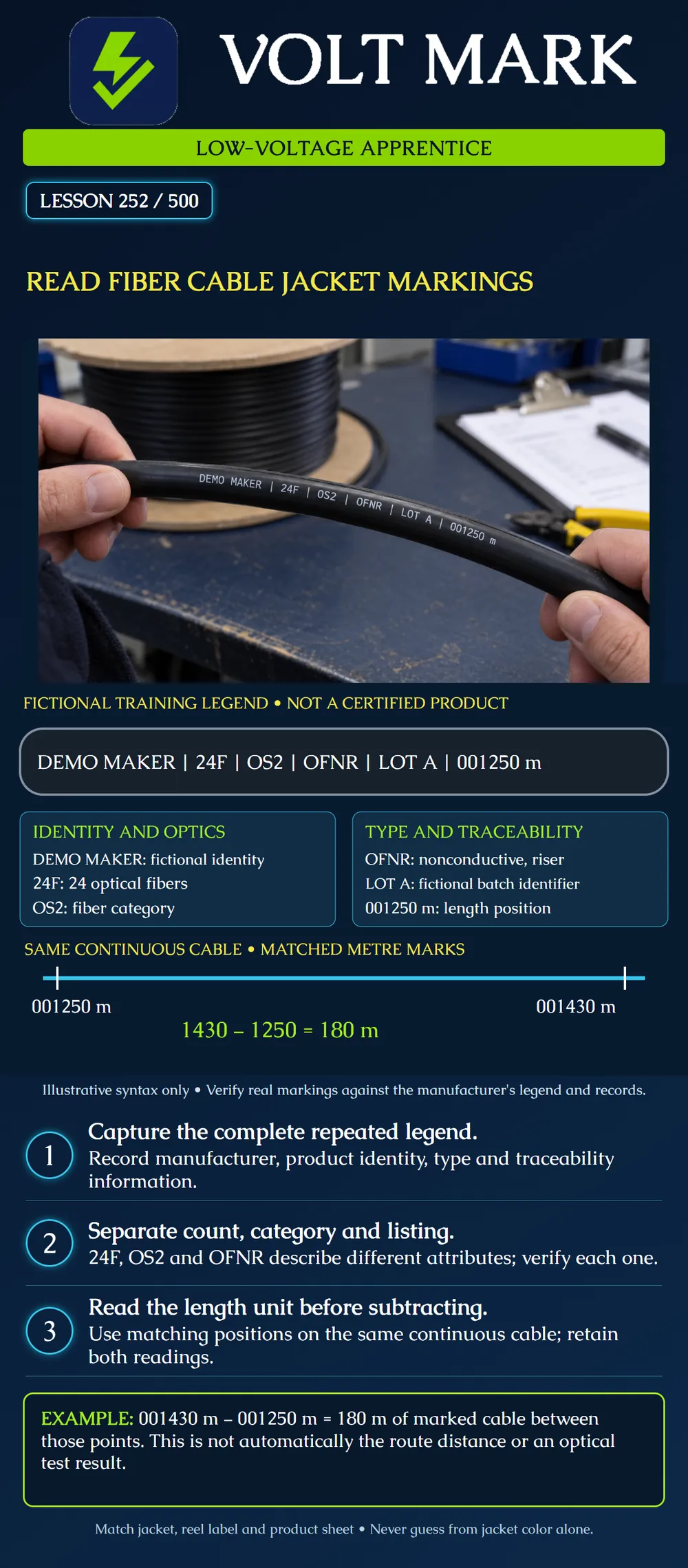
Read a complete cable legend, distinguish its different fields, and preserve enough information to match the cable to the correct product documentation. Calculate a length difference without confusing cable markings with optical measurements.
Photograph a readable repeated section and the associated reel or carton label. Record the exact characters rather than replacing an unfamiliar code with a guess. Identify the manufacturer and product reference using that manufacturer's documentation. Some fields appear as explicit words; others are encoded or supplied on the reel label.
UL's historical optical-fiber marking guidance discusses the cable type, manufacturer identity and certification information on the cable and shipping label. It is a 2010 document with an explicit warning about later changes. Use the identification principle, then check the current certification record and supplied product documents. This lesson does not adopt the historical print spacing as a universal present-day rule.
The poster's entire legend is invented for teaching: DEMO MAKER | 24F | OS2 | OFNR | LOT A | 001250 m
DEMO MAKER is a fictional manufacturer identity. 24F means twenty-four fibers in this defined example, not twenty-four fibre pairs. OS2 identifies the optical fiber category; it does not identify a connector or guarantee an application reach. OFNR is the nonconductive riser cable type described in the UL 1651 public scope. LOT A is a fictional batch identifier. 001250 m is a sequential length position in metres in this example.
This is not a full commercial print specification. No certification logo, file number or actual product approval is fabricated. The presence of a type string in our drawing certifies nothing.
A fiber-count field tells you how many fibers the example contains. A fiber category relates to optical characteristics. A cable type addresses a different classification. Traceability fields help connect the physical item to manufacturing or shipment records.
Do not combine those answers into “this cable is correct for the job” without checking the complete specification. For example, an OS2 legend alone does not establish outdoor exposure suitability, a fire classification, a connector polish or a loss budget.
Manufacturer coding is product-specific. Corning's cited MIC DX family document includes an ordering key for fiber and cable attributes and identifies length-marking units. It also discusses alternative jacket colors. The opened document is dated 2018; use it as an example of why the correct product key matters, not a universal decoding table for other manufacturers.
At one point on a single continuous teaching cable, read 001250 m. At another point, read 001430 m. The units agree: 1430 − 1250 = 180 m.
If read in the opposite direction, the magnitude of the difference remains 180 m. Retain both original readings and their endpoints so another technician can reproduce the calculation.
Do not subtract positions from unrelated reels or across a splice joining cables with independent sequences. Do not mix a mark expressed in feet with one expressed in metres.
If the two positions instead read 001250 ft and 001430 ft, the difference would be 180 ft: 180 × 0.3048 = 54.864 m. The numeral difference is the same, but the length is different. Always carry the unit.
The example gives the indicated cable length between the selected positions. It does not automatically equal building-to-building map distance. Service loops, routing and endpoint placement can affect what is included. It is not a loss measurement, continuity result or certification test.
Jacket length and optical-fiber length are also different quantities; fiber construction can include excess fiber length. Treat marking accuracy and measurement requirements according to the manufacturer's documentation and the project's method. Do not use a printed number as evidence that the installed link passed optical testing.
Use an instructor-supplied disconnected sample and its matching documentation.
If the jacket is damaged or unreadable, do not invent a replacement identity. Seek traceable records or an approved identification method. Never disconnect an operating campus, industrial or life-safety link merely to complete this classroom exercise.
Mistake: Entering 24F as twenty-four duplex pairs. Correction: Record twenty-four individual fibers in this defined legend; any pairing or reserve allocation is a separate design decision.
Mistake: Subtracting jacket positions from separate reels to estimate a joined route. Correction: Identify each continuous sequence and its units, calculate its own segment, and retain the endpoints before combining documented lengths.
Mistake: Accepting an OS2 cable for an outdoor route without further records. Correction: Keep optical category separate from jacket classification, exposure suitability and the exact manufacturer's product evidence.
UL, Optical Fiber Cable Markings, 2010 historical guidance: https://code-authorities.ul.com/wp-content/uploads/2014/04/ul_OpticalFiberCable.pdf UL Standards & Engagement, UL 1651 public scope: https://shopulstandards.com/ProductDetail.aspx?UniqueKey=29520 Corning, MIC DX family sheet 0048_NAFTA_AEN, revision May 24, 2018: https://www.corning.com/catalog/coc/documents/product-family-specifications/0048_NAFTA_AEN.pdf
Texas journeyman, 15 questions, scored by topic against the 70% mark. No card, and no account needed to start.
Free study material for low-voltage apprentices. This is a national foundation course: requirements differ by state and by local jurisdiction, and a practice that is common in one place is not a rule everywhere. Nothing here is a licence, a certification, or authority to work unsupervised, and completing it does not count as apprenticeship hours or continuing-education credit. Check the codes adopted where you are working, the licensing authority for that work, and your employer's safety programme. VoltMark is not affiliated with, endorsed by, or sponsored by NFPA, OSHA, NICET, BICSI, FOA, or any state or local licensing authority.

Electrician licensing exam prep: practice questions, timed exam simulations, and step-by-step help finding every answer in the NEC.