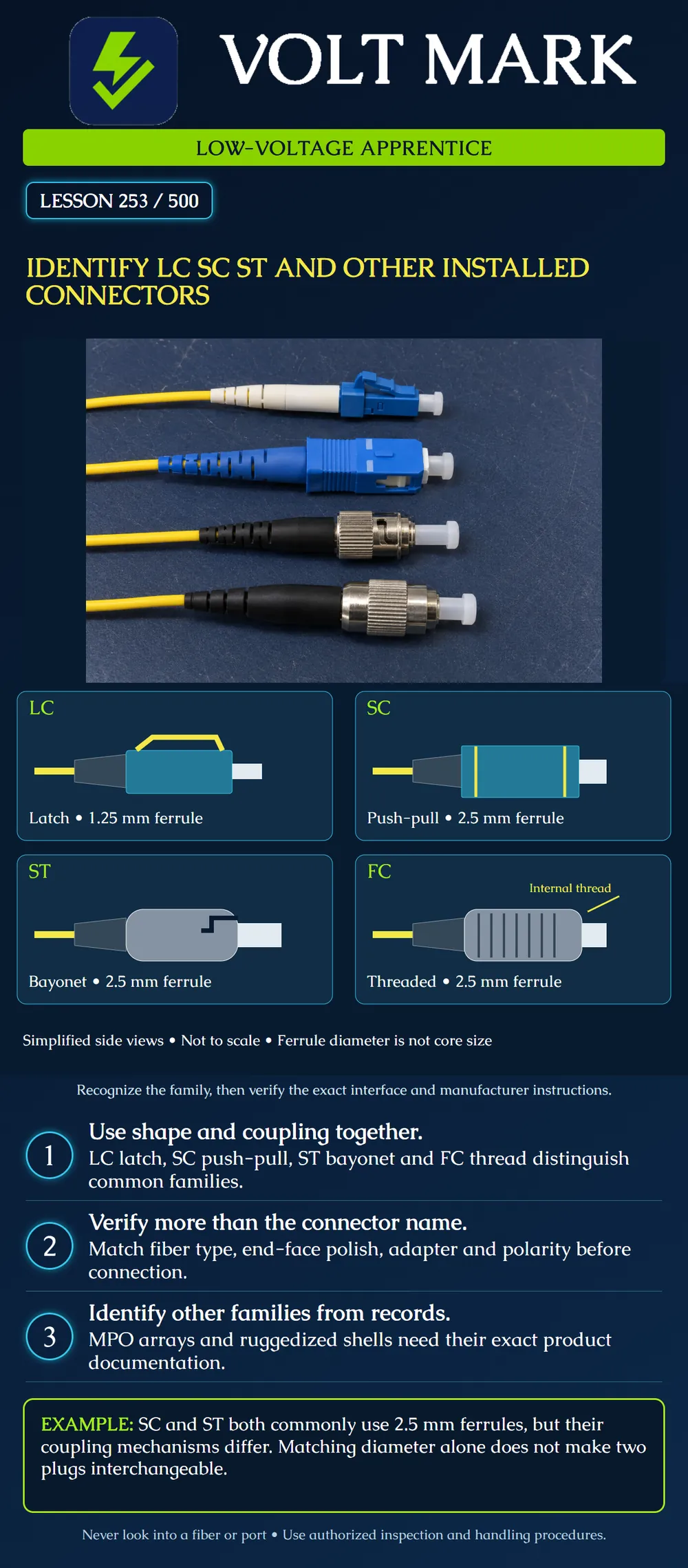
Recognize common connector families from their housing and coupling features, then identify the additional details required before selecting a patch cord or adapter.
These are simplified side views, not dimensioned manufacturing drawings. They show common coupling features and typical ferrule diameters: LC: a compact housing with a latch and a 1.25 mm ferrule. SC: a rectangular push-pull housing with a 2.5 mm ferrule. ST: a bayonet coupling with a 2.5 mm ferrule. FC: a threaded coupling nut with a 2.5 mm ferrule.
The ST slot is a conceptual bayonet feature. The FC grooves depict the outside grip, not external mating threads; its coupling threads are internal. Drawn colors highlight features and do not establish fiber type or polish. The ferrules are enlarged for identification. Their diameter is not the optical core diameter.
The connector family does not by itself establish single-mode versus multimode fiber, the end-face finish, polarity, connector condition or application performance. Match those details using the actual assembly and equipment records.
A shared ferrule diameter is not permission to force unlike plugs into one adapter. An approved hybrid cord or suitable hybrid adapter may provide a designed transition, but its complete interfaces must match. The learner's first task is to identify and document what is present, not to improvise a connection.
MPO uses a multifiber array interface rather than the single round ferrule arrangement shown in these four examples. Its fiber arrangement, keying, pin configuration, polish and polarity must be verified for the exact assembly. Do not assume every MPO has the same fiber count.
Ruggedized outdoor or industrial connectors may enclose a familiar optical interface within a separate protective shell. SENKO's IP-16 SC product is an example of an SC interface in an environmental connector system with a bayonet mechanism. A bayonet outer shell therefore does not automatically make the optical interface ST. Consult the exact product drawing and mating instructions.
Older sites may contain unfamiliar or legacy connectors. Preserve their identity and obtain the manufacturer's information rather than assigning the closest-looking modern name. The lesson is a foundation for identification, not an exhaustive connector catalog.
An instructor supplies four disconnected samples and their matching records: Sample A has a compact latch housing; the record says LC. Sample B has a rectangular push-pull housing; the record says SC. Sample C has a bayonet coupling; the record says ST. Sample D has a threaded nut; the record says FC.
For each sample, write the family and the feature that supports the answer. Next fill in fiber category, polish, simplex/duplex arrangement and intended adapter from the supplied records. If the records do not identify one of these, write “unverified.” Do not fill gaps from housing color alone.
Now the instructor adds a ruggedized sample with an outer bayonet shell. Its product sheet identifies an SC optical interface. Record both layers: external shell system and internal optical interface. Do not record ST merely because the shell rotates.
A fictional panel schedule identifies an SC interface and a fictional equipment schedule identifies LC. The requested assembly must have the specified interface at each end and the required fiber type, finish, polarity and length. “LC patch cord” is incomplete because it says nothing about the other end or those additional attributes.
Draft a request for the missing specifications rather than ordering from appearance. The exercise is complete when every field is supported or clearly unresolved. It does not require connecting the samples.
A connector plug, mating adapter and equipment port are related but different components. A duplex clip holding two connectors does not turn two fibers into one. A protective dust cap is not a reliable indicator of the interface underneath, nor proof of a clean end face.
Do not use repeated blind insertion as an identification method. Protect the ferrule and follow the approved inspection/cleaning process before any authorized mating. Never inspect a fiber by looking directly into its end or an equipment port. Do not disturb an operating security, fire-alarm, industrial or campus link for this classroom task.
An instructor's disconnected ruggedized sample has a bayonet outer shell and a matching manufacturer record identifying the internal optical interface as SC. First record the outer shell system and its exact product identity. Then enter SC in the optical-family field. The bayonet observation does not change that field to ST.
The equipment schedule requests LC at the other end but omits polish and fiber category. The draft assembly description is therefore SC optical interface at the documented shell end and LC at the equipment end, with the required shell assembly, polish, fiber category, polarity and length still to be resolved. Keep the request incomplete rather than choosing a cord by ferrule diameter or color. No sample needs to be mated to reach this conclusion.
Mistake: Choosing an adapter because both plugs have a 2.5 mm ferrule. Correction: Identify each connector family and the intended approved interface; matching ferrule diameter does not make SC, ST and FC interchangeable.
Mistake: Calling the ruggedized sample ST because its outer shell has a bayonet. Correction: Record the environmental shell separately from the documented SC optical interface inside it.
Mistake: Treating an intact dust cap as evidence of connector identity and cleanliness. Correction: Verify the interface from records and follow the approved inspection/cleaning process before authorized mating; the cap settles neither question.
FOA, Fiber Optic Connector Identifier: https://www.thefoa.org/tech/connID.htm SENKO, IP-16 SC Connector: https://www.senko.com/product/ip-16-sc/
Texas journeyman, 15 questions, scored by topic against the 70% mark. No card, and no account needed to start.
Free study material for low-voltage apprentices. This is a national foundation course: requirements differ by state and by local jurisdiction, and a practice that is common in one place is not a rule everywhere. Nothing here is a licence, a certification, or authority to work unsupervised, and completing it does not count as apprenticeship hours or continuing-education credit. Check the codes adopted where you are working, the licensing authority for that work, and your employer's safety programme. VoltMark is not affiliated with, endorsed by, or sponsored by NFPA, OSHA, NICET, BICSI, FOA, or any state or local licensing authority.

Electrician licensing exam prep: practice questions, timed exam simulations, and step-by-step help finding every answer in the NEC.