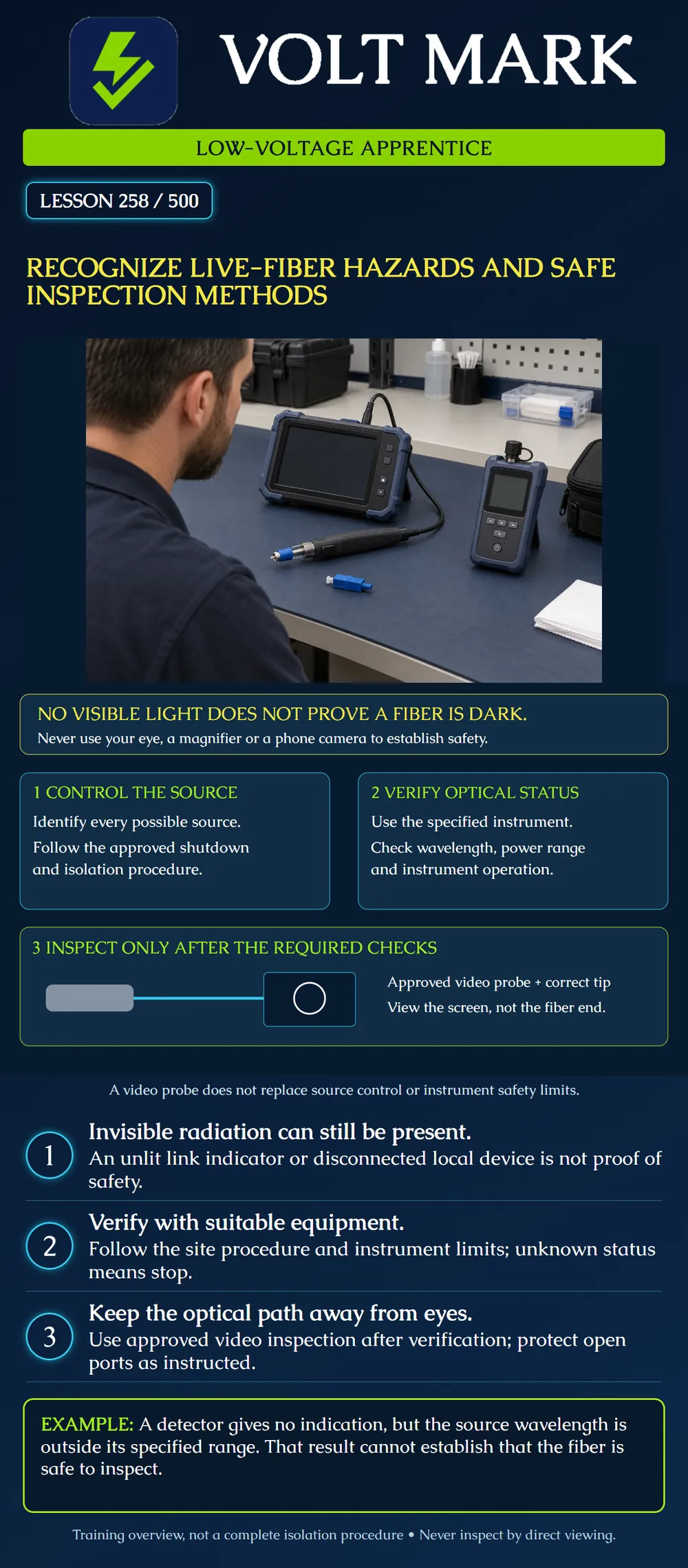
Recognize that a fiber can carry invisible optical radiation and identify the controls required before end-face inspection. Distinguish optical-status verification from viewing an end-face image.
Cisco's laser safety guidance warns that disconnected or unterminated fiber can emit invisible radiation and prohibits direct viewing with optical instruments. Do not look into a fiber, connector or open port. Magnifiers and direct-view microscopes are not a way to decide whether a fiber is active.
An unlit equipment indicator, a covered connector or a device disconnected at the local end does not establish the state of every optical source on the path. Keep the source identity and operating condition part of the approved work plan.
OSHA construction requirements include protection against potentially injurious light radiation under 29 CFR 1926.102 and requirements concerning laser/nonionizing-radiation work under 29 CFR 1926.54. Section 1926.54 limits assignment to install, adjust or operate laser equipment to qualified and trained employees and contains additional controls for covered laser work. These provisions must be applied to the actual optical source and exposure; they do not mean that every communications fiber presents the same hazard or requires identical protective equipment. Manufacturer information, the employer’s approved procedure and the actual source/link conditions remain necessary for the specific task. [1-5]
A detector or optical power meter must be appropriate for the source wavelength, power range, connection arrangement and work procedure. Confirm its operation and follow its instructions. Do not treat “no indication” from an unsuitable or uncertain instrument as clearance.
Fluke's FiberLert page specifies a detection wavelength range of 850–1625 nm and describes a non-contact indication of optical activity. That is a product-specific capability, not a universal detector specification. A detector indication of activity and a calibrated numerical power measurement answer different questions.
Do not apply an arbitrary numerical “safe” threshold from a training example. The source, exposure conditions, equipment limits and applicable laser-safety procedure determine the required controls.
Fluke's inspection guidance distinguishes video probes, which display an image, from direct optical viewing. Viewing the screen reduces the direct eye-exposure path. It does not authorize connecting a probe to any live optical source or exceeding the probe's input limits.
Use the correct inspection tip and approved procedure for the connector and polish. A live video image means a continuously updated camera image; it is not permission to inspect an energized fiber. A cleanliness pass is also not a declaration that optical radiation is absent.
Case A: The local equipment is powered down, but the far-end source status is unknown. Decision: do not proceed with inspection. Complete the approved source-identification and control process.
Case B: The fictional work package identifies a 1650 nm source. The available detector's specified range ends at 1625 nm. Decision: the available instrument does not cover the stated source wavelength. A silent indication cannot establish the required status. Obtain the method and equipment specified by the responsible procedure.
Case C: A technician proposes looking through a magnifier because the fiber shows no visible light. Decision: reject that method. Lack of visible light is not proof of absence of radiation.
Case D: The approved source controls and status checks are complete, but the available video probe tip does not match the interface. Decision: obtain the correct approved tip before inspection. Completing one control does not remove another equipment requirement.
Case E: An inspection image is clean, but no source-status record exists. Decision: the image does not fill the missing safety evidence.
For an instructor-led planning exercise, record:
Use prepared disconnected training samples for classroom practice. Do not disconnect an operating campus, industrial, security or life-safety link to complete this lesson.
Keep fiber ends and ports directed away from people. Protect unused openings with the covers specified by the manufacturer. Do not assume an ordinary dust cap is a certified laser safety barrier. Keep connector cleanliness and optical-source control as separate requirements.
If the source identity, instrument suitability or work authorization is uncertain, stop that operation and obtain the missing information. This is a defined control decision, not a guess based on how ordinary the equipment looks.
Review a fictional inspection request on paper. The local device is shut down, the far-end source is unconfirmed, and the work package identifies a possible 1650 nm source. The available detector covers 850-1625 nm. Compare the upper boundary: 1650 exceeds 1625, so that detector's silence cannot establish the required optical status.
Enter inspection HOLD, with two unresolved items: complete the approved control of the relevant sources, and obtain the procedure's suitable verification instrument and method. A video probe on the bench does not close either item; its own limits and correct tip must also be checked before permitted use. This is a review of supplied evidence, not an instruction to expose or test a live fiber.
Mistake: Proceeding after local shutdown while the far-end optical source is unconfirmed. Correction: Keep inspection on hold and complete the approved identification and control of all relevant sources.
Mistake: Using silence from the 850-1625 nm detector to clear the fictional 1650 nm path. Correction: Record the wavelength coverage mismatch and obtain the procedure's suitable instrument and method; silence outside its range proves no absence of radiation.
Mistake: Using a clean video-probe image as the missing optical-status check. Correction: Keep end-face condition and optical activity as separate evidence, and permit inspection only when the approved source controls, status checks and equipment limits are satisfied.
[1] OSHA 29 CFR 1926.102 - Eye and face protection: https://www.osha.gov/laws-regs/regulations/standardnumber/1926/1926.102 [2] OSHA 29 CFR 1926.54 - Nonionizing radiation: https://www.osha.gov/laws-regs/regulations/standardnumber/1926/1926.54 [3] Cisco Catalyst 8300 Series Edge uCPE - Laser Safety Guidelines (manufacturer): https://www.cisco.com/c/en/us/td/docs/routers/nfvis/c8300-ucpe/c8300-ucpe-hig/laser-safety-guidelines.html [4] Fluke Networks - FiberLert Live Fiber Detector (manufacturer): https://www.flukenetworks.com/datacom-cabling/fiber-testing/fiberlert-live-fiber-detector [5] Fluke Networks - Fiber Contamination, Cleaning and Inspection (manufacturer): https://www.flukenetworks.com/edocs/wp-fiber-cleaning-and-inspection-white-paper
This overview does not replace site-specific procedures or laser-safety training.
Texas journeyman, 15 questions, scored by topic against the 70% mark. No card, and no account needed to start.
Free study material for low-voltage apprentices. This is a national foundation course: requirements differ by state and by local jurisdiction, and a practice that is common in one place is not a rule everywhere. Nothing here is a licence, a certification, or authority to work unsupervised, and completing it does not count as apprenticeship hours or continuing-education credit. Check the codes adopted where you are working, the licensing authority for that work, and your employer's safety programme. VoltMark is not affiliated with, endorsed by, or sponsored by NFPA, OSHA, NICET, BICSI, FOA, or any state or local licensing authority.

Electrician licensing exam prep: practice questions, timed exam simulations, and step-by-step help finding every answer in the NEC.