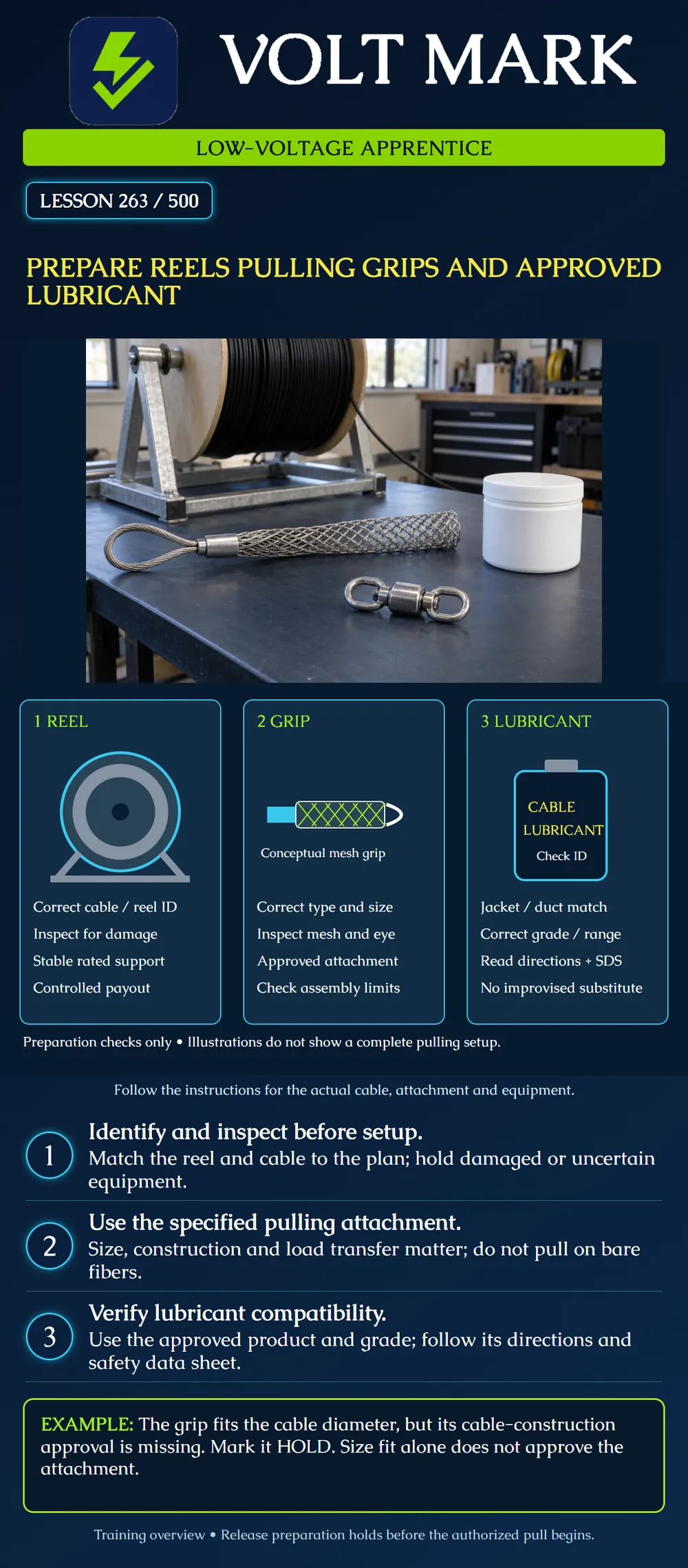
Prepare a documented readiness check for the cable reel, pulling attachment and lubricant. Identify missing evidence and damaged items before the authorized pulling operation begins.
The reel supports and pays out the cable. The pulling attachment transfers the permitted load through the specified cable components. Lubricant reduces friction when required by the approved method. These jobs are related, but one successful check does not cancel a failure elsewhere. A well-lubricated cable can still be damaged by an incorrect attachment.
Corning's duct-installation procedure calls for checking reel and mounting equipment for damaging protrusions, stable level support and unobstructed rotation. It describes product-specific grip and swivel use and directs installers to the relevant grip procedure. It also requires lubricant compatibility with the cable sheath and application according to lubricant directions. Liquid detergent is not a substitute. These are preparation principles; do not borrow another cable's tension rating or another reel's setup.
Polywater F's technical sheet describes a lubricant intended for underground communication-cable pulling, including fiber. It documents material compatibility and product properties. This establishes why a named lubricant needs technical evidence. It is not approval for every cable jacket, duct, installation temperature or placement method.
Create a record with project, cable part number, reel identifier, nominal length, received condition and reference documents. Compare it with the approved material schedule. Record any discrepancy before equipment setup.
Use the equipment manufacturer's procedure for support, lifting, securing and payout. Confirm that the equipment is suitable for the actual reel dimensions and load. Never infer support capacity from appearance. Damaged flanges, an uncertain axle arrangement or a missing equipment identification label belong on a hold record for review. The poster's reel drawing is symbolic; it does not specify an axle, lifting point, brake or stand design.
Record the exact grip or pulling-head product and applicable cable construction. Verify its stated size range, instructions, condition and permitted load against the approved plan. A fitting diameter is only one selection check. A factory-prepared assembly must retain the manufacturer's specified connector and breakout protection.
Do not invent strip lengths, knots, tape patterns or ways to capture strength members. The exact cable and attachment instructions determine the load-transfer method. Do not place pulling load on bare optical fibers or unsupported connectors. If the method requires a swivel, verify the specified component and its applicable limits; a swivel is not automatically a tension monitor.
The diagram's mesh pattern is a recognition illustration. It does not show a complete grip installation, an approved cable-end preparation or a usable connection to a pull line.
Record the product name, grade, container identification and the documents supporting compatibility with the actual jacket and pathway. Check the applicable use and storage conditions and the required application method. Keep the technical data sheet separate from the safety data sheet (SDS): one addresses product/application properties; the other supplies hazard and handling information. Use both as relevant to the work.
A general claim that a lubricant is suitable for fiber is not enough to resolve a specific compatibility question. Do not substitute soap, an unmarked liquid or a different lubricant because the preferred container is empty. Keep the product away from optical connector interfaces; this is cable-pulling lubricant, not an end-face cleaner. Follow the actual instructions for application and cleanup.
The training work package lists cable DEMO-C, outside diameter 10 mm. A proposed grip has a stated diameter range of 8–12 mm. The diameter check passes because 10 lies within that range. However, no document confirms that this grip is intended for DEMO-C's construction or required load-transfer method. The result is HOLD, not ready.
A labeled lubricant container is present, but the available technical sheet covers a different grade. Record the mismatch and request the correct evidence. Do not rewrite the container label or assume grades are interchangeable.
The reel identification matches the schedule, but a flange has visible damage. Photograph and report the condition from a permitted position. The designated reviewer determines the appropriate disposition; an apprentice does not repair the reel or start payout merely because the cable jacket looks intact.
These exercises require three separate resolutions. Passing the reel-ID comparison does not release the grip or lubricant holds.
Project / pull segment / date: Cable part number / reel ID: Reel and support-equipment identification: Condition findings / photo references: Grip or pulling-head ID / size range: Cable-construction and attachment evidence: Swivel or other specified assembly parts: Lubricant name / grade / container ID: Compatibility evidence / technical sheet / SDS: Required instructions available: Open issue / responsible reviewer / resolution: Final readiness authorization:
Label each exercise item VERIFIED FOR THIS CHECK or HOLD. State the evidence needed to resolve each HOLD. Then identify which person in the approved pulling plan has authority to release the operation. Do not carry out equipment setup or cable preparation as part of this paper exercise.
Mistake: Releasing the grip because its 8-12 mm range includes the 10 mm cable. Correction: Also confirm construction, load-transfer method, condition and applicable working limits against the exact cable and attachment instructions.
Mistake: Substituting detergent or another lubricant grade when the named product is unavailable. Correction: Hold the substitution until product identity and compatibility are approved; obtain the matching technical sheet and handling information.
Mistake: Starting payout because the reel ID matches even though its flange is damaged. Correction: Record the damage and obtain the designated reviewer's disposition; correct identity does not establish mechanical readiness.
Corning, Duct Installation of Fiber Optic Cable, SRP 005-011, Issue 17, June 2019: https://www.corning.com/content/dam/corning/catalog/coc/documents/standard-recommended-procedures/005-011.pdf Reference for reel preparation, grip and lubricant selection. Source-specific pulling speeds, dimensions and force values are not generalized.
Polywater F Technical Data Sheet: https://www.polywater.com/en/technical-data-sheet/f-communications-lubricant-tds/ Reference for the purpose and compatibility-based selection of a named communication-cable lubricant; no universal approval or application quantity asserted.
Texas journeyman, 15 questions, scored by topic against the 70% mark. No card, and no account needed to start.
Free study material for low-voltage apprentices. This is a national foundation course: requirements differ by state and by local jurisdiction, and a practice that is common in one place is not a rule everywhere. Nothing here is a licence, a certification, or authority to work unsupervised, and completing it does not count as apprenticeship hours or continuing-education credit. Check the codes adopted where you are working, the licensing authority for that work, and your employer's safety programme. VoltMark is not affiliated with, endorsed by, or sponsored by NFPA, OSHA, NICET, BICSI, FOA, or any state or local licensing authority.

Electrician licensing exam prep: practice questions, timed exam simulations, and step-by-step help finding every answer in the NEC.