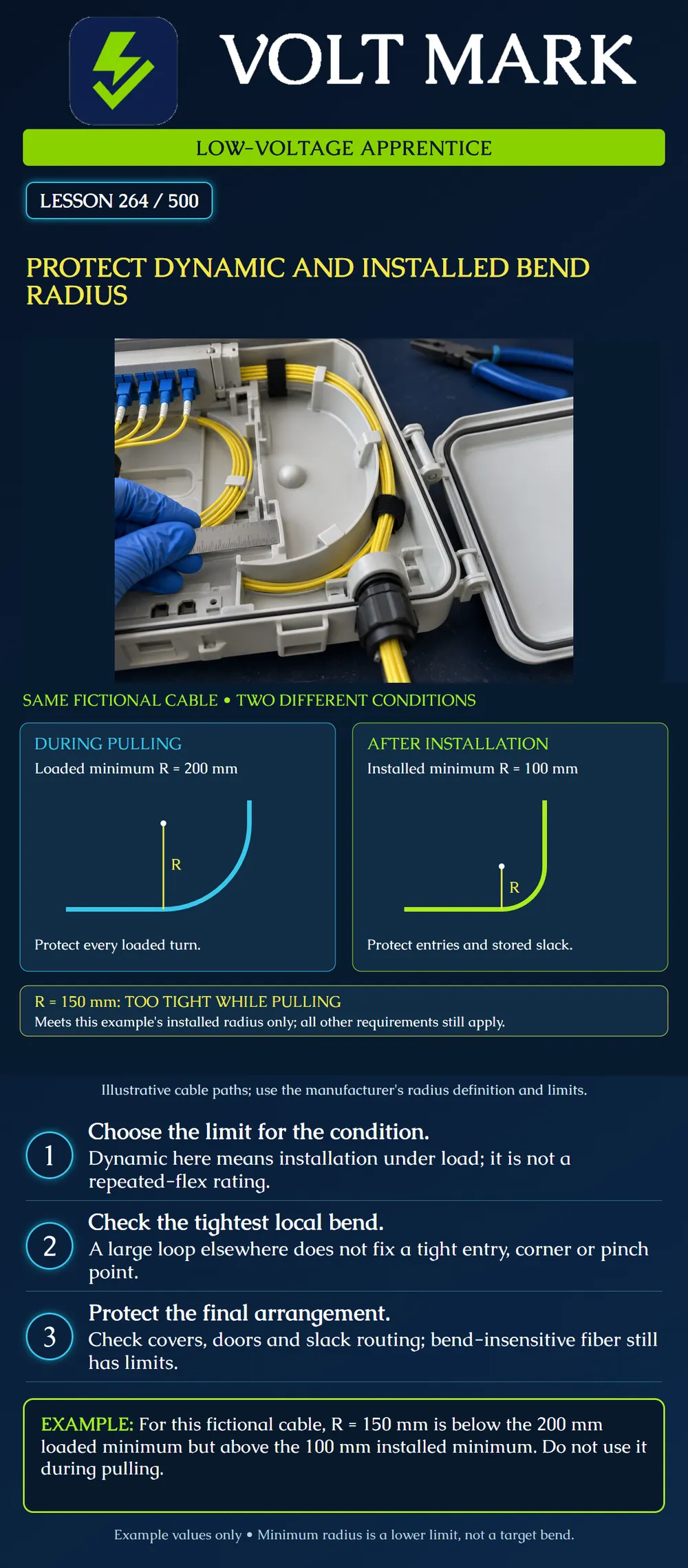
Select the applicable bend-radius requirement for a cable's condition, recognize a local bend violation and document the checks needed during installation and in the final arrangement.
For this lesson, dynamic refers to installation while the cable is under pulling load. Manufacturers may use terms such as loaded or installation radius. Installed, static or operating radius refers to the applicable final condition defined by the product documentation. Read those definitions for the exact cable and assembly.
Do not confuse an installation bend allowance with a rating for continuous motion or repeated flexing. An industrial cable carrier that moves thousands of times needs a suitable cable and a separately verified motion application. Meeting a one-time installation radius does not establish that suitability.
Record the exact part number, source document, revision, radius value, units and condition. If the manufacturer gives a multiplier, record which outside diameter it applies to. Do not assume a bare fiber's optical bend specification is the jacketed cable's mechanical limit. A connectorized assembly, pulling head or breakout can introduce additional requirements.
Corning's duct-installation guidance distinguishes loaded and installed bend radii and directs the installer to the actual cable specification. FOA similarly emphasizes product-specific requirements rather than treating common diameter multipliers as universal. This lesson therefore uses explicitly fictional numbers.
Radius is the distance from the center of a circular bend to the specified reference path. Diameter spans the full circle and equals twice the radius. A minimum radius is a lower bound: a larger radius is a gentler bend. Follow the manufacturer's measurement convention for the cable and hardware instead of assuming that a flange edge or housing dimension is the relevant cable path.
The two quarter-turns on the poster show circular curvature only. The larger arc has twice the illustrated radius of the smaller one. They do not depict a complete guide, tray, enclosure or pulling setup. The drawing has no real-world scale.
Identify every local direction change, including the point where cable enters or leaves a guide. A broad sweep can still end at a small sharp corner. Likewise, a generous service loop does not compensate for a tight bend at its exit.
In the finished assembly, review the cable path in the actual permitted enclosure positions. A cable that looks acceptable with a door open can be crowded or pinched when the door closes. Verify the intended service movement and storage path without disturbing live service. Use the approved arrangement and restraints, and avoid crushing the cable while trying to make it look tidy.
Treat any observed violation or suspected damage as an issue to report and resolve through the approved procedure. Making a kink look straight again does not prove that the cable is undamaged. Visual inspection and optical acceptance testing answer different questions; neither replaces compliance with installation instructions.
Continue the teaching cable from lesson 262: Loaded minimum bend radius: 200 mm. Installed minimum bend radius: 100 mm.
Evaluate three proposed local bends:
These are checks of radius only. They do not approve pulling force, crush conditions, attachment, cable environment, guide design or a complete installation.
The diameters corresponding to the example minima are 400 mm loaded and 200 mm installed. If a sketch labels a loop as “200 mm,” ask whether that is radius or diameter before assessing it. A 200 mm diameter circle has radius 100 mm and would fail this example's loaded-radius check. Units alone do not resolve the ambiguity.
A fictional stored cable follows a 180 mm-radius loop but turns through a 70 mm-radius bend at the enclosure entry. The installed minimum remains 100 mm. The loop passes its comparison, but the entry fails by 30 mm. Do not average 180 and 70 to claim an acceptable path. The local minimum is the problem. Request an approved reroute or suitable hardware change; do not force the cable to fit.
Fiber designed to reduce bend-related optical loss can still be inside a cable or assembly with mechanical and installation restrictions. The product name does not authorize tight ties, sharp edges or use of an unknown bend radius. Keep the complete cable or assembly requirements attached to the work record.
Cable / assembly: Manufacturer document / revision: Loaded radius and definition: Installed radius and definition: Measurement reference and units: Location checked / actual local radius: Applicable condition: Result / unresolved issue / authorized disposition:
Mistake: Accepting a loop labeled 200 mm as meeting the 200 mm loaded-radius requirement. Correction: Resolve radius versus diameter; 200 mm diameter means 100 mm radius and fails that loaded comparison.
Mistake: Averaging the 180 mm loop and 70 mm entry bend to claim an acceptable installed path. Correction: Check each local bend against the 100 mm minimum; the entry is 30 mm too tight despite the generous loop.
Mistake: Ignoring the cable's mechanical bend limits because the fiber is bend-insensitive. Correction: Use the complete cable and assembly requirements for the actual condition; reduced optical bend sensitivity does not remove mechanical restrictions.
Corning SRP 005-011, Duct Installation of Fiber Optic Cable: https://www.corning.com/content/dam/corning/catalog/coc/documents/standard-recommended-procedures/005-011.pdf Reference for distinct loaded and installed limits, exact cable specifications and maintaining bend protection. No generic multiplier adopted as a universal requirement.
Fiber Optic Association, Installing Fiber Optic Cable: https://www.thefoa.org/tech/ref/install/installcbl.html Reference for product-specific bend limits, avoiding kinks and the distinction between radius and diameter. Its general numerical recommendations and unrelated handling examples are not adopted as universal rules.
Texas journeyman, 15 questions, scored by topic against the 70% mark. No card, and no account needed to start.
Free study material for low-voltage apprentices. This is a national foundation course: requirements differ by state and by local jurisdiction, and a practice that is common in one place is not a rule everywhere. Nothing here is a licence, a certification, or authority to work unsupervised, and completing it does not count as apprenticeship hours or continuing-education credit. Check the codes adopted where you are working, the licensing authority for that work, and your employer's safety programme. VoltMark is not affiliated with, endorsed by, or sponsored by NFPA, OSHA, NICET, BICSI, FOA, or any state or local licensing authority.

Electrician licensing exam prep: practice questions, timed exam simulations, and step-by-step help finding every answer in the NEC.