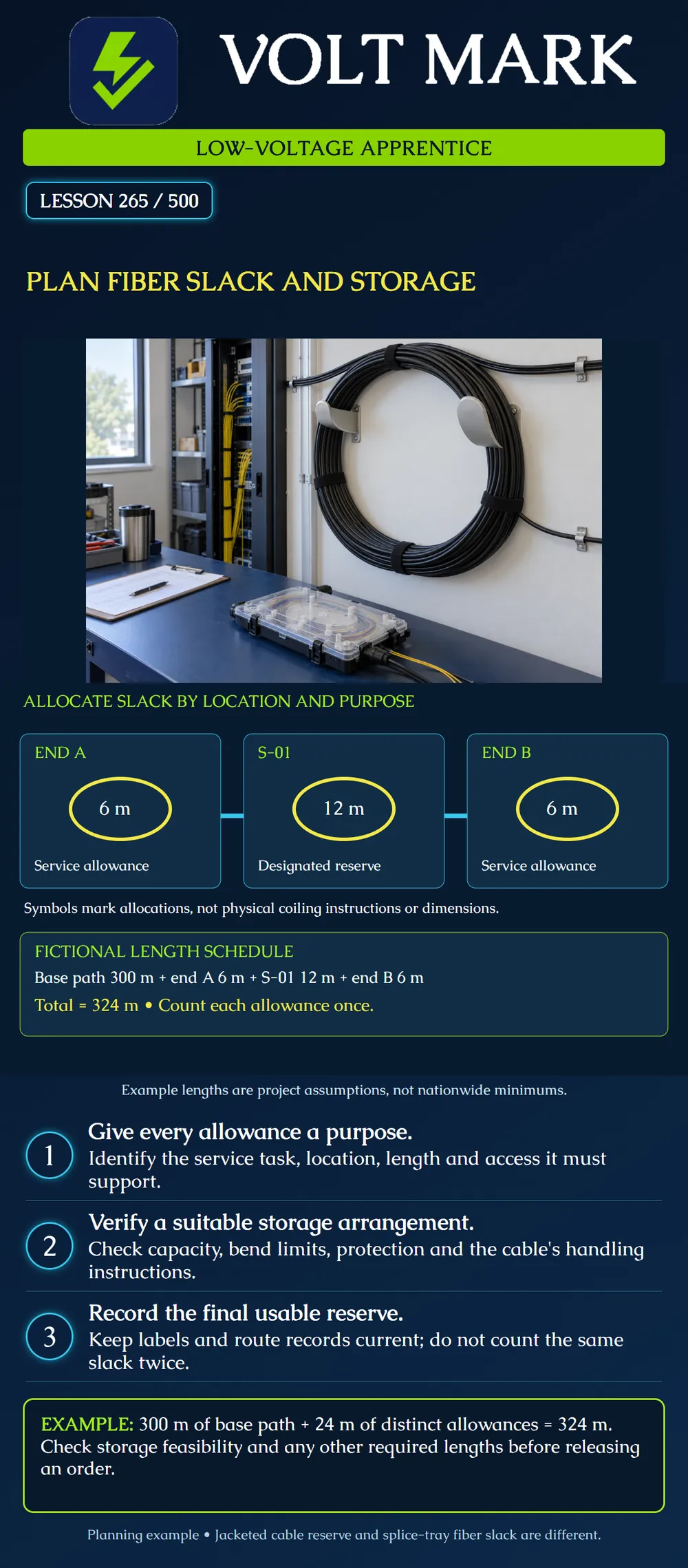
Create a location-based slack schedule that explains the purpose, length and storage arrangement of each allowance. Distinguish external cable reserve from the fiber routing inside a splice tray.
Slack is deliberately allocated length for a defined task, such as reaching an approved service position or providing a documented repair reserve. Random surplus is not automatically useful reserve. It may be inaccessible, stored in the wrong location or incompatible with the available space.
Start with the approved route and the intended maintenance approach. Ask what must move, how far, through which permitted path and under whose authorization. Record the decision in the design rather than leaving each installer to guess.
Base path: the cable length along the defined route, with its boundaries stated. External cable allowance: additional jacketed cable assigned to a named service or reserve location. Internal preparation and fiber routing: cable-end preparation, buffer-tube routing or fiber slack specified for the actual enclosure and tray.
These categories can overlap if the project records are unclear. A documented end allowance may already include termination preparation. State that explicitly. Never add the same length again under another heading.
Corning's AEN 173 addresses preferential-bend cables. It explains that bend direction and twisting affect these constructions and that storage must respect the cable's minimum bend geometry and the available vault space. Its methods and example lengths apply in that document's context, not to every fiber cable. Corning's CCH-CF product description illustrates a different scale of storage: a termination/slack cassette for compatible panel hardware. That is not an outdoor jacketed-cable reserve rack.
The lesson therefore does not prescribe a universal service-loop length, number of turns, bend multiplier or vault size. Follow the selected cable, enclosure and storage-hardware instructions.
Assign an identifier to each planned reserve. Record the building, room, frame, enclosure or authorized outside-plant location. Identify the hardware intended to hold the cable and how the reserve supports the service task.
Consider access to other installed equipment, the closure or panel, and the ability to restore the cable to its intended position after authorized work. A store of cable that prevents a cover from closing or blocks access to another component is not an acceptable plan merely because its length matches the drawing.
Check the product-specific bend limits, permitted routing and capacity. Account for entrances, exits and transitions as well as the main stored curve. Avoid twisting, crushing or forcing the cable into corners. Preferential-bend constructions need the applicable handling method; a generic circular-loop sketch cannot supply that method.
The three oval symbols on the poster identify allocations only. They are not instructions to form three physical coils, specify orientation or enter an underground structure. Service work and access require the established authorization and safety procedures.
A training design defines a complete base path of 300 m between its two termination reference points. The drawing explicitly excludes three additional allowances: End A service allowance: 6 m. S-01 designated reserve: 12 m. End B service allowance: 6 m. Additional allowance total: 6 + 12 + 6 = 24 m. Scheduled cable length: 300 + 24 = 324 m.
For this exercise, the end allowances already include the stated termination-preparation needs. They are not added again. The example assumes the defined base path includes all planned rises and offsets. A real design must verify those boundaries and any further allowances before ordering. Factory-terminated assemblies also require checking the manufacturer's length-reference convention.
Suppose the authorized designer increases the S-01 reserve from 12 m to 18 m after confirming the service reach and suitable storage. The total becomes 300 + 6 + 18 + 6 = 330 m, an increase of 6 m. Adding 18 m to the old 324 m total would produce 342 m and double-count the original 12 m at S-01.
The revised schedule is still a planning document. Confirm that the specified storage method accommodates the revised allocation; length arithmetic alone cannot prove feasibility.
Record the actual reserve location, identification, length basis and storage arrangement according to the project documentation method. Do not label a guessed length as measured. If future work consumes part of a reserve, update the record and note any required restoration of the reserve or storage configuration.
An OTDR distance does not by itself separate route length from each storage allowance. Use the project records and appropriate measurement methods to maintain that distinction. Do not open closures or disturb live fibers merely to fill in a missing worksheet value.
Cable / link ID: Base-path definition and drawing revision: Reserve ID / location: Purpose / required service reach: Allocated length / included preparation allowance: Cable and storage-hardware references: Capacity and bend checks: Access restrictions: As-installed record / measurement basis: Reviewer / unresolved items:
Mistake: Adding the new 18 m reserve to the old 324 m total. Correction: Replace S-01's original 12 m allocation: 324 - 12 + 18 = 330 m. Retain the revised location schedule so the old reserve is not counted twice.
Mistake: Adding termination preparation again after using the example's 6 m end allowances. Correction: Read the allowance boundaries; preparation is already included here. Add a separate length only when the approved schedule explicitly excludes it.
Mistake: Approving S-01 storage solely because the revised cable length is correct. Correction: Check the designated hardware, accessible service path, capacity and cable-specific bend/twist requirements for the 18 m allocation before accepting the storage plan.
Corning, Handling Preferential Bend Cables, AEN 173 Revision 1, December 14, 2021: https://www.corning.com/content/dam/corning/catalog/coc/documents/application-engineering-notes/AEN173.pdf Reference for product-specific bend-axis, twist and storage-space considerations. Its typical 75-foot reserve and specific storage procedures are not presented as universal rules.
Corning, CCH-CF Termination and Slack Storage cassette: https://ecatalog.corning.com/optical-communications/EMEA/en/Fiber-Optic-Hardware/Panels-Modules-and-Cassettes/CCH-Cassette/p/CCH-CF Product reference for a modular termination/slack-storage cassette. No detailed capacity or compatibility claim beyond that product description is relied on.
Texas journeyman, 15 questions, scored by topic against the 70% mark. No card, and no account needed to start.
Free study material for low-voltage apprentices. This is a national foundation course: requirements differ by state and by local jurisdiction, and a practice that is common in one place is not a rule everywhere. Nothing here is a licence, a certification, or authority to work unsupervised, and completing it does not count as apprenticeship hours or continuing-education credit. Check the codes adopted where you are working, the licensing authority for that work, and your employer's safety programme. VoltMark is not affiliated with, endorsed by, or sponsored by NFPA, OSHA, NICET, BICSI, FOA, or any state or local licensing authority.

Electrician licensing exam prep: practice questions, timed exam simulations, and step-by-step help finding every answer in the NEC.