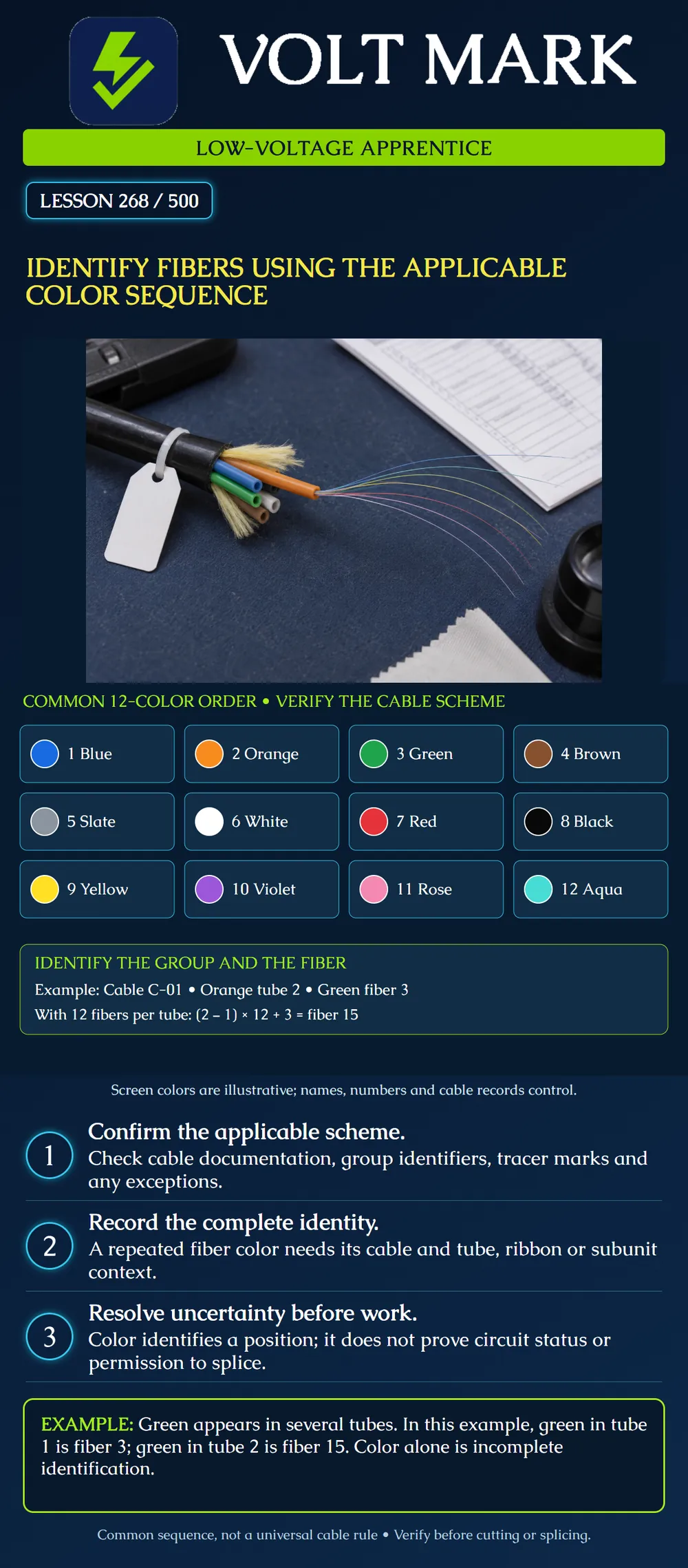
Use the documented identification scheme to name a fiber's position within its correct cable and group. Recognize why a color alone does not uniquely identify a circuit.
1 Blue 2 Orange 3 Green 4 Brown 5 Slate 6 White 7 Red 8 Black 9 Yellow 10 Violet 11 Rose 12 Aqua
Corning's AEN029 documents this sequence within its TIA/EIA-598-based identification scheme. The note also describes product-specific group labels and repeated-color tracers. It distinguishes a repeated black buffer-tube marking from a particular repeated black fiber marking. Therefore, do not create one universal tracer rule for every tube, fiber and cable family.
The poster colors are display approximations, not calibrated color samples. Number and name every position so the lesson remains understandable without relying on a swatch alone. Confirm ambiguous physical colors using the actual cable documentation and approved identification process.
A cable may contain several tubes, ribbons or subunits with repeated fiber colors. Record the cable ID and the applicable group identity before assigning the fiber position. Do not assume that group order follows the physical clockwise arrangement visible at a cut end. Follow the documented construction and identification method.
A complete record can include cable C-01, group type “tube,” tube number and observed marking, fiber number within that tube, and the project's overall fiber number. Include ribbon or layer information when required by that cable's scheme. A familiar color chart does not remove the need for those fields.
Assume a training cable has consecutively numbered, fully populated tubes, each containing twelve fibers. The exercise documentation explicitly applies the displayed order to both tubes and fibers. Under those assumptions: Tube 1, blue, contains overall fibers 1–12. Tube 2, orange, contains overall fibers 13–24. Tube 3, green, contains overall fibers 25–36.
Green is local fiber 3. In orange tube 2, its overall position is: (2 − 1) × 12 + 3 = 15. Record “C-01 / tube 2 orange / local fiber 3 green / overall fiber 15.”
Green in tube 1 is overall fiber 3. Green in tube 3 is overall fiber 27. All three fibers are green; the group context changes the complete identity.
The equation (group number − 1) × fibers per group + local position applies to the defined exercise because groups have equal population and consecutive numbering. Do not apply it automatically to cables with fillers, unequal populations, special subunits or a different numbering scheme. A manufacturer's printed group number can also require additional context.
For ribbon products, consult the actual ribbon print or marking legend. Do not infer a ribbon number from a photographed edge color alone. For larger counts, confirm how repeated groups and tracers are identified. This lesson teaches the basic twelve positions, not a complete decoder for every ribbon or high-count design.
Using only the fictional twelve-per-tube arrangement, identify overall fiber 29. Two complete groups account for 24 fibers. 29 − 24 = 5. It is local position 5, slate, in tube 3, green.
Now identify overall fiber 24. Tube 2 covers positions 13–24. 24 − 12 = 12. It is aqua in orange tube 2. A boundary value such as 24 belongs to the end of tube 2, not the start of tube 3.
Another example: local yellow fiber 9 in brown tube 4 gives (4 − 1) × 12 + 9 = 45. This answer is valid only under the exercise assumptions.
A color or numerical identity does not establish whether the fiber is active, isolated, reserved or abandoned. It does not prove polarity, continuity, connector cleanliness or a correct splice. Obtain the required circuit records and authorization before any field work. Never cut a fiber just because its color matches a work order.
If the documentation and observed markings disagree, record the discrepancy and stop the proposed change. Do not relabel the physical cable or alter the splice schedule merely to make the disagreement disappear.
Make a paper table with four columns: cable/group identity, local fiber position, color name and overall number. Fill it for overall fibers 15, 24 and 29 using the stated exercise scheme. Then write a HOLD note for a sample whose tracer cannot be distinguished. The correct action is to verify the relevant manufacturer's marking legend, not to guess from the screen swatch.
Mistake: Recording a green fiber as overall fiber 3 without recording its tube. Correction: Identify the cable and group first; in this exercise green local fiber 3 in orange tube 2 is overall fiber 15, while the same color in tube 3 is 27.
Mistake: Placing overall fiber 24 in tube 3 because 24 divided by 12 equals two complete groups. Correction: Check the inclusive group ranges: tube 2 contains fibers 13 through 24, so fiber 24 is local position 12, aqua; tube 3 starts at 25.
Mistake: Applying the twelve-per-group formula to a cable containing fillers or unequal group populations. Correction: Use that cable's documented group population and numbering map; the exercise formula requires equal populated groups with consecutive numbering.
Corning, Optical Fiber Color Codes, AEN029: https://www.corning.com/catalog/coc/documents/application-engineering-notes/AEN029.pdf The referenced publication is dated March 12, 2026. Its main heading says Revision 13 while page footers say Revision 12; this inconsistency is preserved here rather than silently resolved. The twelve-color tables agree. Detailed tracer exceptions and ribbon-numbering examples are not generalized. The lesson's numbering exercises are original and use explicitly stated assumptions.
Texas journeyman, 15 questions, scored by topic against the 70% mark. No card, and no account needed to start.
Free study material for low-voltage apprentices. This is a national foundation course: requirements differ by state and by local jurisdiction, and a practice that is common in one place is not a rule everywhere. Nothing here is a licence, a certification, or authority to work unsupervised, and completing it does not count as apprenticeship hours or continuing-education credit. Check the codes adopted where you are working, the licensing authority for that work, and your employer's safety programme. VoltMark is not affiliated with, endorsed by, or sponsored by NFPA, OSHA, NICET, BICSI, FOA, or any state or local licensing authority.

Electrician licensing exam prep: practice questions, timed exam simulations, and step-by-step help finding every answer in the NEC.