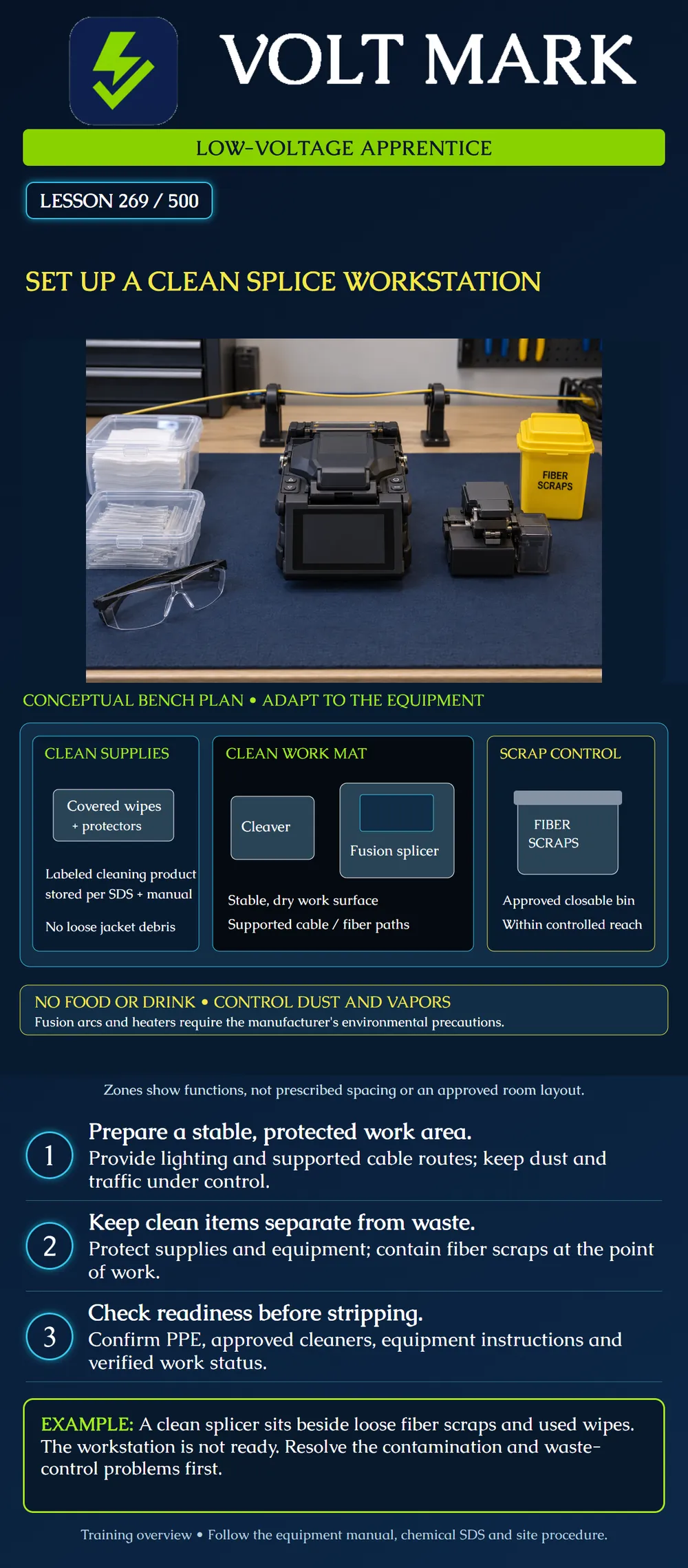
Arrange a splice workstation so equipment, clean materials and waste have distinct places. Identify readiness problems before a fiber is stripped or cleaved.
Use the approved work location and a stable, dry surface with adequate lighting. Protect the work from dust, weather, traffic and accidental contact. Support cable routes so their weight or movement does not pull on prepared fibers. A convenient tabletop is not automatically an acceptable work area.
Confirm the work scope, cable identity and required optical and other energy controls. A clean bench does not establish that a cable is isolated. Use known isolated samples for the paper or supervised training exercise in this lesson.
Clean supplies: keep unused wipes, approved splice protectors and other consumables protected from debris. Retain product identification and instructions. Store cleaning products according to their safety data sheets and equipment requirements.
Working area: place the cleaver and splicer where they can be operated as instructed without pulling fibers across unrelated tools. A suitable dark mat can improve visibility of fine fiber pieces. Keep the approved fiber holders, cable supports and necessary tools available. Remove items that have no role in the current operation.
Scrap control: place the approved closable fiber-scrap container and any specified cleaver collector where scraps can be contained without uncontrolled transfer across clean materials. Distinguish fiber scraps from used chemical wipes and ordinary packaging; follow the site's waste procedures for each.
The poster is a conceptual plan, not prescribed left-to-right workflow or minimum spacing. Its splicer and cleaver icons do not show operational controls. Adapt the arrangement to the actual equipment and safe working reach.
OSHA construction requirements can apply to several hazards represented in a fiber-splice workstation. OSHA 1926.59 applies the Hazard Communication requirements of 1910.1200 to construction work, including applicable requirements for hazardous-chemical information, labels and safety data sheets. OSHA 1926.102 addresses appropriate eye and face protection where workers are exposed to specified eye or face hazards. OSHA 1926.25 addresses construction housekeeping and waste collection. Where cleaning products meet applicable flammable-liquid classifications, 1926.152 contains requirements for handling flammable liquids and controlling ignition hazards. Which provisions apply depends on the actual products, quantities, task and work environment. Manufacturer instructions, safety data sheets and the employer’s approved procedures remain necessary for the specific workstation. [1-7]
FOA's safety guidance supports eye protection, keeping food and drinks out of the work area, controlled fiber-scrap disposal, ventilation and careful handling of cleaning chemicals. It also identifies the fusion arc as an ignition source. Apply the equipment manufacturer's environmental restrictions; do not operate in a flammable atmosphere or use the lesson diagram as proof that a space is safe.
Keep chemical containers identified and closed when not in use as directed. Do not place an unmarked liquid beside the splicer. Do not treat an open window, a clean-looking room or an absent odor as atmospheric clearance. Resolve environmental concerns through the approved site procedure.
Fujikura's cleaning guidance explains that coating debris and cable compounds can contaminate cleaver surfaces and interfere with results. It identifies lint-free cleaning materials and appropriate cleaning fluid, while providing equipment-specific maintenance guidance.
For actual work, use the manual for the exact model and component. Follow its power-state and handling instructions before cleaning. Do not generalize a lens, groove or electrode maintenance method from a different machine. This lesson does not authorize dismantling the splicer or replacing electrodes.
A clean appearance is not a completed readiness check. Confirm the required equipment condition, compatible holders, current setup and any calibration or checks specified by the work procedure. Record unresolved equipment problems instead of hiding them by changing a splice parameter.
Do jacket preparation in the designated area so larger debris and cable compounds do not spread into the clean fiber-working area. Change or clean the work surface according to the approved method when contamination occurs. Do not carry used wipes through the supply container or rest bare fiber ends on packaging.
Keep documents and record entry practical without transferring scraps to a keyboard, phone or notebook. The next lesson focuses specifically on collecting and containing fiber shards. Here, the requirement is to have that collection system ready before scraps are created.
A training bench has a clean splicer, a cleaver with an unverified scrap collector, an open drink, covered splice protectors and an unlabeled cleaning bottle. The correct assessment is NOT READY.
Remove food and drink from the work area through normal housekeeping. Verify the collector and approved disposal arrangement. Resolve the cleaner's identity and compatibility rather than guessing. Keep the covered protectors protected. Recheck the work area before beginning the authorized exercise.
A second bench has all the right tools but is directly beside dusty drilling work. Equipment possession does not solve environmental contamination. Coordinate a protected work location or effective approved controls before preparation. The decision is based on the actual conditions, not a fixed distance invented for this poster.
Work area / job / date: Authorized cable or training sample: Surface, lighting and environmental conditions: Supported cable route: Clean supply protection: Splicer and cleaver model / instruction references: Required equipment checks: Cleaner identity / SDS / approved application: Scrap collection and waste arrangements: PPE: Unresolved condition / responsible person / resolution:
Sketch a training bench with covered clean supplies, a cleaver and splicer, and a dedicated scrap container. The cable hangs unsupported over the edge, the scrap container can be reached only by passing over the clean supplies, and drilling starts beside the bench. Identify three readiness holds and revise the plan on paper before any fiber preparation. Answer guide: provide approved cable support that prevents movement from loading prepared fibers; rearrange collection within safe reach without carrying scraps over clean stock; coordinate a protected work location or approved environmental controls for the drilling. Record the responsible person and recheck each condition before releasing the affected task. Tool possession alone does not close any of these holds.
Mistake: Putting the scrap container behind the covered protectors because that leaves more space beside the cleaver. Correction: Rehearse the collection path before preparation and arrange approved collection within safe reach without carrying fragments across clean supplies.
Mistake: Moving a clean splicer onto the bench while leaving the cable hanging from its edge. Correction: Support the cable using the approved arrangement and check that normal workstation movement cannot pull on prepared fibers.
Mistake: Compensating for debris-related splice problems by changing a splice setting first. Correction: Stop and check the cleaver and splicer condition against the exact model's cleaning and readiness instructions; resolve contamination before evaluating authorized settings.
[1] OSHA 29 CFR 1926.59 - Hazard Communication: https://www.osha.gov/laws-regs/regulations/standardnumber/1926/1926.59 [2] OSHA 29 CFR 1910.1200 - Hazard Communication: https://www.osha.gov/laws-regs/regulations/standardnumber/1910/1910.1200 [3] OSHA 29 CFR 1926.102 - Eye and face protection: https://www.osha.gov/laws-regs/regulations/standardnumber/1926/1926.102 [4] OSHA 29 CFR 1926.25 - Housekeeping: https://www.osha.gov/laws-regs/regulations/standardnumber/1926/1926.25 [5] OSHA 29 CFR 1926.152 - Flammable liquids: https://www.osha.gov/laws-regs/regulations/standardnumber/1926/1926.152
[6] Fiber Optic Association, Safety in Fiber Optic Installations (technical, not a regulation): https://www.thefoa.org/tech/safety.htm Reference for work-area, scrap, chemical and fusion-arc precautions. The lesson does not adopt the page's medical advice or direct-viewing suggestions.
[7] Fujikura Europe, How to Clean Your Fusion Splicer (manufacturer, not a regulation): https://www.europe.fujikura.com/insights/how-to-clean-your-fusion-splicer/ Reference for contamination control and model-appropriate cleaning preparation, not a universal disassembly procedure.
FOA, Installer Toolkits (supplementary technical support): https://thefoa.org/tech/ref/install/tools.html Reference for dark work mats used to improve visibility of fibers and scraps.
Texas journeyman, 15 questions, scored by topic against the 70% mark. No card, and no account needed to start.
Free study material for low-voltage apprentices. This is a national foundation course: requirements differ by state and by local jurisdiction, and a practice that is common in one place is not a rule everywhere. Nothing here is a licence, a certification, or authority to work unsupervised, and completing it does not count as apprenticeship hours or continuing-education credit. Check the codes adopted where you are working, the licensing authority for that work, and your employer's safety programme. VoltMark is not affiliated with, endorsed by, or sponsored by NFPA, OSHA, NICET, BICSI, FOA, or any state or local licensing authority.

Electrician licensing exam prep: practice questions, timed exam simulations, and step-by-step help finding every answer in the NEC.