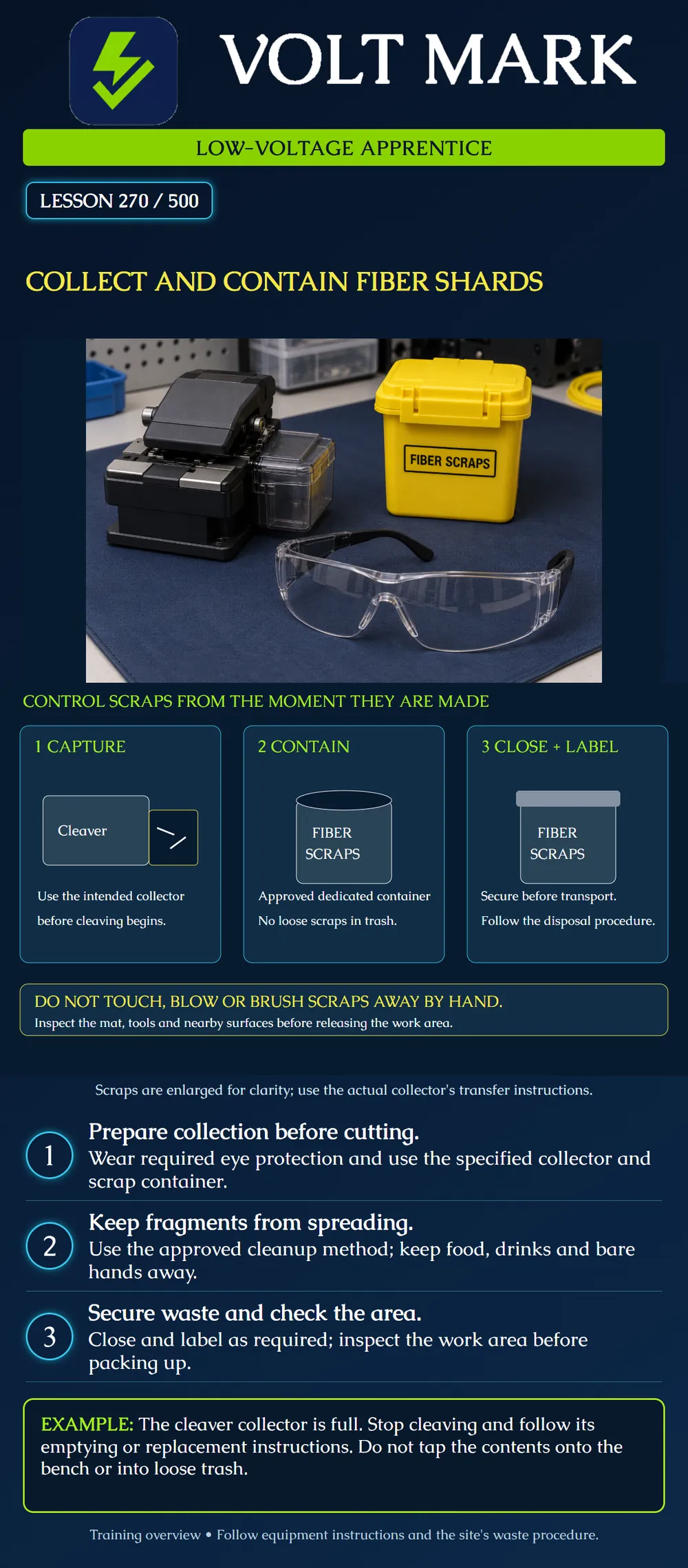
Maintain control of small fiber fragments from their creation through cleanup and the approved disposal process. Recognize when collection equipment is not ready and when work must stop.
Cleaving and other fiber-preparation work can produce small, sharp glass fragments. FOA identifies these scraps as a work-area hazard and advises eye protection, controlled disposal, keeping food and drinks away, and thorough cleanup. Fragments can be difficult to see. Do not treat a small piece as harmless because it is nearly invisible.
A container beside the bench is useful only when the collection method actually keeps scraps inside it. Plan the full path from the tool to the final closed container before starting. Maintain the controls during breaks and pack-up as well as during the splice itself.
OSHA construction requirements provide general support for housekeeping, waste collection and eye protection relevant to this work. OSHA 1926.25 requires debris to be kept clear of work areas, passageways and stairs and requires containers for collection and separation of waste, trash and other refuse. OSHA 1926.102 requires appropriate eye or face protection where employees are exposed to applicable eye or face hazards, including flying particles, and requires side protection where flying objects are a hazard. These provisions do not establish one universal legal disposal classification or container design for fiber shards. Fiber-specific collection, cleanup and disposal methods must follow the actual equipment instructions, employer/site procedures and any applicable waste requirements. [1-5]
Check the exact cleaver's instructions. If it uses an attached collector, confirm that the correct collector is installed, serviceable and ready to receive scraps. Check the specified fill or service condition. Do not improvise a replacement that prevents the cover or collection mechanism from functioning.
Some tools capture scraps automatically; others require a different approved collection method. The poster's small side collector is conceptual and is not a model-specific setup or removal guide. Never put fingers into the cutting or collection mechanism to check it.
Keep an approved fiber-scrap container available at the work position. Jonard's FDC-66 is one manufacturer example of a dedicated container with a closing lid. The lesson does not require buying that model; use the equipment and containers approved for the task.
Identify the contents clearly and keep the container stable. Do not reuse a drinking cup or food container in a way that could create confusion. A thin loose trash bag is not a substitute for controlled collection. Keep chemical wipes, blades and other waste in their designated systems unless the site procedure specifically permits combined handling.
When the tool's collector needs servicing, stop the operation. Follow the manufacturer's method for emptying or replacing it and the site's containment procedure. Keep the transfer controlled and avoid scattering fragments. Do not shake scraps onto the work mat, brush them off with a hand or use breath or compressed air to blow them away.
Do not reach into a full container, compress its contents or exceed its designated service condition. Secure the lid before moving the container. An attached collector and a final disposal container may serve different functions; verify the actual arrangement rather than assuming one replaces the other.
Use the approved tools and cleanup method for the work surface and equipment. Do not sweep bare fingers across a dark mat to decide whether it is clean. A dark surface can help reveal fragments but does not guarantee detection.
Inspect the mat, tool area and nearby surfaces where scraps could have escaped. Keep clean consumables separate while resolving contamination. Do not pack loose scraps into a tool case or allow them to spread onto phones, paperwork, clothing or footwear.
If fragments have spilled, stop the affected work, keep others clear of the area and follow the site's spill or cleanup process. Report any exposure or suspected injury through the site's response procedure; this lesson does not prescribe medical treatment.
Secure and identify the container before transport according to its instructions and the site procedure. Use the approved waste route, including any locally applicable requirements. Do not assume that a manufacturer's product description establishes the legal disposal classification for every workplace or every mixed waste stream.
Record a collection problem if the equipment was damaged, overfilled or missing. Resolve it before restarting. A later cleanup promise is not a substitute for having collection ready now.
During a supervised training session, the cleaver's collector reaches its specified service condition. The trainee sees a spare disposal can but cannot find the collector-servicing instructions.
The correct response is to stop cleaving, secure the work area and obtain the applicable instructions or supervisor assistance. Do not pull the collector apart by trial and error. Once serviced by the authorized method, verify readiness before continuing.
In a second scenario, the disposal can has a damaged lid. Putting it in a pocket for the walk to the waste area is not an acceptable resolution. Keep the contents controlled and obtain the approved replacement or containment arrangement.
In a third scenario, a few fragments are visible near a clean wipe packet. Protect the clean supplies, stop the affected task and clean the area using the approved method. Do not wipe the scraps into an ordinary open bin.
Cleaver model / collector identification: Collection instructions available: Collector condition / service status: Dedicated container / closure condition: Required PPE: Approved cleanup method: Waste-handling procedure: Spill or equipment issue: Resolution / readiness recheck:
In a fictional training review, an attached collector captures scraps correctly but its final disposal container has a lid that will not secure. The trainee proposes finishing the next batch because the attached collector still has room. The reviewer separates capture from transport: working capture does not repair the failed closure downstream. The affected work is held while the supervisor arranges an approved replacement or containment method. After that arrangement and the required transfer instructions are confirmed, readiness is rechecked. The decision does not depend on inventing a capacity or assuming the waste belongs in ordinary trash.
Mistake: Treating an attached collector as the entire disposal system because it catches fragments automatically. Correction: Trace the remaining transfer, closure and approved waste route before starting, and confirm which instructions govern each stage.
Mistake: Pressing down scraps to regain space when the collector reaches its service condition. Correction: Stop producing scraps and follow the specified servicing method; do not reach into or compress the contents.
Mistake: Packing the dark work mat after removing only the fragments that are easy to see. Correction: Complete the approved cleanup and inspection of the mat and nearby surfaces before packing, keeping clean supplies protected while contamination is resolved.
[1] OSHA 29 CFR 1926.25 - Housekeeping: https://www.osha.gov/laws-regs/regulations/standardnumber/1926/1926.25 [2] OSHA 29 CFR 1926.102 - Eye and face protection: https://www.osha.gov/laws-regs/regulations/standardnumber/1926/1926.102
[3] Jonard Tools, Fiber Scraps Disposal Can FDC-66 (manufacturer, not a regulation): https://jonard.com/fdc-66?v=127 Manufacturer reference for dedicated collection and lid closure. No model-specific collector transfer procedure is inferred.
[4] Fiber Optic Association, Fiber Optic Installation (technical, not a regulation): https://www.thefoa.org/tech/ref/OSP/install.html Supporting installation reference.
[5] Fiber Optic Association, Safety in Fiber Optic Installations (technical, not a regulation): https://www.thefoa.org/tech/safety.htm Supports scrap containment, eye protection, food/drink exclusion and cleanup. Medical-treatment and direct-viewing suggestions are not adopted.
Texas journeyman, 15 questions, scored by topic against the 70% mark. No card, and no account needed to start.
Free study material for low-voltage apprentices. This is a national foundation course: requirements differ by state and by local jurisdiction, and a practice that is common in one place is not a rule everywhere. Nothing here is a licence, a certification, or authority to work unsupervised, and completing it does not count as apprenticeship hours or continuing-education credit. Check the codes adopted where you are working, the licensing authority for that work, and your employer's safety programme. VoltMark is not affiliated with, endorsed by, or sponsored by NFPA, OSHA, NICET, BICSI, FOA, or any state or local licensing authority.
Electrician licensing exam prep: practice questions, timed exam simulations, and step-by-step help finding every answer in the NEC.