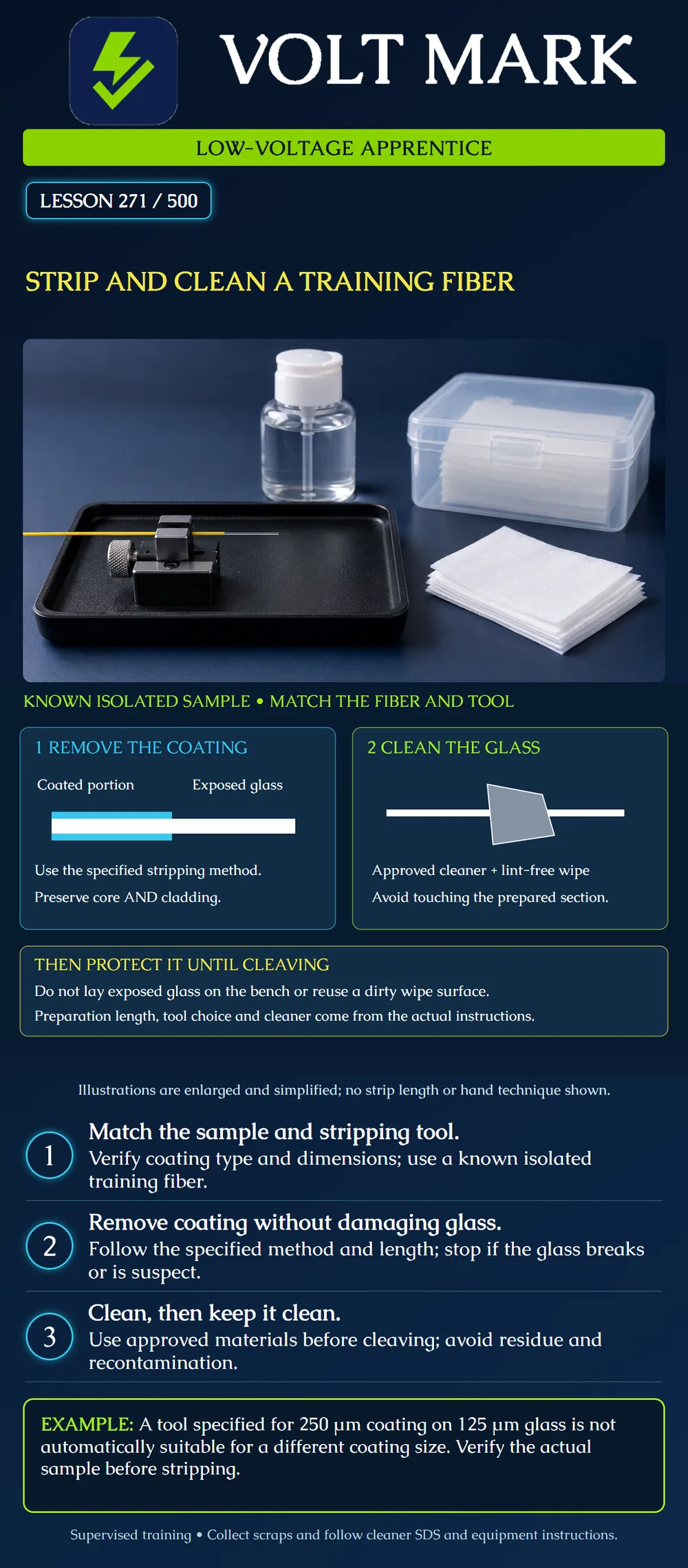
On a known isolated training sample, distinguish coating removal from cleaning and recognize the conditions needed before cleaving. Select instructions that match the actual fiber and tools. WHAT IS REMOVED? A polymer coating protects the glass fiber. The glass includes the optical core and surrounding cladding. Stripping the coating is not stripping away the cladding. The poster shows a coated portion beside exposed glass; it simplifies the layers and does not show the tiny core separately. Do not confuse this task with cable-jacket access or buffer-tube opening. Those tasks expose other layers and use their own tools and procedures. Start this exercise only after the instructor has identified and prepared the correct sample.
Record the fiber's glass diameter, coating diameter and coating type. Confirm the intended stripper and holder compatibility. Different coatings and specialty fibers may require different methods; a familiar tool is not proof of suitability.
Jonard's published JIC-375 specification, for example, identifies a function for removing 250 micrometer coating to expose 125 micrometer glass. That is a product capability, not a universal statement about all optical fibers. It does not authorize adjusting a factory-set tool or using it on an unlisted coating.
Use the clean work area and scrap controls from lessons 269 and 270. Wear the required eye protection and other task-specific PPE. Confirm the training sample is disconnected from optical sources. Keep food and drink outside the work area.
Have the applicable fiber, stripping-tool, holder and cleaver instructions available. Obtain the required preparation length from the actual method. Do not substitute a dimension recalled from a different machine. This lesson supplies no universal stripping length.
Use the selected tool's prescribed opening, holding position and motion. Follow its condition and cleaning checks. If the method requires a particular thermal process, temperature or holder, use the approved instructions for that combination; do not improvise with heat.
Maintain control of the sample and removed material. Stop if the glass breaks, the tool binds unexpectedly or the result is suspect. Do not scrape exposed glass with an improvised blade to remove stubborn residue. The instructor should resolve the cause and decide whether to prepare a fresh section under the approved method.
This poster describes the task sequence, not a complete hand-technique demonstration. Practical competence requires supervised use of the actual tool.
Fujikura's manufacturer guidance describes cleaning stripped fiber with appropriate alcohol and lint-free material before cleaving to remove coating residue. Use the exact cleaner, grade and materials approved for the equipment and fiber in the exercise. Follow the safety data sheet, ventilation requirements and precautions around ignition sources.
Use a clean wiping surface as directed. A wipe that has collected residue is not a clean surface for the next pass or sample. Do not use an unidentified liquid, household tissue or an unrelated cleaner merely because it is nearby. Allow the required drying or evaporation according to the procedure.
Avoid touching exposed glass or resting it on the workbench. Transfer it to the next approved preparation step while maintaining the required support and cleanliness. If it contacts a dirty surface, stop and follow the specified re-preparation method rather than assuming the next machine will correct the contamination.
Cleaning before cleaving does not mean wiping a freshly cleaved end face afterward. Cleaved-end preparation and inspection are covered in lesson 272 and must follow the equipment procedure. Do not add an extra wiping step after cleaving by analogy with this lesson.
Sample A is documented as 250 µm coating on 125 µm glass. Sample B has 200 µm coating on 125 µm glass. The available tool documentation lists only Sample A's combination. Sample A passes that compatibility check, subject to the rest of the procedure; Sample B remains HOLD until a suitable method is verified. The same glass diameter does not make the coatings interchangeable.
In another scenario, the coating is removed successfully but the prepared glass touches the bench. The correct response is to stop and use the approved re-preparation process. Do not continue just because the contact was brief.
In a third scenario, the trainee calls the exposed glass “the bare core.” Correct the terminology: the core is still surrounded by cladding. The removed material is the coating.
Sample identification / verified isolated status: Glass and coating dimensions / coating type: Stripper and holder identification: Applicable instructions / revision: Required preparation length: Approved cleaning material / SDS: Observed stripping result: Contamination or breakage: Instructor disposition / readiness for cleaving:
Mistake: Selecting a stripper for a 200 micrometer coating because it worked on 250 micrometer coating over the same glass diameter. Correction: Check the actual coating size and type against the tool documentation and hold the sample until that combination has an approved method.
Mistake: Reusing the residue-covered part of a wipe to avoid wasting cleaning material. Correction: Use a clean wiping surface as the preparation instructions require and replace contaminated material before it contacts another prepared sample.
Mistake: Adding a wipe after cleaving because cleaning helped in the previous preparation step. Correction: Keep pre-cleave cleaning separate from end preparation; protect the cleaved end and follow the actual process if contamination requires re-preparation.
Jonard Tools, Fiber Optic Stripper, Three Hole: https://jonard.com/fiber-optic-tools-fiber-optic-stripping?v=233 Manufacturer documentation identifies the 250 µm coating/125 µm glass capability. No unlisted sample compatibility is claimed.
Fujikura Europe, How to Clean Your Fusion Splicer: https://www.europe.fujikura.com/insights/how-to-clean-your-fusion-splicer/ Its stripped-fiber cleaning guidance supports residue removal before cleaving. Model-specific maintenance/disassembly instructions are not generalized.
Texas journeyman, 15 questions, scored by topic against the 70% mark. No card, and no account needed to start.
Free study material for low-voltage apprentices. This is a national foundation course: requirements differ by state and by local jurisdiction, and a practice that is common in one place is not a rule everywhere. Nothing here is a licence, a certification, or authority to work unsupervised, and completing it does not count as apprenticeship hours or continuing-education credit. Check the codes adopted where you are working, the licensing authority for that work, and your employer's safety programme. VoltMark is not affiliated with, endorsed by, or sponsored by NFPA, OSHA, NICET, BICSI, FOA, or any state or local licensing authority.
Electrician licensing exam prep: practice questions, timed exam simulations, and step-by-step help finding every answer in the NEC.