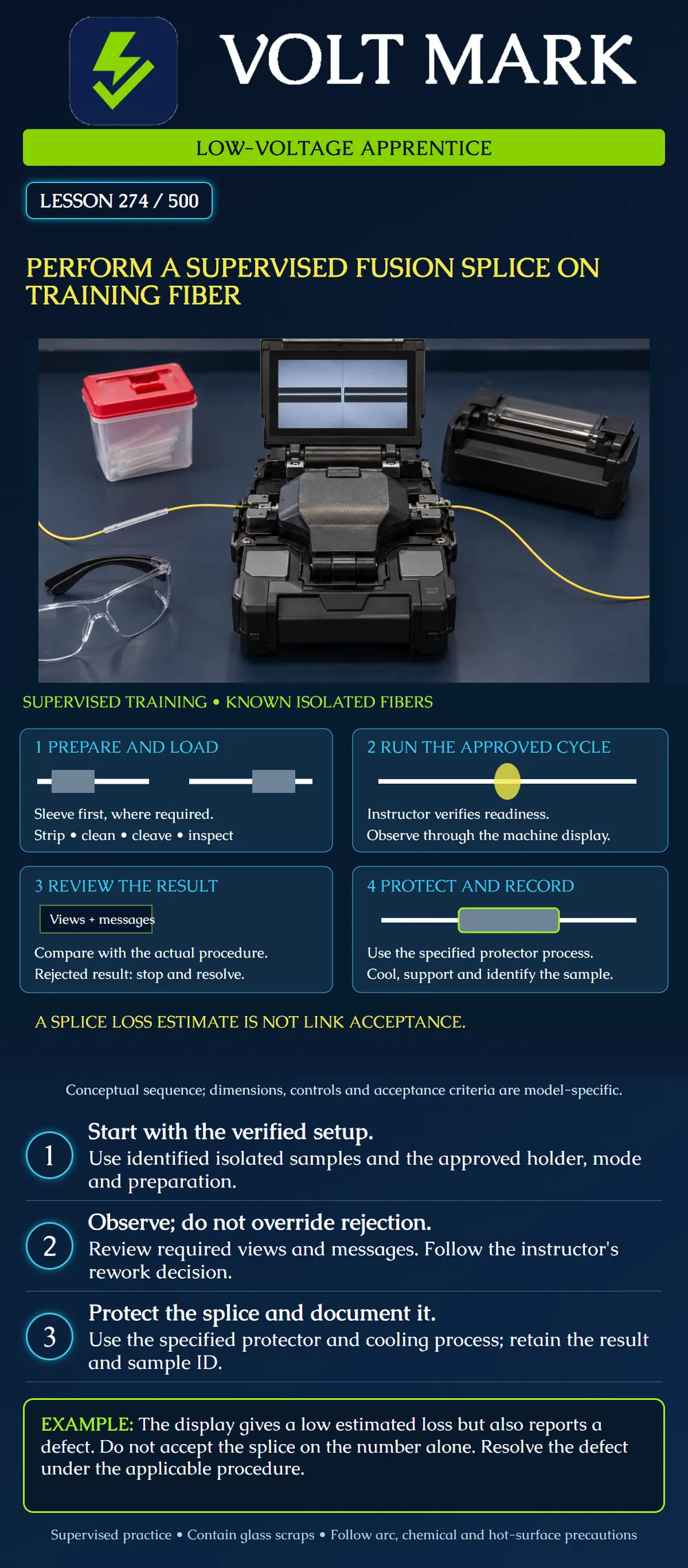
Complete a supervised practice splice using known isolated training samples, review the result against the applicable procedure, and protect and document the sample. This lesson provides the learning sequence; the instructor demonstrates the actual equipment controls and handling.
Carry forward the verified setup from lesson 273. Confirm the two sample IDs, fiber types, compatible holders, preparation dimensions, splice program and required equipment checks. Resolve every open setup item before the instructor authorizes the cycle.
Use the correct protection system for the exercise. Where a heat-shrink sleeve must be placed on one fiber before joining, install it at the prescribed stage and park it clear of preparation. Confirm its fit and the applicable heater program. A forgotten sleeve is a process error, not a reason to invent a substitute protector.
Keep the work surface clean and stable. Use the required eye protection, controlled scrap collection and safe chemical handling. Confirm the training fibers are isolated from optical sources. Keep flammable atmospheres and uncontrolled solvent exposure away from the arc process. Follow the splicer instructions for covers, moving parts, electrodes and hot surfaces.
Use the stripping, cleaning and cleaving methods from the actual tool instructions. Protect each prepared end from contact and contamination. Confirm the required end condition before loading.
Seat the approved holders or clamp arrangement as specified. Do not force a holder into place, pull the glass to adjust its position or touch the prepared end to a surface. If loading damages or contaminates the sample, stop and follow the re-preparation method.
The diagram simplifies the fiber paths and supports. It does not specify an end gap, exposed length, blade position or hand placement. Those details must come from the model-specific procedure and instructor demonstration.
Have the instructor verify readiness. Use the selected program and the machine's required start sequence. Observe the process through its display and permitted viewing arrangement. Keep hands out of the working area during operation.
A fusion splicer aligns the prepared ends and joins them using its controlled process. The operator still has responsibility for compatible materials, sound preparation and correct setup. Automation does not make an unidentified fiber or poor preparation acceptable.
If a warning or abnormal operation occurs, use the prescribed stop or reset procedure and ask the instructor to resolve it. Do not experiment with arc settings or bypass a rejection to keep the exercise moving.
Review the required machine views, messages and result record against the actual acceptance instructions. Use both required views where the equipment and procedure call for them. Do not classify every visible line as the same defect or treat a favorable number as proof that the joint is acceptable.
AFL's 90S+ guide identifies several possible contributors to a high estimated loss, including preparation, end-face condition, contamination, mode and equipment settings. Its troubleshooting is model-specific. Use the applicable manual to choose the corrective action; do not copy maintenance or re-arc instructions across machines.
Record the estimated loss explicitly as an estimate. It is not a substitute for the project's required optical tests. Lesson 275 develops that distinction.
After the instructor accepts the process result, follow the approved removal and protection sequence. Avoid stressing the unprotected joint. Position and process the specified protector according to its instructions and the equipment requirements.
Allow the required cooling before handling or storing the protected splice. Support it in the appropriate training tray or holder. Do not squeeze a protector into an incompatible slot or leave unsupported fiber where movement can damage it. No universal heater temperature, heating time, cooling time or tray dimension is given here.
Keep the sample identity tied to the result. Record the machine, program, preparation details, observations and any rework. A rejected attempt belongs in the training record even if a later attempt succeeds.
Case A: A low estimated-loss number appears with a defect warning. Hold the sample for the instructor's review. The number does not cancel the warning.
Case B: The trainee realizes the required sleeve was not installed before joining. Stop and ask for the approved rework decision. Do not improvise a covering and label it equivalent.
Case C: The protected joint is still hot. Follow the required cooling process rather than rushing it into storage.
Case D: The result record belongs to a different sample ID. Resolve the traceability error before calling the exercise complete.
Case E: The joint looks satisfactory and has been protected, but no optical acceptance testing has been performed. Record the completed training operation and the remaining testing requirement accurately.
Left and right sample IDs: Splicer / holder / cleaver / program: Readiness verified by: Preparation and loading observations: Required views / messages / estimated loss: Disposition / rework and reason: Protector / heater instructions / cooling: Storage position / sample label: Required next test or exercise: Instructor assessment:
A fictional training attempt displays a favorable estimated loss together with an unresolved defect warning. The trainee starts to label the sample complete because the number looks acceptable. The instructor holds the result, records the estimate as an estimate and records the warning with the sample IDs. The applicable troubleshooting process leads to an authorized re-preparation and another attempt. Both attempts remain in the training record. After the instructor accepts the process result, the specified protector is installed and cooled as required, and the sample is stored in its designated support. The record states that the supervised splice operation is complete but required optical testing remains outstanding. The second attempt does not erase the first or convert a machine estimate into a test result.
Mistake: Letting a favorable estimated-loss number override a defect warning. Correction: Hold the sample, record both the estimate and warning, and obtain the instructor's disposition under the applicable procedure before protection or release.
Mistake: Discovering a required preinstalled sleeve was omitted and substituting an improvised covering. Correction: Stop and obtain the approved rework decision; use the specified protection system rather than declaring a substitute equivalent.
Mistake: Saving only the successful attempt after reworking the same training pair. Correction: Retain each attempt, its sample IDs, warning or observation, and reason for rework so the final result remains traceable.
FOA, Fusion Splicing: https://www.thefoa.org/tech/ref/termination/fusion.html Educational reference for broad process, model-specific instruction requirement and distinction between machine estimate and testing. No historical equipment prices, universal preparation lengths or generic re-arc count adopted.
FOA, Virtual Hands-On Fusion Splicing: https://www.thefoa.org/tech/ref/termination/VHO-fuspl/VHO-Splice-fusion.pdf Educational reference describing a particular older training machine, used for supervised-lab precautions and protector-before-splicing planning; no pages, screenshots, controls or model performance claims reproduced.
AFL, 90S+ Splicer Error Code and Troubleshooting Quick Guide, AN-3035 Rev0: https://learn.aflglobal.com/_pfcdn/assets/preprocessed/11221/dbdf55c9-3246-42c1-9b9b-97f0610bab9b/dbdf55c9-3246-42c1-9b9b-97f0610bab9b.92e046c3-a933-447f-8e98-f44d65042f19 Manufacturer reference supporting model-specific error investigation; no universal arc or maintenance settings supplied.
Texas journeyman, 15 questions, scored by topic against the 70% mark. No card, and no account needed to start.
Free study material for low-voltage apprentices. This is a national foundation course: requirements differ by state and by local jurisdiction, and a practice that is common in one place is not a rule everywhere. Nothing here is a licence, a certification, or authority to work unsupervised, and completing it does not count as apprenticeship hours or continuing-education credit. Check the codes adopted where you are working, the licensing authority for that work, and your employer's safety programme. VoltMark is not affiliated with, endorsed by, or sponsored by NFPA, OSHA, NICET, BICSI, FOA, or any state or local licensing authority.
Electrician licensing exam prep: practice questions, timed exam simulations, and step-by-step help finding every answer in the NEC.