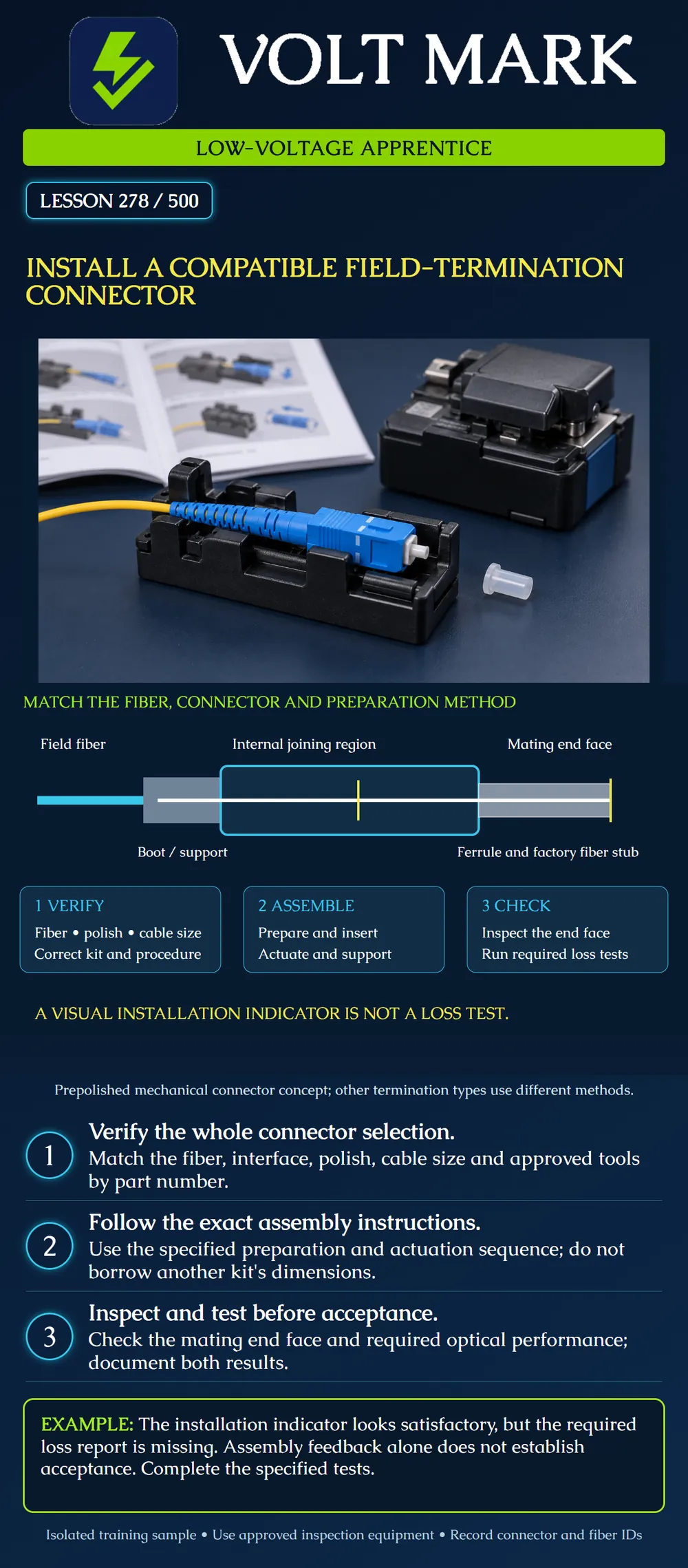
Plan and complete a supervised training termination using a connector compatible with the identified fiber and application. Distinguish assembly feedback, end-face inspection and optical test evidence. WHICH TERMINATION METHOD? Field-installable connectors are not all assembled the same way. This lesson's illustration represents a prepolished mechanical connector with an internal fiber stub. Other products use a fusion-spliced stub or an adhesive-and-polish process. Select the method required by the actual connector before touching the sample. In the conceptual cutaway, field fiber enters through the rear support and meets the factory fiber within the body. The external mating end face is at the ferrule tip. The internal joint and external mating surface are different locations. A clean external end face does not prove correct internal fiber insertion. The image is not a product-specific assembly drawing. Its dimensions, colors and shape do not identify a purchasable part.
Record the connector part number, fiber type, interface, end-face polish, supported cable or buffer size, and the required kit. Confirm that the receiving interface and connector are intended to mate. Do not select solely by housing color or by whether the connector seems to fit.
The appropriate boot, tubing, support and assembly tool may depend on the cable construction. A loose fiber, buffered fiber and jacketed cable do not automatically follow the same preparation branch. Review the relevant instruction section and template before work.
AFL's FASTConnect instructions INS-01056 provide separate preparation and assembly paths for different fiber/cable sizes and identify required accessories. They also flag a template as not to scale. Use its stated dimensions or the intended physical gauge; do not measure a resized poster or browser screenshot.
Confirm the sample is isolated from optical sources. Prepare a clean, stable area with required eye protection and controlled glass-scrap collection. Use approved cleaning materials and follow their safety information.
Read the complete assembly sequence first. Identify parts that must go onto the sample before preparation. Mark and prepare the sample using the exact connector instructions, suitable stripping tools and precision cleaver. Protect the prepared end from contamination and damage.
Do not transfer the mechanical-splice dimension from lesson 277 to this connector. Similar-looking glass preparation can have different reference points and required lengths.
Use the prescribed insertion and actuation method. Keep required supports, indicators and reference marks visible. If the expected indication is absent, stop and consult the instructions with the instructor. Extra force, improvised gel or an unrelated tool is not an acceptable substitute.
Follow the product's re-termination restrictions. AFL's instructions and FAQ distinguish a recoverable insertion problem from fiber broken inside the body, which requires replacement for that product. Do not generalize a permitted retry count to a different connector or instruction revision.
Inspect the external mating end face using the approved inspection equipment and procedure. Do not use direct eye viewing. Clean and reinspect when required; lesson 279 develops that process in detail.
Perform the optical tests and apply the limits defined for the exercise or project. AFL explains that its visual installation aid is a secondary check and does not replace loss testing. An apparently favorable indicator is not a substitute for measured evidence.
Keep connector and fiber IDs linked to the results. Protect the accepted connector from contamination and provide the specified support and bend control. If an assembly changes during corrective work, retain the required final-condition evidence.
Fiber ID / type / cable construction: Connector part number / interface / polish: Boot and support parts: Tools / cleaver / instruction revision: Preparation branch and reference dimensions: Assembly observations / abnormal indications: End-face inspection and cleaning record: Required optical test / limit / report ID: Corrective action and final result: Instructor review / storage location:
A fictional training connector has the correct interface and polish, its installation indicator looks favorable, and its external end face passes the approved inspection. The required loss report is missing. The reviewer records those observations but leaves optical acceptance incomplete: neither the indicator nor the clean mating surface measures the internal joint's performance. The trainee completes the specified optical test with the instructor. If the result is unacceptable, the test setup and product troubleshooting are checked rather than assuming a clean end face rules out an assembly problem. Any corrective work follows the applicable re-termination or replacement rules, and the final connector ID remains linked to its inspection and test records.
Mistake: Measuring a resized instruction screenshot to set the preparation length. Correction: Use the stated dimensions and their reference points or the intended approved gauge; do not derive dimensions from screen or print scale.
Mistake: Treating a clean external mating end face as proof of correct internal fiber insertion. Correction: Keep end-face inspection separate from assembly feedback and complete the required loss test to evaluate optical performance.
Mistake: Applying a permitted retry allowance to a connector with a suspected internal fiber break. Correction: Stop and check the exact product's replacement rule with the instructor; do not treat every failed installation as a recoverable insertion problem.
AFL, FASTConnect Connector Termination and Assembly Instructions, INS-01056, March 15, 2024: https://afl-delivery.stylelabs.cloud/api/public/content/FASTConnect-SC-LC-ST-instructions?v=d8f27f39 Manufacturer instructions covering variant-dependent preparation, accessories, template scaling and re-termination conditions. No operational dimensions or universal retry count copied into the poster.
AFL, FASTConnect Specific FAQ: https://www.aflglobal.com/en/resources/product-related-materials/frequently-asked-questions/fiber-inside-plant/faq-fast-connect-specific Manufacturer reference for visual-aid limitations and product-specific replacement/rework distinctions. Its cleave-length discussion includes differing range wording, so this lesson does not resolve that ambiguity by inventing an interval. Confirm instructions applicable to the actual kit.
Texas journeyman, 15 questions, scored by topic against the 70% mark. No card, and no account needed to start.
Free study material for low-voltage apprentices. This is a national foundation course: requirements differ by state and by local jurisdiction, and a practice that is common in one place is not a rule everywhere. Nothing here is a licence, a certification, or authority to work unsupervised, and completing it does not count as apprenticeship hours or continuing-education credit. Check the codes adopted where you are working, the licensing authority for that work, and your employer's safety programme. VoltMark is not affiliated with, endorsed by, or sponsored by NFPA, OSHA, NICET, BICSI, FOA, or any state or local licensing authority.
Electrician licensing exam prep: practice questions, timed exam simulations, and step-by-step help finding every answer in the NEC.