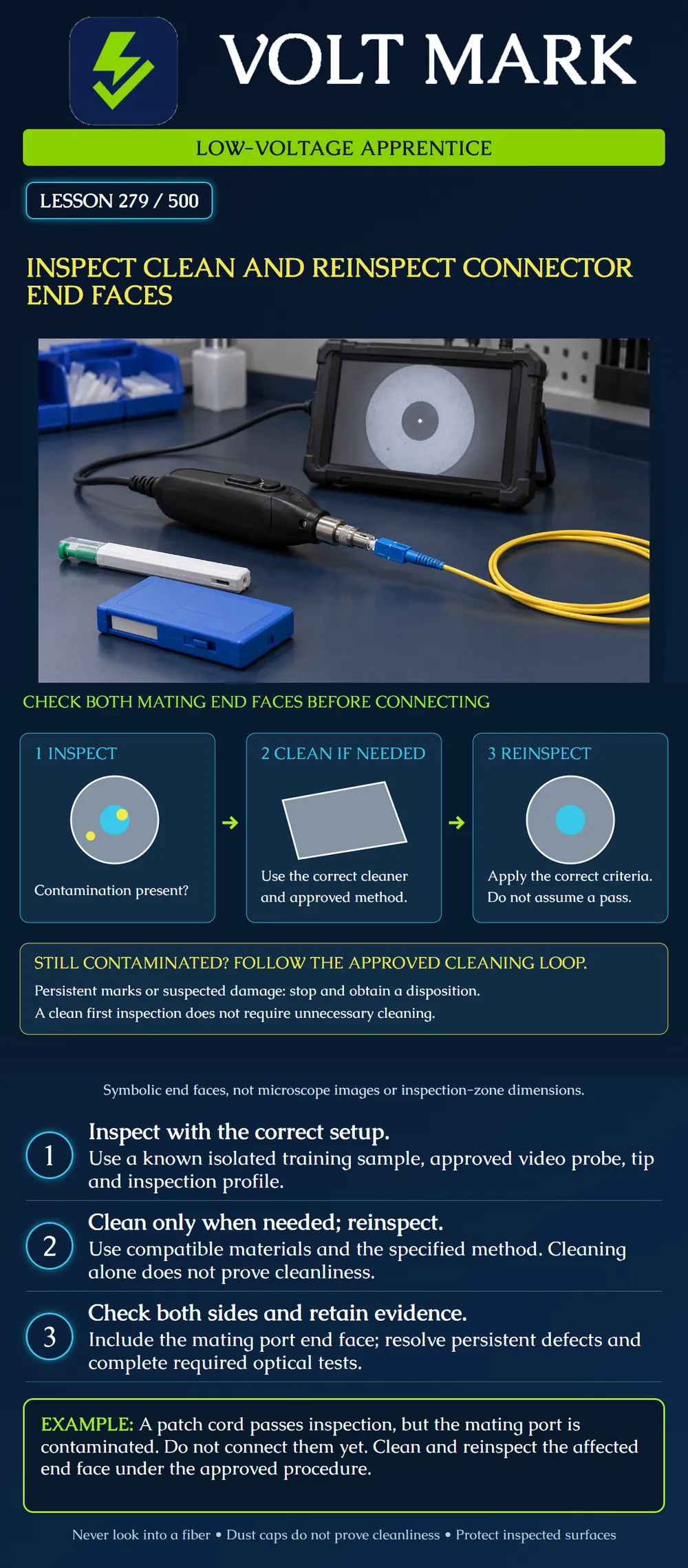
Use an approved inspection setup to decide whether a connector needs cleaning, verify the result afterward, and check both mating end faces before connection.
Use known isolated training samples. Confirm the optical-source status using the applicable procedure; an unplugged local connector alone does not establish the status of its remote end. Never look directly into a fiber. Use the approved video inspection arrangement and stay within its specifications.
Select the correct probe tip and inspection profile for the connector and polish. Check that the instrument provides a usable, focused view of the required area. A blurred or incorrectly centered image is not evidence of cleanliness.
A connector within an adapter may require a different tip from an exposed patch-cord ferrule. Do not force an unsuitable tip into a port. Multifiber connectors require equipment and coverage appropriate to their array; inspecting one fiber does not inspect the entire connector.
Identify the sample and mating location. Inspect each end face that will be joined, including the one accessible through the mating port. Keep the image tied to the correct connector ID.
Fluke Networks recommends inspection before connection, cleaning when necessary and reinspection afterward. Its guidance explains that a dirty mate can contaminate a clean one, and that a protective cap does not guarantee a clean surface. These principles apply to factory-terminated as well as field-terminated ends.
Use the inspection criteria required by the project and connector application. Do not invent a universal allowed particle count or substitute a poster drawing for the applicable criteria.
Use the connector and cleaning-tool instructions to select the method and consumables. Match the cleaner to the ferrule or port and to any multifiber geometry. Keep the cleaning surface fresh and avoid transferring residue from a used area.
Follow the approved dry or wet-to-dry procedure as applicable; this lesson does not specify a universal solvent or number of strokes. Do not substitute clothing, breath, an unidentified liquid or extra force.
Reinspect after the cleaning operation. A cleaner click, a completed wipe or a newly removed dust cap is an action, not an inspection result. Check for remaining contamination and possible damage.
If contamination remains, follow the approved repeat-cleaning or escalation process. If a mark persists or damage is suspected, stop and obtain the required technical disposition. Do not keep scrubbing in the hope of removing a scratch.
Inspection criteria and optical performance requirements are related but distinct. Do not claim that every visible mark automatically requires disposal, or that an optical reading automatically overrides a required inspection result. Apply the actual acceptance plan and authorized review process.
Once the surfaces are ready, avoid touching or exposing them unnecessarily before mating. If they are exposed again, follow the required inspection process before reconnecting. Complete the required optical tests separately.
Connector ID / mating location: Connector type / polish / fiber configuration: Source isolation or approved safety verification: Probe / adapter tip / inspection profile: Initial image and result: Cleaning method and consumable: Reinspection image and result: Persistent marks / disposition: Mating surface on the other side checked: Required optical report / reviewer:
In a fictional training connection, the patch-cord end passes the required inspection but its mating-port image shows contamination. The trainee proposes connecting because the cord is new. The instructor holds mating: the other surface can contaminate the clean one. The affected surface is cleaned using its compatible method, then reinspected with the correct tip and profile. If the camera cannot provide a usable image, cleanliness remains unverified even though cleaning occurred. Only acceptable current inspection of both mating surfaces permits connection under the procedure. Required optical testing remains a separate step.
Mistake: Inspecting the patch cord but assuming the end inside the adapter is clean because it stayed connected. Correction: Inspect both mating end faces with the appropriate tips and resolve contamination before joining them.
Mistake: Recording PASS after the cleaner clicks when the inspection image is unavailable. Correction: Record cleaning as an action and leave the inspection result unresolved until a usable reinspection confirms the applicable criteria.
Mistake: Applying more pressure to a persistent mark to make it disappear. Correction: Stop at the approved escalation point and obtain a technical disposition for possible damage instead of improvising force or solvent.
Fluke Networks, Standard-Compliant Certification & Best Practices: https://www.flukenetworks.com/edocs/white-paper-standard-compliant-certification-amp-best-practices Manufacturer guidance for conditional cleaning, reinspection, cross-contamination and cap limitations. No numerical standard limits reproduced; applicable edition/profile must be selected for the actual work.
Fluke Networks, Cleaning and Inspecting MPO/MTP Connectors: https://www.flukenetworks.com/knowledge-base/multifiber-pro/cleaning-and-inspecting-mpompt-connectors Manufacturer reference supporting the need for connector-specific inspection and cleaning equipment. No connector-specific hand technique generalized.
Texas journeyman, 15 questions, scored by topic against the 70% mark. No card, and no account needed to start.
Free study material for low-voltage apprentices. This is a national foundation course: requirements differ by state and by local jurisdiction, and a practice that is common in one place is not a rule everywhere. Nothing here is a licence, a certification, or authority to work unsupervised, and completing it does not count as apprenticeship hours or continuing-education credit. Check the codes adopted where you are working, the licensing authority for that work, and your employer's safety programme. VoltMark is not affiliated with, endorsed by, or sponsored by NFPA, OSHA, NICET, BICSI, FOA, or any state or local licensing authority.

Electrician licensing exam prep: practice questions, timed exam simulations, and step-by-step help finding every answer in the NEC.