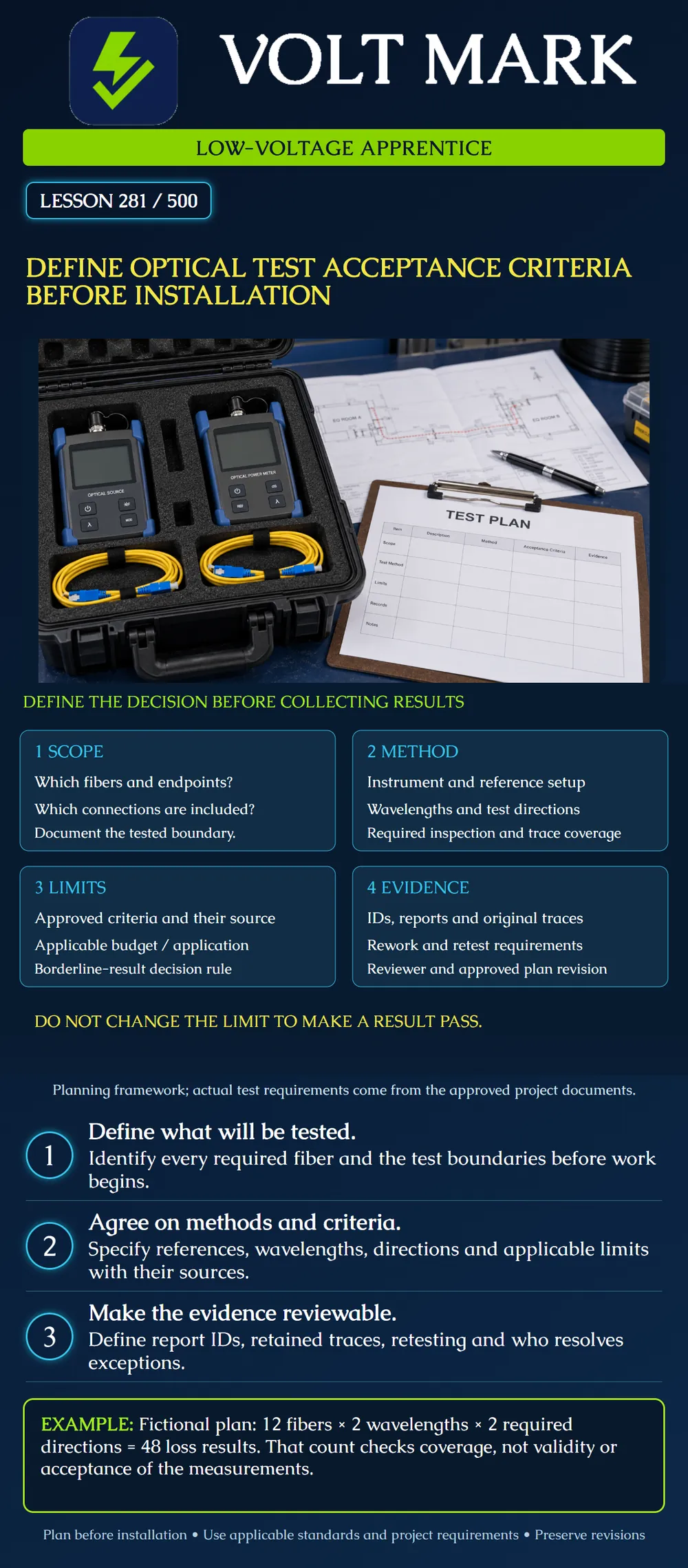
Prepare an optical acceptance-plan worksheet before installation begins. Define the tested scope, valid methods, applicable limits and evidence needed for an authorized decision. WHY PLAN FIRST? A number is meaningful only when its scope and method are known. Two crews can report different losses because they tested different boundaries or used different reference arrangements. Resolve those choices before testing rather than after a disputed result. FOA's testing guidance calls for understanding the cable layout, preparing fiber records, choosing appropriate equipment and calculating expected loss before field testing. Its deliverables guidance also emphasizes review of understandable test evidence. The apprentice's role is to document the agreed plan and raise gaps, not invent acceptance limits.
Identify the cable, each required fiber and both endpoints. State whether the test concerns a component, a cable segment or the completed path. List which connections and intermediate devices are included. Distinguish required working and spare fibers; do not silently omit spares if the plan includes them.
Record the intended fiber type and application. Requirements for one campus backbone are not automatically suitable for another network or an industrial link. Long distance alone does not identify the right instrument setup or acceptance threshold.
List the required inspections, continuity or polarity checks, insertion-loss measurements and any OTDR or other tests. Give the applicable procedure and edition where required. Identify the reference method, compatible reference cords and instrument configuration.
Specify wavelengths and directions separately for each test. A direction requirement for one method must not silently be assumed for another. Define how matching OTDR events will be evaluated where that evidence is required.
Include the required instrument condition, reference verification and data-retention arrangements. These are part of measurement validity. A selected PASS limit on the instrument does not prove that its setup matches the project.
Record the source and revision of each criterion. Distinguish a component allowance used in a calculated cable-plant budget from a finished-link application limit, an individual event criterion or a reflectance requirement. These may address different questions.
Do not adopt a manufacturer's typical value as a universal pass/fail threshold. Do not treat a splicer estimate as an optical acceptance measurement. The next lesson develops loss-budget arithmetic using declared component allowances.
Ask the responsible reviewer to resolve conflicting requirements before work begins. Also define how uncertainty, rounded values and borderline results will be handled. An apprentice should not add an unofficial tolerance after seeing a failure.
List the required report fields, naming convention and original data files. Identify who reviews the evidence and how missing, invalid or failed results are handled. Define the retest scope after corrective work and preserve the reason for a changed plan revision.
An approved change can revise a requirement through the project's process. Quietly increasing a threshold solely to turn a failing result green is not that process.
A fictional training plan requires insertion-loss results for 12 individually identified fibers, at two specified wavelengths, in both specified directions.
Required result entries = 12 × 2 × 2 = 48. These are measurement entries, not necessarily 48 separate files or instrument runs; an instrument may package several entries into one report.
If the package contains only 44 unique required combinations, four entries are missing. If it contains 48 entries but four are duplicates replacing other combinations, coverage is still incomplete. A total count alone cannot establish correct fiber identity or setup.
The two-direction and two-wavelength requirements are premises of this exercise, not a nationwide rule for all optical tests.
Project / plan revision / responsible reviewer: Cable and fiber inventory: Endpoints and tested boundaries: Fiber type / intended application: Required test methods and references: Wavelengths and directions by method: Instrument and reference verification: Applicable limits / source / revision: Borderline-result decision rule: Required report fields and original files: Rework / retest process: Open questions and approval status:
Mistake: Accepting 48 entries as complete coverage without checking which combinations they represent. Correction: Reconcile each entry to the required fiber, wavelength and direction; identify duplicates and obtain any missing combinations before recording coverage complete.
Mistake: Using the instrument's default PASS profile because it produces a clear result. Correction: Compare the profile, reference method and tested boundaries with the approved plan and resolve mismatches before testing.
Mistake: Adding an informal rounding allowance after a result narrowly exceeds its limit. Correction: Apply the agreed decision rule and refer unresolved criteria to the responsible reviewer; record approved revisions rather than quietly changing the threshold.
FOA, Fiber Optic Testing: https://www.thefoa.org/tech/ref/basic/test.html Educational reference for advance planning, suitable equipment, fiber inventory and loss-budget context. Older direct-viewing suggestions and generic numerical loss allowances are not adopted.
FOA, Fiber Optic Installation Deliverables: https://www.thefoa.org/tech/ref/install/deliverables.html Educational reference for understandable documentation and qualified evidence review; numerical recommendations are not universal acceptance limits.
Texas journeyman, 15 questions, scored by topic against the 70% mark. No card, and no account needed to start.
Free study material for low-voltage apprentices. This is a national foundation course: requirements differ by state and by local jurisdiction, and a practice that is common in one place is not a rule everywhere. Nothing here is a licence, a certification, or authority to work unsupervised, and completing it does not count as apprenticeship hours or continuing-education credit. Check the codes adopted where you are working, the licensing authority for that work, and your employer's safety programme. VoltMark is not affiliated with, endorsed by, or sponsored by NFPA, OSHA, NICET, BICSI, FOA, or any state or local licensing authority.

Electrician licensing exam prep: practice questions, timed exam simulations, and step-by-step help finding every answer in the NEC.