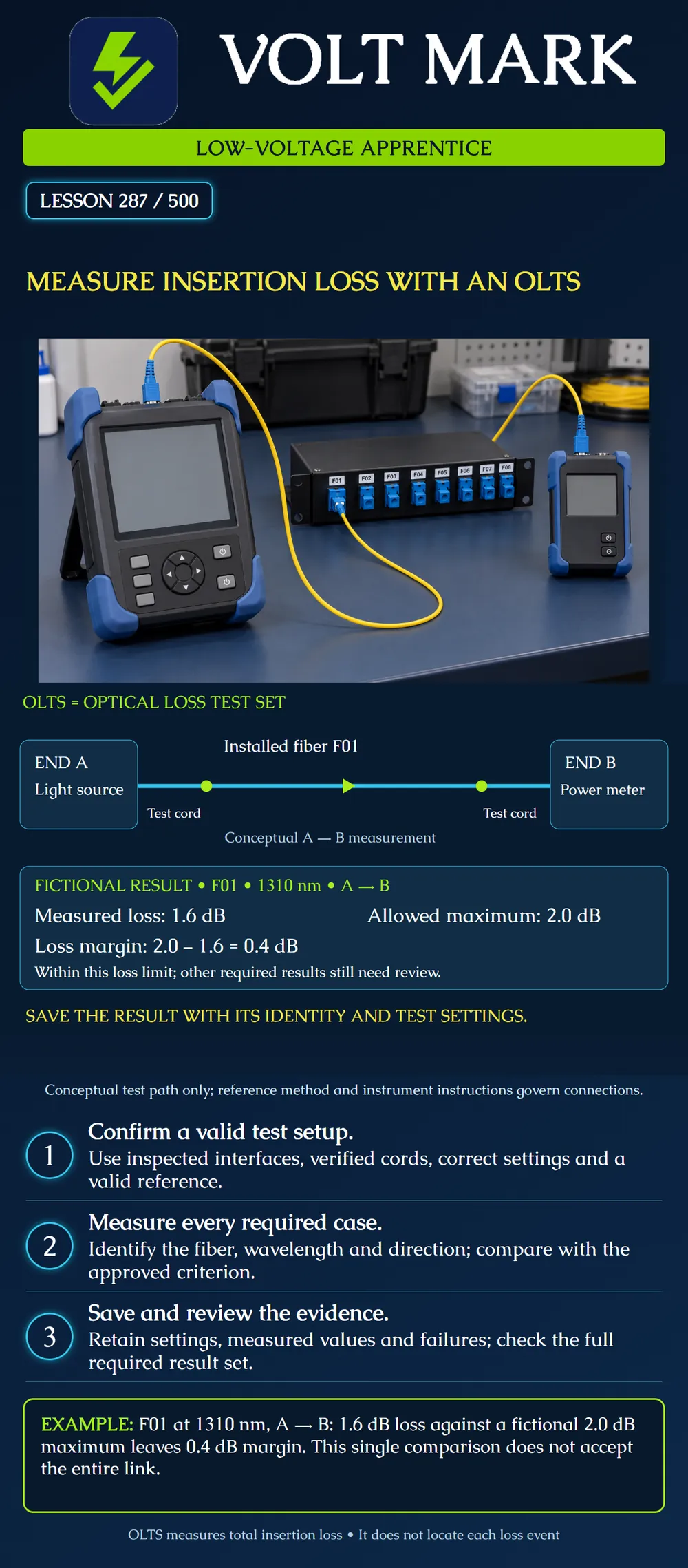
Describe a supervised optical loss test, associate a result with the correct fiber and settings, calculate loss margin, and distinguish one acceptable comparison from a complete acceptance package.
An optical loss test set, or OLTS, uses a source and a power meter to determine insertion loss relative to a valid reference. A source sends light through the test path and a meter measures the power at the far end. The reported loss describes the defined path as a whole. It does not identify which individual splice, bend or connector contributed a particular amount.
Begin with the approved test plan and current instructions for the actual instrument. Confirm the installed fiber identity, endpoints, required wavelengths and directions, reference method, launch conditions and written test criteria. Select the correct configuration. A limit suitable for a different application is not made suitable by producing a green result.
Complete the reference and cord checks from lessons 285 and 286. Inspect interfaces with appropriate equipment, clean contamination as required and reinspect. Connect the isolated training link as specified without disturbing connections that preserve the reference. Follow the instrument's sequence, including any required changes for reverse-direction measurements. This overview does not supply a universal port-by-port connection procedure.
Run the required measurement and review the actual values and settings. An OLTS may offer automatic wavelength switching, duplex testing, length measurement or other functions, but available features depend on the model and configuration. Confirm what was actually measured. A displayed overall result is meaningful only for the selected limits and completed tests.
Insertion loss is expressed in dB. Preserve the instrument's result and sign convention. Loss margin, when expressed as a simple positive-loss comparison, is maximum permitted loss minus measured loss. Apply the project's decision rules and any instrument uncertainty indications; do not manually relabel a marginal result contrary to those rules.
An original training record might read: Project: Campus Training Link: A-TR1 to B-TR1 Fiber: F01 Wavelength: 1310 nm Direction: A to B Method/configuration: approved training procedure TP-01, revision 2 Loss: 1.6 dB Maximum: 2.0 dB Margin: 0.4 dB Disposition: within the stated loss limit; full test set still under review
Attach or link the actual reference and verification evidence, instrument identity, test time and operator record. Save the native result where available and retain the required report format. A handwritten “pass” without traceable settings and measurements is weaker evidence than the complete record.
Use isolated training fibers under the site's optical-safety procedure. Do not connect a test source to an active service or look into an optical interface. Have the supervisor confirm the setup and written criteria. Practice naming and saving results before measuring a larger group of fibers.
What does OLTS stand for? Optical loss test set. Does total insertion loss locate each individual event? No. It measures the defined path as a whole; event location requires suitable diagnostic evidence. What is the poster margin? 0.4 dB, calculated as the fictional 2.0 dB maximum minus 1.6 dB measured loss. Does one acceptable loss comparison prove every application requirement? No. Other required wavelengths, directions and application criteria still need evidence. How many combinations are required in case 3? Sixteen. What happens to an original failed result after a successful retest? Retain it with the correction and retest history.
In the fictional four-fiber assignment, the plan requires two wavelengths and two directions per fiber. The reviewer calculates 4 × 2 × 2 = 16 required combinations. The package has 16 entries, but one repeats F01 at 1310 nm from A to B while F04 at the second required wavelength from B to A is absent. There are only 15 unique required combinations. The reviewer leaves coverage incomplete and requests the missing measurement using the valid prescribed setup. F01's 1.6 dB reading has 0.4 dB margin against its fictional 2.0 dB limit, but that acceptable comparison cannot supply the missing F04 evidence. The corrected package must be reconciled by identity and configuration, not merely recounted.
Mistake: Naming a bad splice from a high OLTS total alone. Correction: Preserve the result, verify the accessories, reference and setup, then use the approved diagnostic process to locate the cause; total loss does not allocate loss to individual events.
Mistake: Treating a duplicate saved result as the missing wavelength/direction combination. Correction: Reconcile each fiber, wavelength and direction against the plan and obtain the actual missing measurement.
Mistake: Replacing an original failed result with a passing retest without recording the correction. Correction: Retain both results and link the authorized corrective action and final configuration to the same verified fiber identity.
Fluke Networks, OLTS & OTDR: A Complete Testing Strategy: https://www.flukenetworks.com/edocs/olts-otdr-complete-testing-strategy Used for source/meter operation, total insertion loss and the distinction from event characterization. Unrelated reflectance/return-loss wording is not used.
Fluke Networks, Certifying duplex LC to LC multimode links – CertiFiber Pro: https://www.flukenetworks.com/knowledge-base/certifiber-pro/certifying-duplex-lc-lc-multimode-links-certifiber-pro Used for written test limits, configuration, cord verification and manufacturer-specific workflow. Historical revisions, suggested verification intervals and numeric cord limits are not adopted as universal requirements. The poster's 1310 nm single-direction schematic is conceptual, not a reproduction of that multimode product procedure.
Texas journeyman, 15 questions, scored by topic against the 70% mark. No card, and no account needed to start.
Free study material for low-voltage apprentices. This is a national foundation course: requirements differ by state and by local jurisdiction, and a practice that is common in one place is not a rule everywhere. Nothing here is a licence, a certification, or authority to work unsupervised, and completing it does not count as apprenticeship hours or continuing-education credit. Check the codes adopted where you are working, the licensing authority for that work, and your employer's safety programme. VoltMark is not affiliated with, endorsed by, or sponsored by NFPA, OSHA, NICET, BICSI, FOA, or any state or local licensing authority.

Electrician licensing exam prep: practice questions, timed exam simulations, and step-by-step help finding every answer in the NEC.