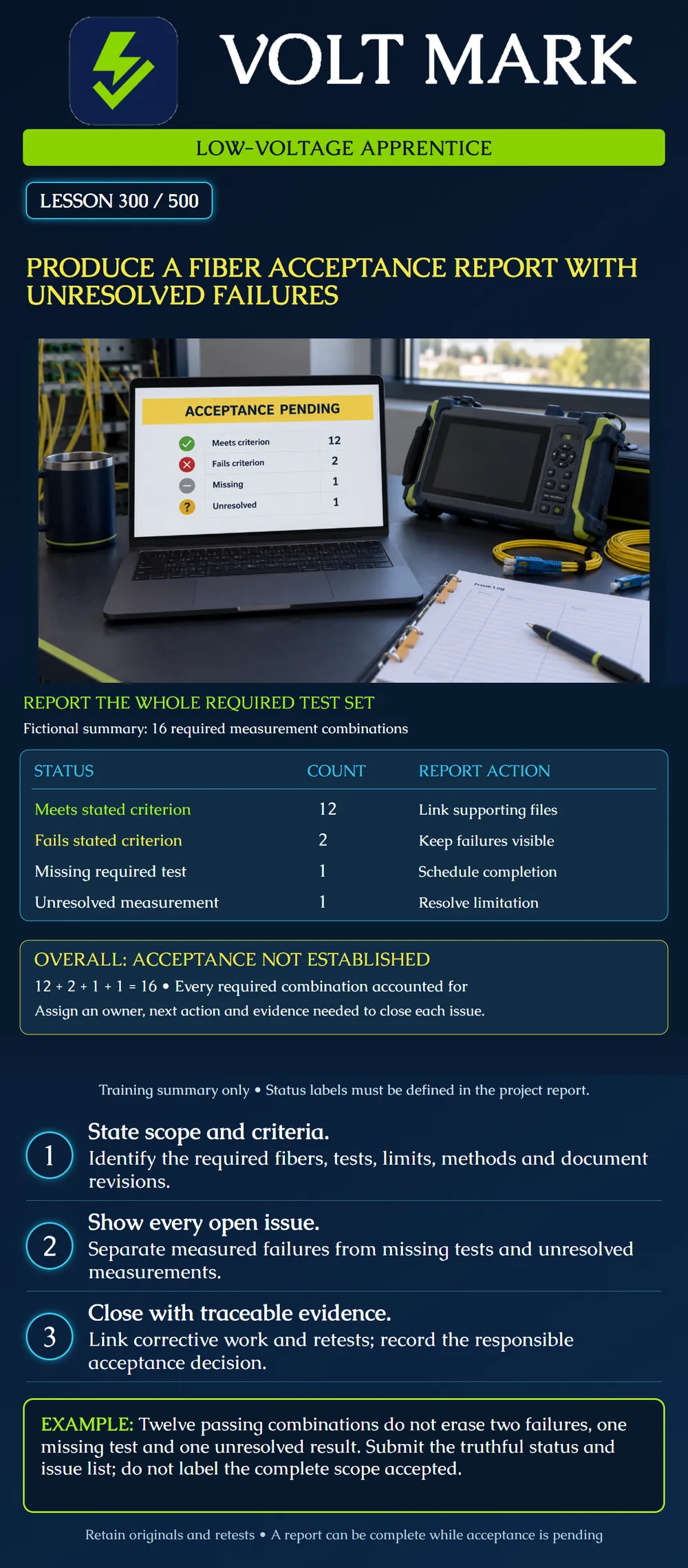
Prepare an understandable fiber acceptance report that states the tested scope, applicable criteria, evidence and unresolved issues without presenting incomplete work as accepted.
A report supports a decision; producing the report does not itself establish acceptance. FOA's installation-deliverables guidance calls for understandable documentation and test data reviewed by a knowledgeable person before sign-off. It connects performance requirements to the project scope and includes route and component information in the delivered records. [1] Use the actual approved requirements rather than substituting a generic number or a convenient tester preset.
Identify the project, cable, fiber IDs, endpoints and report revision. List the required measurements, wavelengths and directions. State the reference method, test boundary, relevant instrument information and applicable limits or specification revision. Link the loss budget where applicable, and distinguish an estimated design budget from a formally adopted acceptance criterion. Include required inspection, polarity, insertion-loss and OTDR evidence according to the actual scope. Do not assume that an attractive OTDR trace replaces another required test.
For this teaching exercise:
Fluke's backscatter-warning example shows that an OTDR can be unable to calculate loss even where a different test method produces a result. [2] An unavailable measurement is not proof of zero loss. A pass from another method does not automatically complete the missing evidence required by a project. The source's historical statements about standards and reflectance are not current universal rules.
The training plan requires 16 measurement combinations. After checking the evidence, 12 meet their stated criteria, two fail, one is missing and one is unresolved. The categories are mutually exclusive in this example: 12 + 2 + 1 + 1 = 16. All combinations are accounted for, but acceptance is not established. The report should show the four open items with their affected fiber, wavelength, direction, requirement and evidence. These are combinations, not necessarily sixteen fibers or sixteen files. One fiber may have several required records.
Issue LV-01 concerns a fictional F03 insertion-loss result at 1550 nm from A to B. The valid measurement is 2.30 dB and the stated exercise limit is 2.00 dB, so the excess is 0.30 dB. Record the method, original filename, criterion source and observed failure. Assign an owner to investigate and complete the approved follow-up. These numbers illustrate documentation only; they are not a national limit. Issue LV-02 concerns a required reverse-direction trace that is absent. Its status is missing, not a measured failure and not a pass. Issue LV-03 concerns an event whose loss cannot be resolved. Keep the warning and the limitation visible until suitable evidence supports a conclusion.
A technician filters out unsuccessful tests and submits only green rows. The resulting file is easy to read but no longer describes the full required scope. A reader could wrongly infer that every fiber and test was accepted. The proper correction is to restore the complete coverage summary and issue list, retain the successful evidence, and explicitly state the remaining work. A clear report should make the open items easier to act on, not harder to discover.
Link each retest to the original issue, noting the authorized work or setup correction and the new evidence. Keep dates, identifiers and relevant settings. If analysis settings or limits change, record the reason and governing approval rather than silently making failures disappear. A corrected setup may invalidate an earlier measurement; explain that disposition and its basis. Do not claim a physical repair occurred when only the report was reanalyzed.
For each open item, name a responsible role, next action and required closure evidence. Include target dates when supplied by the project team; do not invent commitments for other people. The final disposition belongs to the authorized project reviewer. If the project permits a documented exception or limited acceptance, preserve the actual decision, scope, conditions and approver; do not fabricate one. Remaining issues must stay visible. This report-writing lesson provides no authority to waive requirements or activate service.
Given a fictional package, reconcile the required combination list with the result index. Open supporting native files. Confirm identifiers, methods, limits and warnings. Check arithmetic, link each failure to an issue, and verify that the overall conclusion matches the evidence. Ensure the recipient can identify precisely what remains to be done without reading every raw trace first.
[1] Fiber Optic Association, Fiber Optic Cable Plant — Acceptance Of The Finished Product — Deliverables. Accessed 2026-10-01. Used for scope, documentation and knowledgeable review. Suggested numeric limits, broad uncertainty allowances and directional-loss discussion were not adopted. https://www.thefoa.org/tech/ref/install/deliverables.html [2] Fluke Networks, WARNING: Cannot measure backscatter (OptiFiber), April 4, 2014. Accessed 2026-10-01. Used only for unavailable measurement versus another test result; historical standards claims excluded. https://www.flukenetworks.com/knowledge-base/optifiber/warning-cannot-measure-backscatter-optifiber
Texas journeyman, 15 questions, scored by topic against the 70% mark. No card, and no account needed to start.
Free study material for low-voltage apprentices. This is a national foundation course: requirements differ by state and by local jurisdiction, and a practice that is common in one place is not a rule everywhere. Nothing here is a licence, a certification, or authority to work unsupervised, and completing it does not count as apprenticeship hours or continuing-education credit. Check the codes adopted where you are working, the licensing authority for that work, and your employer's safety programme. VoltMark is not affiliated with, endorsed by, or sponsored by NFPA, OSHA, NICET, BICSI, FOA, or any state or local licensing authority.

Electrician licensing exam prep: practice questions, timed exam simulations, and step-by-step help finding every answer in the NEC.