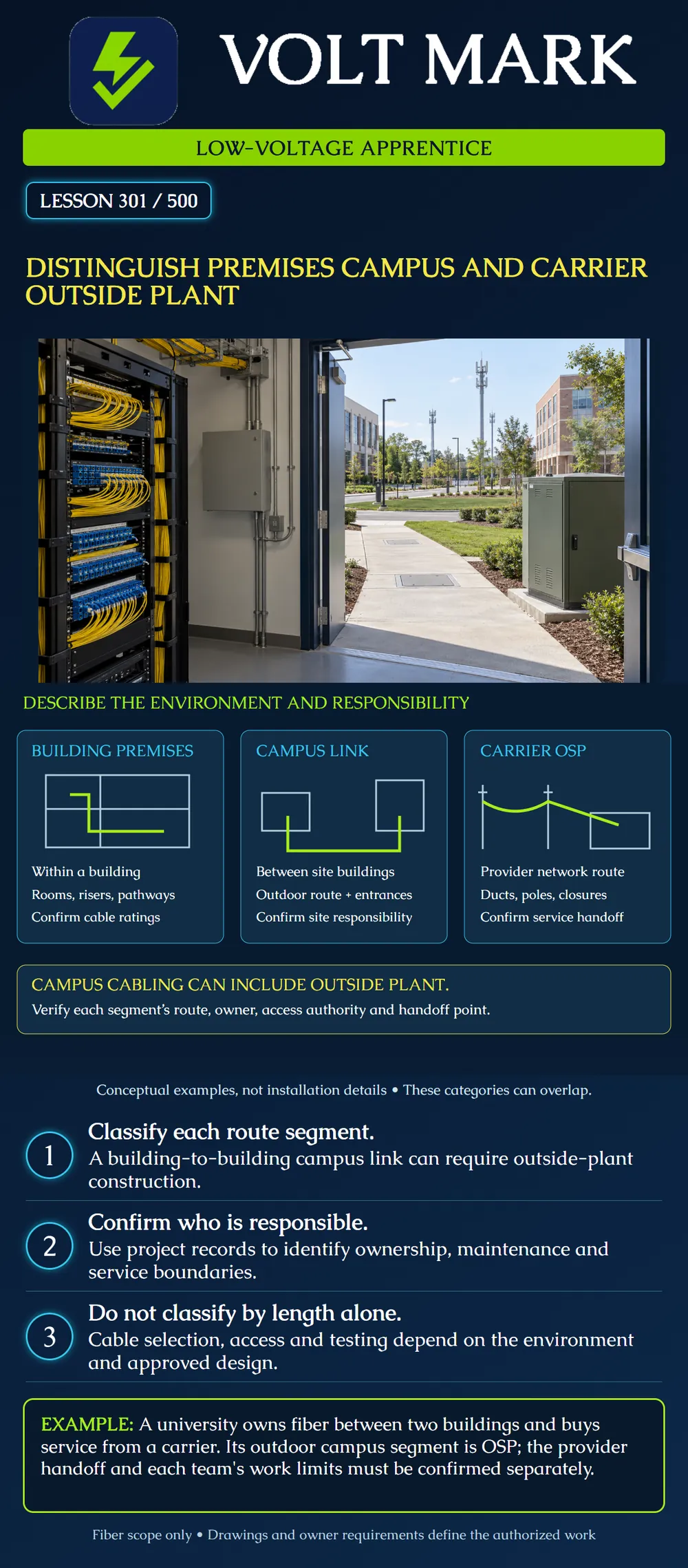
Describe building, campus and carrier fiber segments without confusing physical environment, network purpose and responsibility.
Where is this segment installed, and who is responsible for it? “Premises,” “campus” and “carrier outside plant” are useful descriptions, but they do not form three mutually exclusive boxes. A campus network can connect indoor equipment rooms through outdoor ducts. A carrier can deliver service into a building. Describe the segment and confirm the work boundary instead of assigning the entire route one label.
FOA's 2025 installation guidance describes outside-plant routes in underground ducts, direct burial, aerial installations and underwater crossings. It also describes premises systems within buildings or campuses and the need to address outdoor-to-indoor entrances. Cable and hardware selection depend on the route environment. [1] These descriptions establish context; they are not permission to choose cable solely by a poster illustration.
The first panel shows fiber routed within a building between equipment locations. Typical planning questions concern pathways, support, spaces, cable ratings, identification and the systems served. A route may pass through floors or connect multiple rooms. Indoor does not automatically mean multimode, a particular connector, or an absence of splices. Use the actual system design and product requirements. This lesson remains about fiber and does not authorize electrical power work.
The middle panel shows fiber leaving one building, following an outdoor route and entering another. A campus may be a university, hospital, industrial site, airport or other multi-building facility. Its network can include both building premises segments and outside plant. An indoor/outdoor transition deserves its own review; do not assume an outdoor cable may continue indefinitely through a building. Confirm the specified entrance arrangement and applicable requirements with the responsible design and site team.
The third panel shows an illustrative provider route on poles leading to a cabinet. Carrier networks can also use underground routes and other construction. The diagram does not imply every carrier link is aerial or that a cabinet always marks the customer boundary. Outside plant is also used by utilities, municipalities and private organizations, not only carriers. FOA's installation overview describes this variety of users and environments. [2]
A cable can be owned by one organization, installed in another organization's duct and maintained under a service agreement. A carrier-provided connection on a campus does not make every campus cable carrier property. Likewise, owning the premises does not establish authority to change provider equipment. Verify the service handoff, often called the demarcation point, in the actual service and project records. Its physical location, responsibilities and permitted actions should not be guessed from a building wall or patch panel.
A university owns the fiber connecting Building A and Building B. The path uses an outdoor duct and enters equipment rooms at both ends. Describe it as a campus network with an outside-plant segment and premises segments. A separate carrier service terminates at a documented handoff. The university's ownership of its inter-building fiber does not define the carrier's handoff location. Identify both on the project drawing.
A plant connects a control room to a remote process building. The fiber path includes indoor trays, an outdoor route and a harsh equipment area. “Industrial” describes the application and environment; it does not supply all installation requirements. Record the actual exposures, route conditions, selected products and responsible review. Do not assume glass fiber eliminates every hazard from metallic cable elements, equipment or the surrounding site.
One private campus link is much longer than a nearby carrier drop. The longer link does not become carrier-owned because of its length, and the short drop does not become customer-owned because it is short. Distance matters for optical design and testing, but it is not a universal ownership or environment boundary. The same lesson applies whether a route spans nearby buildings or many miles.
For each segment, record:
A fictional hospital owns fiber running from an indoor equipment room through an outdoor duct to a second building. The duct belongs to a separate site organization. A provider service also reaches the first building, but the handoff record is absent. Using the route-segment worksheet, identify the environments, ownership facts and unresolved responsibilities. State what must be confirmed before work is assigned. Expected reasoning: identify two premises segments and an outside-plant segment within the hospital campus network. Record hospital cable ownership separately from duct ownership. Maintenance responsibility, access authority and the provider handoff remain unconfirmed unless supporting records supply them. Request those records through the responsible project lead; do not infer permission from property ownership or the building wall.
[1] Fiber Optic Association, Standard For Installing Fiber Optic Cable Plants, Version 1.0, October 2025. Sections 5, 6 and 7.2 used for environments, cable selection and entrances. Accessed 2026-10-01. https://www.thefoa.org/tech/ref/1pstandards/FOA%20Installation%20Standard%202025%20V1.pdf [2] Fiber Optic Association, Fiber Optic Installation. Used only for the range of OSP users and premises contexts; older distance, technology, cost and generic bend-radius statements were not adopted. Accessed 2026-10-01. https://www.thefoa.org/tech/ref/basic/install.html
Texas journeyman, 15 questions, scored by topic against the 70% mark. No card, and no account needed to start.
Free study material for low-voltage apprentices. This is a national foundation course: requirements differ by state and by local jurisdiction, and a practice that is common in one place is not a rule everywhere. Nothing here is a licence, a certification, or authority to work unsupervised, and completing it does not count as apprenticeship hours or continuing-education credit. Check the codes adopted where you are working, the licensing authority for that work, and your employer's safety programme. VoltMark is not affiliated with, endorsed by, or sponsored by NFPA, OSHA, NICET, BICSI, FOA, or any state or local licensing authority.

Electrician licensing exam prep: practice questions, timed exam simulations, and step-by-step help finding every answer in the NEC.