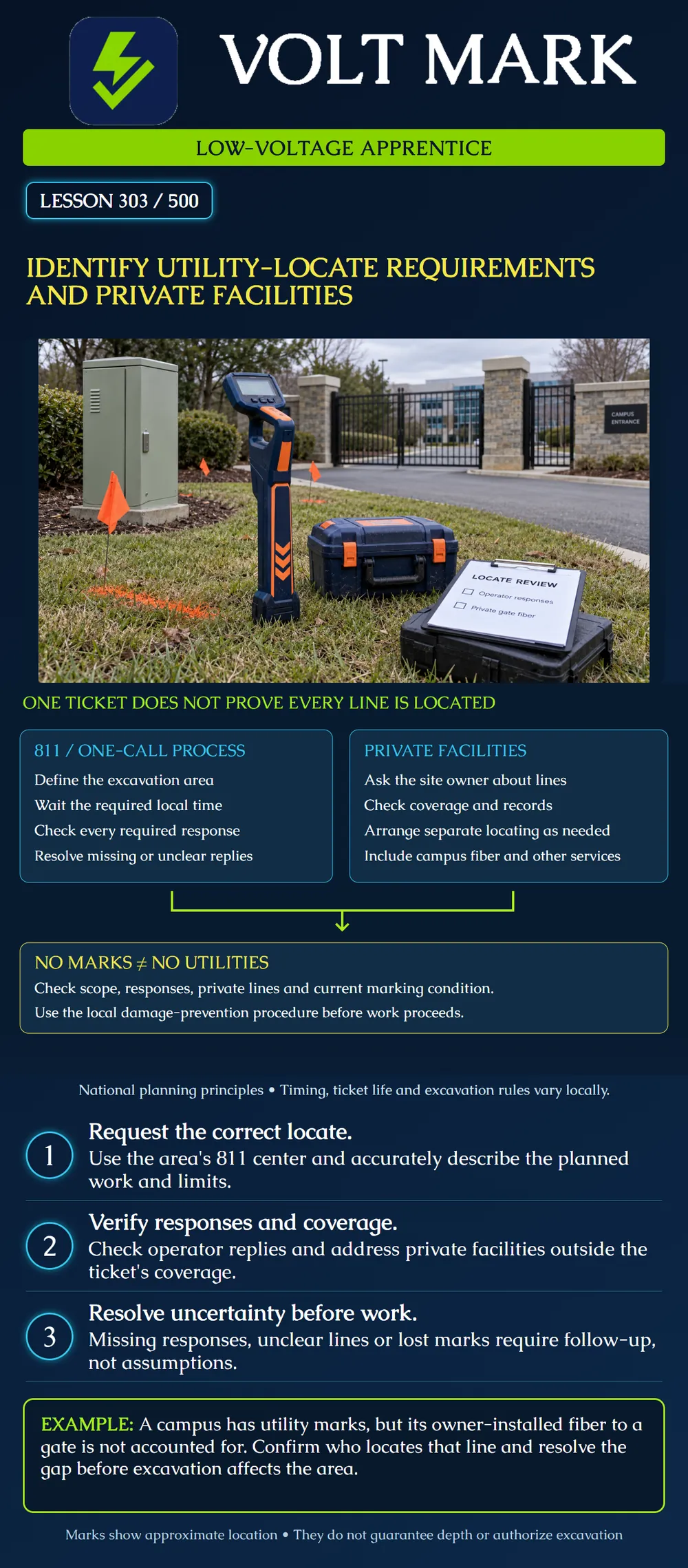
Recognize the difference between requesting utility locates, verifying responses and accounting for private facilities before excavation associated with a low-voltage project.
811 is the national call-before-you-dig number. The Common Ground Alliance's national guidance directs users to the applicable center, the required waiting period and confirmation that utilities have responded. Marks indicate approximate locations, not a complete underground survey. State procedures vary. [1] Use the current instructions for the actual work location rather than carrying a waiting-period rule from another job or state.
The responsible excavator should use the applicable process and describe the work area, location and scope accurately. Keep the ticket and contact details available. Determine the required notice, earliest permitted start, response-checking process, ticket validity and renewal requirements locally. These details are intentionally not replaced here with a nationwide number of hours or days. A planning inquiry and an excavation request may serve different purposes; verify which request is needed.
Confirm the notified operators and review their responses using the area's prescribed method. “Marked,” “clear/no conflict,” “not complete” and “no response” do not mean the same thing. Interpret each code according to the actual system. A clear response applies to that operator's facilities and the stated work area, not every possible underground line. Do not treat elapsed time alone as proof that all required responses are complete.
An owner-installed campus fiber, irrigation line, gate service or building-to-building utility may be outside the locating coverage provided through the one-call request. Ask the owner and determine who is responsible for identifying and locating each facility. Do not assume the property line or a meter is the universal coverage boundary for every service.
For a specific example, JULIE's Illinois guidance says its member utilities do not locate private lines and directs the owner to have them located. It also requires checking responses rather than proceeding merely because the expected start time has arrived. [2] Texas811 likewise identifies private locating as an owner's responsibility with associated fees. [3] These examples support checking coverage; they are not substitutes for the rules of other centers.
A campus plans a trench near an entrance gate. Utility marks are present, but the owner remembers installing a fiber link to the gate several years earlier. The responsible team should reconcile that line with the locate scope and arrange appropriate locating where it is not covered. Do not assume it is absent because no communications mark appears. Old drawings help identify the question but do not prove the current line position.
A ticket lists several operators. Most responded, but one response is missing. The apprentice reports the gap and the responsible excavator follows the local no-response procedure. The team does not convert silence into a no-conflict response. The absence of paint is ambiguous: the operator may have no facility in the area, may not have completed the work or may require further information.
The crew proposes moving the trench beyond the described work limits. Existing responses and marks should not be assumed to cover the new area. Follow the applicable update or new-request procedure and resolve private-facility coverage there too. Similarly, damaged, moved or faded marks require the appropriate follow-up; do not recreate their positions from memory.
Paint and flags do not establish a guaranteed burial depth. Follow the applicable tolerance-zone, exposure and excavation practices under the responsible site's procedure. This lesson does not specify a universal clearance or digging method. A utility locate also does not replace land-access permission, construction permits or site work authorization.
For a training review, record:
A fictional ticket lists three operators: one marked its facilities, one gave a clear response, and one has not responded. The owner also reports a private gate fiber whose locating coverage is unconfirmed. The crew proposes extending the route outside the ticket area. Using the record checklist, identify the open items and their next actions. Do not submit a real ticket or select a digging method. Expected reasoning: preserve the distinct responses and refer the absent response for the local no-response procedure. The clear response concerns only that operator and the stated area. Confirm the gate fiber's coverage and locating responsibility with the owner and responsible team. Refer the route extension for the applicable request process and private-facility review. These unresolved items prevent this paper package from supporting a release to excavate; elapsed time and existing paint do not close them.
[1] Common Ground Alliance, Before You Dig, accessed 2026-10-01. https://811beforeyoudig.com/Before-You-Dig/ [2] JULIE, What To Expect After You Submit A Request, accessed 2026-10-01. Used as an Illinois service-area example, not nationwide timing guidance. https://www.illinois1call.com/after-the-request-homeowner/ [3] Texas811, FAQ, private-line locating section, accessed 2026-10-01. Used for private-facility responsibility, not universal timing or ticket validity. https://texas811.org/faq/
Texas journeyman, 15 questions, scored by topic against the 70% mark. No card, and no account needed to start.
Free study material for low-voltage apprentices. This is a national foundation course: requirements differ by state and by local jurisdiction, and a practice that is common in one place is not a rule everywhere. Nothing here is a licence, a certification, or authority to work unsupervised, and completing it does not count as apprenticeship hours or continuing-education credit. Check the codes adopted where you are working, the licensing authority for that work, and your employer's safety programme. VoltMark is not affiliated with, endorsed by, or sponsored by NFPA, OSHA, NICET, BICSI, FOA, or any state or local licensing authority.

Electrician licensing exam prep: practice questions, timed exam simulations, and step-by-step help finding every answer in the NEC.