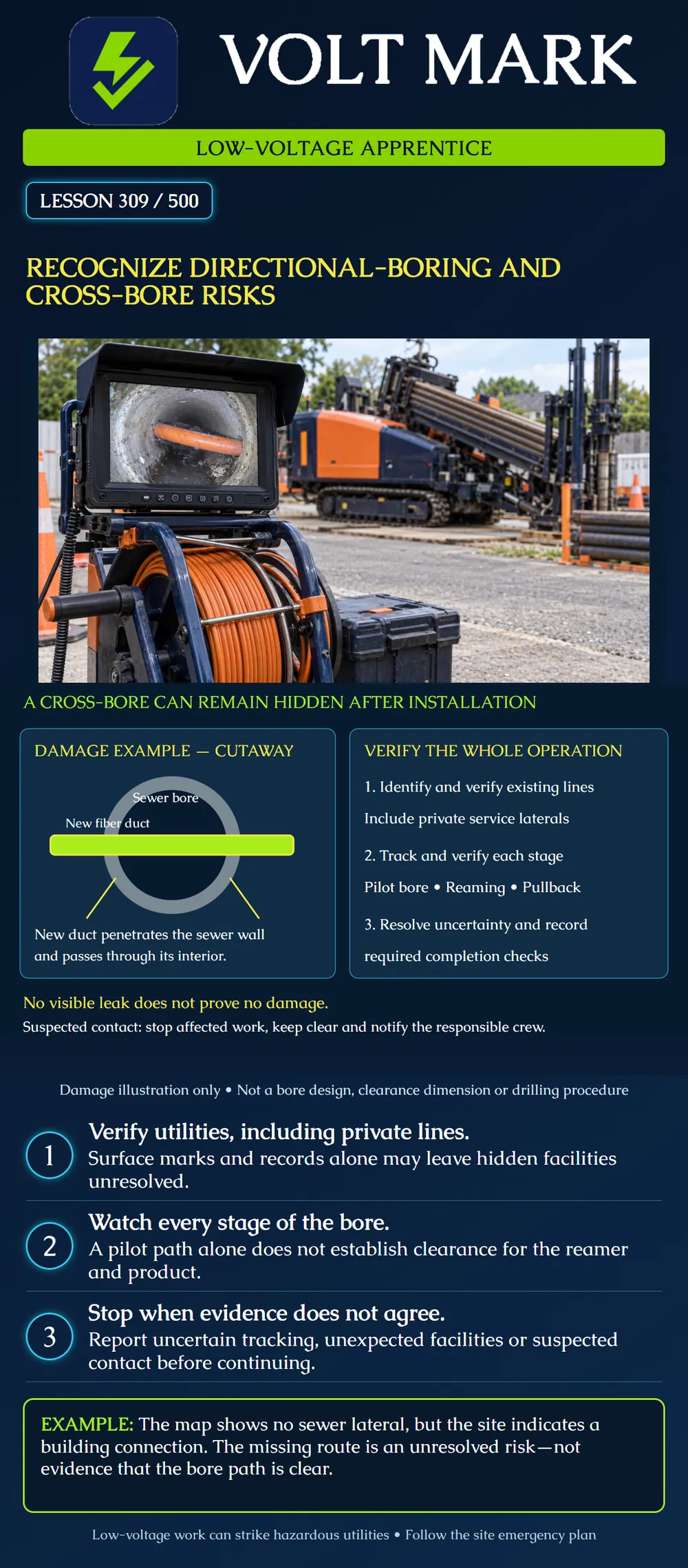
Recognize how a fiber installation can damage existing underground facilities during horizontal directional drilling, and identify uncertainty that must be resolved by the responsible crew. This is risk-recognition training, not operator or tracker qualification. WHAT IS A CROSS-BORE? A cross-bore involves an installed utility intersecting an existing underground utility or structure with damaging contact. Two lines crossing on a plan drawing do not, by themselves, establish a cross-bore; their vertical positions may differ. The concern is physical interference that compromises the existing or new installation. The poster's cutaway shows an invented fiber duct passing through an existing sewer's interior and walls. Lime identifies the new duct only within this illustration; it is not a field-marking color convention. The circle is the sewer's cutaway, not an inspection camera image. The illustration is intentionally a damage example, not an acceptable crossing arrangement.
PHMSA describes cross-bores that remain undiscovered until later work on a sewer encounters the intersecting facility. Its gas-line example can lead to gas release when clearing equipment damages the line. Fiber duct does not carry gas, but a fiber installation can still damage a sewer or strike a gas or electric utility. Do not confuse the service being installed with the hazards already present.
Private sewer laterals can be absent from utility records or outside a locate request's coverage. Investigate their status with the responsible owner and locating crew; do not assume one-call markings account for every private facility. A missing line on a drawing is an unanswered question.
The pilot bore establishes an initial path. Reaming enlarges the bore, and the product is pulled into place. OSHA's HDD guidance addresses verification during drilling and backreaming, not merely a successful pilot pass. The approved plan must address the actual tools and product, existing utilities and uncertainties. No universal separation value is supplied here.
Operators and trackers require training and communication appropriate to the equipment and site. Inconsistent readings, unverified utility identity or unexpected conditions require stopping affected work for investigation. Apprentices do not resolve uncertain clearance by telling the operator to “go deeper.”
Use the applicable utility-notification process and the project's safe verification methods, including required physical exposure and observation. Finding one buried line does not prove it is the line shown on a particular record. Keep utility identity, location and verification evidence connected.
Physical exposure is a task for the trained responsible crew using approved methods. It does not authorize entry into an unsafe excavation or contact with a utility. Trench and equipment hazards remain even when the project is called trenchless.
A campus drawing shows a clear corridor between a building and a road. The building has a sewer cleanout, but the drawing does not show where its lateral crosses the corridor. The planned route is for fiber duct.
Write the concern as an observation: “The connection route is not accounted for.” Identify the drawing revision, approximate area and source of the observation. Ask the supervisor to coordinate with the facility owner and responsible verification crew. Do not invent a depth or decide that the lateral must run somewhere else.
Now add another fact: the pilot has already reached the exit point. Does that close the concern? No. The existing facility remains unresolved, and the later bore stages have their own physical extent. The crew must address the discrepancy through the site-specific process before the affected work continues.
Ask what the permit, owner and approved plan require for verifying affected facilities after installation. Retain specified inspection results, route records and the resolution of exceptions. A photograph of the new cable reel or an optical test result cannot establish that a sewer was not penetrated. Optical performance and utility-damage verification answer different questions.
Some jurisdictions impose specific physical-verification and documentation requirements. Hudson, Ohio's published HDD standards are one example. Do not apply its particular intervals or procedures automatically to another city. Verify the requirements for the actual work location.
Stop the affected activity and notify the responsible crew. Keep clear of the suspected hazard; do not touch equipment or facilities that might be energized and do not attempt to repair or pull free a damaged utility. Follow the site emergency plan and utility response instructions. If there is an immediate threat, move to a safe location and contact emergency services. This lesson does not replace the equipment-specific response briefing.
A fictional HDD record shows a completed pilot and an exposed utility with no confirmed identity. An owner drawing shows a sewer lateral near the planned corridor. The crew's proposed closeout evidence is an optical test of the new fiber. List the unanswered questions and the correct handoff; do not choose a drilling depth or clearance. Expected reasoning: identify the exposed facility and account for the sewer lateral through the responsible owner and verification crew. Keep the affected work pending resolution under the site-specific process, including later bore stages. Request the required affected-facility inspection or verification evidence; the optical result cannot answer whether the sewer was penetrated. Record who is responsible, the supporting files and the unresolved disposition rather than inventing a safe crossing.
OSHA, Avoiding Underground Utilities during Horizontal Directional Drilling Operations, SHIB 03-13-2018: https://www.osha.gov/sites/default/files/publications/SHIB031318.pdf Used for HDD stages, utility identity/location verification, monitoring and site-specific emergency planning. The bulletin is guidance; no invented clearance or operating setting is provided.
PHMSA, Gas Distribution Integrity Management Program: Resources, cross-bores section: https://www.phmsa.dot.gov/pipeline/gas-distribution-integrity-management/gas-distribution-integrity-management-program-resources Used for the cross-bore concept, delayed discovery and sewer-lateral awareness. Gas examples are distinguished from the fiber duct shown.
City of Hudson, Ohio, Horizontal Directional Drilling Standards: https://www.hudson.oh.us/1538/Horizontal-Directional-Drilling-Standard Used as a local applicability example only; no Hudson spacing rule is generalized nationally.
Texas journeyman, 15 questions, scored by topic against the 70% mark. No card, and no account needed to start.
Free study material for low-voltage apprentices. This is a national foundation course: requirements differ by state and by local jurisdiction, and a practice that is common in one place is not a rule everywhere. Nothing here is a licence, a certification, or authority to work unsupervised, and completing it does not count as apprenticeship hours or continuing-education credit. Check the codes adopted where you are working, the licensing authority for that work, and your employer's safety programme. VoltMark is not affiliated with, endorsed by, or sponsored by NFPA, OSHA, NICET, BICSI, FOA, or any state or local licensing authority.

Electrician licensing exam prep: practice questions, timed exam simulations, and step-by-step help finding every answer in the NEC.