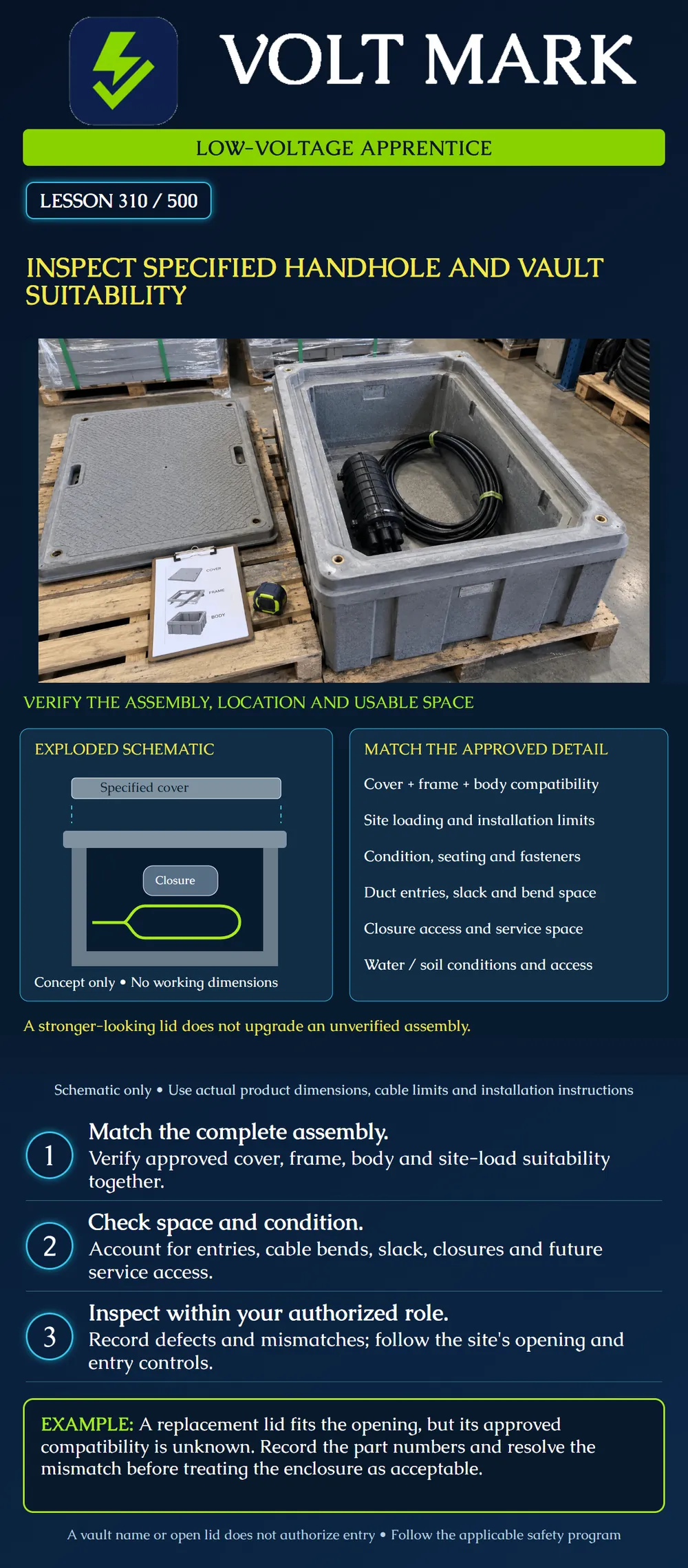
Compare a fiber handhole or vault with the approved project requirements, identify missing evidence or damage, and refer discrepancies to the responsible reviewer. Inspection here means authorized observations and document checks, not structural certification or permission to enter.
Identify the approved model and the cover, frame and body components. A lid that physically fits is not automatically an approved replacement. Check the manufacturer's compatible assembly information and the project submittal.
Load ratings must be interpreted in their actual application. Do not equate a tier designation with approval for every vehicle exposure, or convert a test-load figure into a vehicle-weight allowance. The product's intended service, supporting installation and authority's requirements matter. Some traffic-oriented assemblies require installation details different from ordinary tier-rated enclosures.
Use actual internal dimensions and the proposed hardware layout. Account for duct entrances, closures, cable slack and the cable's specified bend limits. Include access for maintenance and the arrangement needed to retrieve or service a closure. Do not assume the outside length and width describe unobstructed storage space.
Use the exact cable and closure instructions. A generic bend-radius multiplier in a brochure is not a substitute for the selected cable's specification. A loop that fits on a flat sketch may still interfere with other hardware or the installed cover.
Compare the approved location with current site conditions. An enclosure originally placed beside a walkway may now lie in a vehicle path after a site change. Report that change for review rather than assuming the original selection still applies.
Within the authorized inspection scope, record visible cracks, broken edges, displaced seating, missing fasteners, unreadable identification or other discrepancies. Check against the approved installation and acceptance criteria. Do not independently repair, drill, load-test or modify the enclosure.
Water, soil conditions and access affect the design and use of the installation. Confirm the specified arrangement and report conditions that differ from it. Do not assume a handhole is dry because its cover appears sealed, or improvise a drain. Water management is addressed in the next lesson.
The project calls for a particular body and matching cover assembly. A delivery has the expected body, but the cover bears a different part number. A coworker says it is stronger and therefore acceptable.
The proper record states what is known: body identity, cover identity, specification reference and the mismatch. Obtain manufacturer compatibility evidence and the project's substitution decision. A higher number on a different lid does not establish the rating or suitability of the entire installation.
In a second exercise, a closure and slack storage occupy the proposed enclosure, but the layout leaves no documented service access. Record the conflict and ask for the approved arrangement. Do not trim the specified slack or tighten cable bends to force the components into place.
Only perform opening, lifting and inspection tasks authorized by the site's safety program. Protect openings and follow the prescribed handling method for the actual cover. Do not lean or reach into a space as a workaround for entry controls.
For construction work within OSHA's confined-space scope, the employer must have a competent person identify confined and permit spaces. A product called a vault is not automatically classified by its name, and an open cover does not eliminate hazards. The employer's assessment and applicable entry program determine the controls. This lesson is not an entry permit.
Use a training worksheet with location; approved drawing revision; component part numbers; required service/load classification; installation-detail reference; internal layout; visible condition; access restrictions; discrepancy; and disposition. Attach authorized photographs or document excerpts as evidence. Leave unresolved items visibly unresolved.
Oldcastle, Questions Answered, ©2014: https://oldcastleinfrastructure.com/wp-content/uploads/2018/11/FAQ-Brochure.pdf Used for assembly/component rating and enclosure sizing considerations. Historical load tables, generic bend multipliers and broad environmental claims are not adopted as current universal requirements.
Hubbell, Installing Electrical Enclosures Adjacent to Roadways, July 2, 2021: https://blog.hubbell.com/en/hubbellpowersystems/installing-electrical-enclosures-adjacent-to-roadways Used to illustrate that traffic-related assemblies can require different installation details. Product availability, agency approvals and numeric surround dimensions are not generalized.
OSHA 29 CFR 1926.1203(a)–(d): https://www.osha.gov/laws-regs/regulations/standardnumber/1926/1926.1203 Used for construction confined-space identification and entry-program boundaries. The employer determines applicable standards and exclusions for the actual work.
Texas journeyman, 15 questions, scored by topic against the 70% mark. No card, and no account needed to start.
Free study material for low-voltage apprentices. This is a national foundation course: requirements differ by state and by local jurisdiction, and a practice that is common in one place is not a rule everywhere. Nothing here is a licence, a certification, or authority to work unsupervised, and completing it does not count as apprenticeship hours or continuing-education credit. Check the codes adopted where you are working, the licensing authority for that work, and your employer's safety programme. VoltMark is not affiliated with, endorsed by, or sponsored by NFPA, OSHA, NICET, BICSI, FOA, or any state or local licensing authority.

Electrician licensing exam prep: practice questions, timed exam simulations, and step-by-step help finding every answer in the NEC.