Identify separate water paths and sealing interfaces in a fiber installation, and document how the approved design addresses them. This is a planning and verification lesson, not a drainage design or seal-installation procedure.
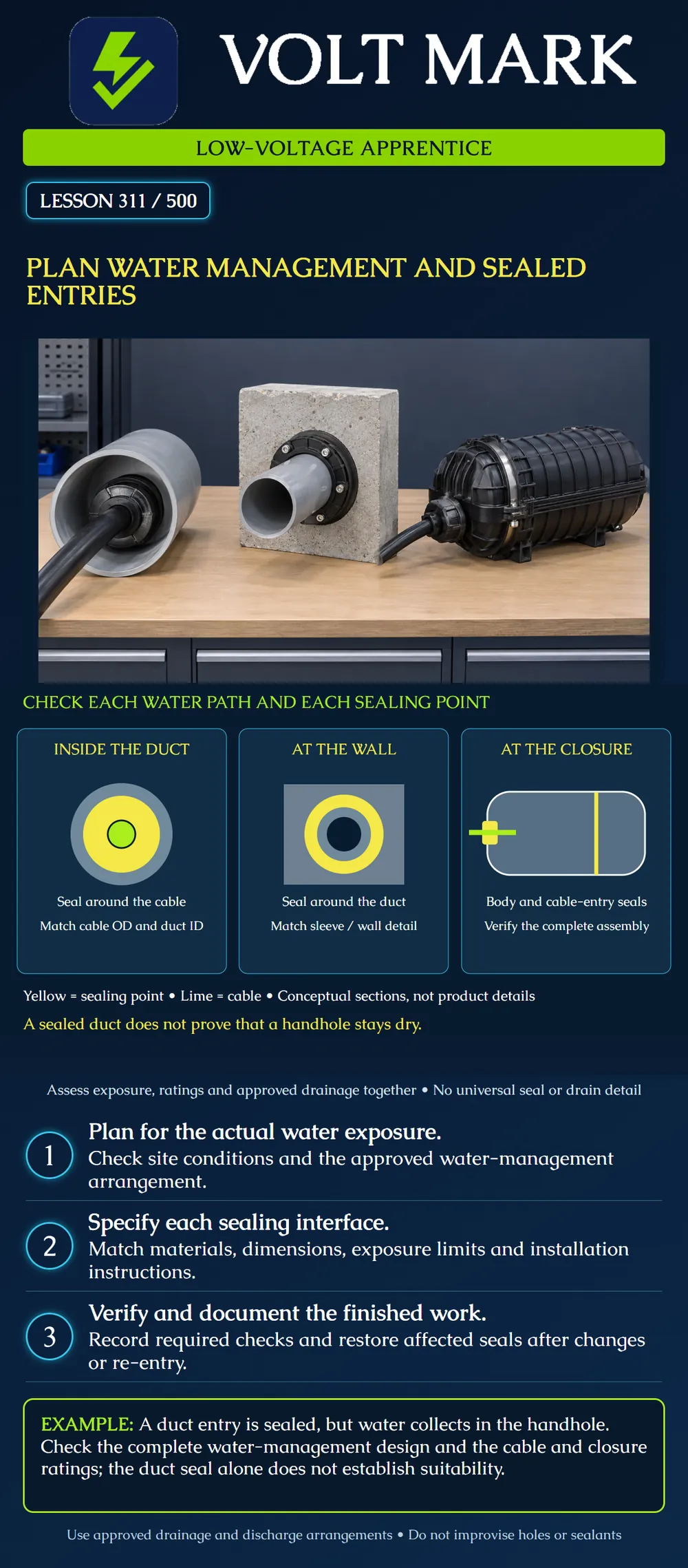
The first panel shows a cable inside a duct. The yellow material represents a specified seal around that cable. Its suitability depends on the selected system, actual dimensions and exposure.
The second panel shows a duct passing through a wall. The yellow ring represents the seal around the outside of the duct. This is a different interface from the inside-duct seal. A sealed cable passage does not automatically seal the surrounding wall penetration.
The third panel shows a conceptual splice closure with a body joint and cable entry. Each belongs to the closure's complete sealing arrangement. The colors are teaching labels, not instructions to apply one material at every location. No illustrated geometry is a manufacturer installation detail.
On a route drawing, identify where water could collect or travel: enclosure openings, ducts, wall penetrations and cable entries. Record the expected exposure and the approved design response. Distinguish a handhole or vault from the splice closure housed inside it. Suitability of one does not establish suitability of the other.
Ask the responsible designer how groundwater, surface runoff and the site's drainage arrangement are addressed. Do not assume that gravel guarantees drainage or that a lid guarantees a dry interior. If standing water is observed, record the condition and obtain the prescribed response; do not create a drain connection or drill a new hole.
For a duct seal, obtain the applicable product and installation information. Compare cable outside diameter, duct inside diameter, number of cables, material compatibility, temperature and expected exposure with the approved system. Follow its preparation and verification requirements. A generic construction foam or putty is not a documented substitute.
For a closure, identify the exact model and configuration, including the relevant entry hardware and unused-port treatment. Match the environmental limits and required assembly procedure. A family's outdoor description does not replace the selected configuration's instructions.
Water resistance, a duct's seal rating and a closure's environmental rating refer to different assemblies and conditions. Do not transfer a published water-head or test-pressure value from one product to another. A fire-retardant material description also does not, by itself, establish an approved firestop system for a rated wall.
A campus handhole contains a fiber splice closure and two ducts. The installation record lists a cable seal for one occupied duct, but nothing for the spare duct or the wall penetration at the building end.
Build an interface list. For each point, record location, function, dimensions, selected product, approved detail and verification status. Mark the unknown entries as unresolved. The record is incomplete even if the occupied duct looks neatly sealed.
Now suppose the handhole later fills with water. This does not automatically prove the occupied duct seal failed; water could have another path. It also does not establish that the closure is suitable for that exposure. Refer the observed condition and component information to the responsible reviewer. Do not open the closure while wet simply to look for water inside it.
Use only the approved water-management plan and the applicable site requirements. A pump or drain route needs its own authorization and controls; water cannot simply be directed wherever it is convenient. This lesson provides no pumping, excavation-entry or discharge procedure.
Keep the enclosure's structural requirements and service access intact. Do not assume a field modification will preserve its rating. Coordinate changes with the responsible designer and manufacturer as required by the project.
Record product identity, location, installed configuration, required checks and any unresolved issue. Use manufacturer-prescribed tests only with the correct equipment and training. Do not invent a pressure test because a product has a test valve.
When a cable is added or a closure reopened, determine which seals are affected and follow the required re-entry and restoration procedure. Update the record. A previously accepted configuration does not document the modified one.
For the fictional handhole record above, make separate rows for the occupied duct, spare duct, building-wall penetration and splice closure. The occupied duct has a listed cable-seal product, but its installed configuration and specified checks still need confirmation. The spare duct and wall penetration have no listed treatment, so record those as unresolved design/documentation items. For the closure, obtain its exact model, entry configuration and exposure limits. Refer the interface list to the responsible reviewer. A neat seal in the first row cannot close the other rows, and later standing water requires investigation of possible paths rather than an unsupported diagnosis of that seal.
Polywater, FST Foam Duct Sealant: https://www.polywater.com/en/product/polywater-fst-foam-duct-sealant/ Used for duct-seal function, compatibility and product-specific performance. Marketing code claims and numerical water-head limits are not generalized.
Polywater, Mechanical Seals: https://www.polywater.com/en/mechanical-seals/ Used for the distinction between cable/duct and wall-penetration sealing applications.
CommScope, FOSC-400 product family, features and environmental information: https://www.commscope.com/product-type/hubs-closures-terminals-boxes/fiber-closures/fiber-splice-closures/fosc-400/ Used for separate body and cable seals and model-specific environmental applicability. No universal test pressure, water depth or heat-shrink procedure is taught.
Texas journeyman, 15 questions, scored by topic against the 70% mark. No card, and no account needed to start.
Free study material for low-voltage apprentices. This is a national foundation course: requirements differ by state and by local jurisdiction, and a practice that is common in one place is not a rule everywhere. Nothing here is a licence, a certification, or authority to work unsupervised, and completing it does not count as apprenticeship hours or continuing-education credit. Check the codes adopted where you are working, the licensing authority for that work, and your employer's safety programme. VoltMark is not affiliated with, endorsed by, or sponsored by NFPA, OSHA, NICET, BICSI, FOA, or any state or local licensing authority.

Electrician licensing exam prep: practice questions, timed exam simulations, and step-by-step help finding every answer in the NEC.