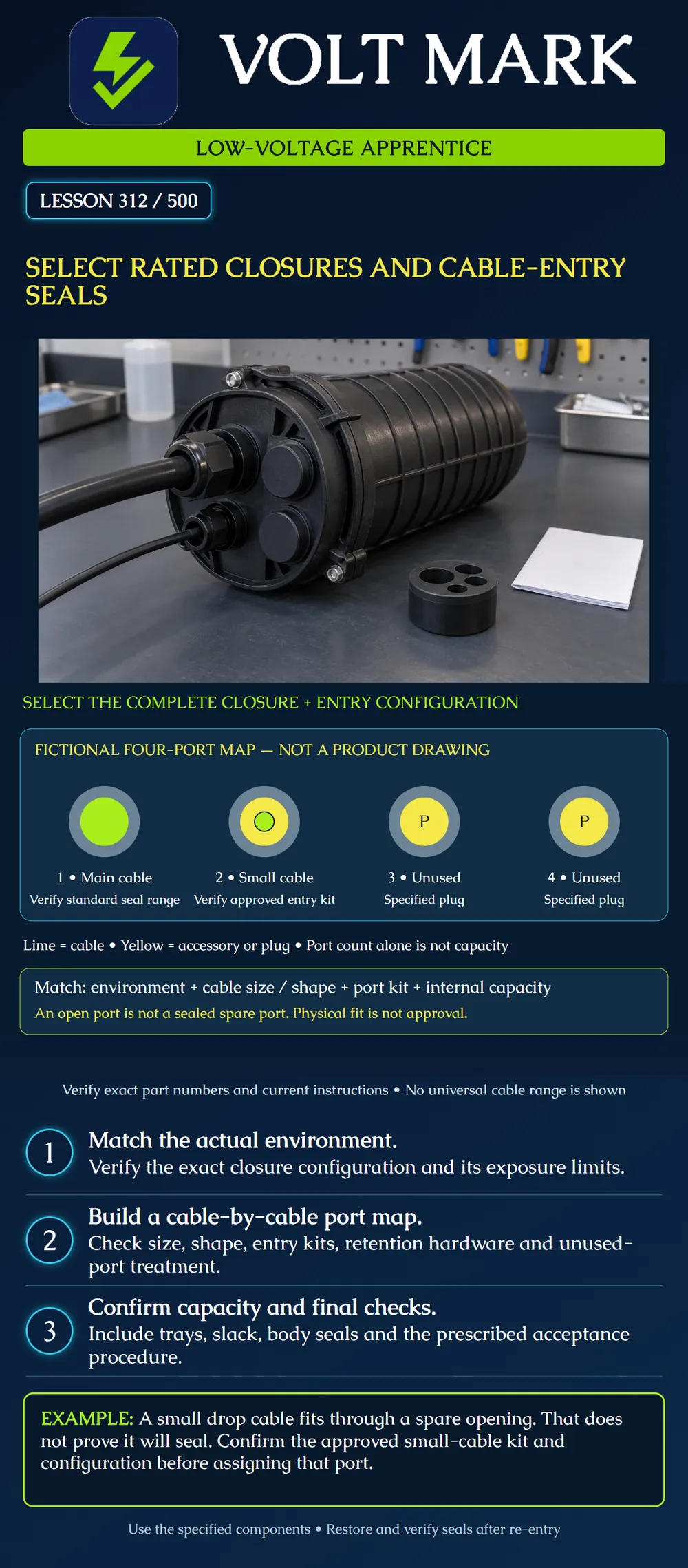
Match a fiber splice closure and its entry components to the actual cables, environment and internal arrangement. Produce a port map with documented compatibility, rather than selecting by appearance or advertised maximum fiber count alone.
The poster is an invented four-port layout. Port 1 represents a main cable using a verified standard entry configuration. Port 2 represents a smaller cable that requires an approved accessory in this teaching example. Ports 3 and 4 have specified plugs. Their unused status does not mean they should remain open.
Lime identifies cable; yellow identifies an accessory or plug. These are teaching colors, not a universal product code. The circles are not drawn to dimensional scale and do not specify how to assemble a real seal.
Record the closure model, part number, revision and installation environment. A product family can contain different sizes, port arrangements, trays and accessory combinations. Confirm the selected configuration's limits and instructions, including the intended exposure. Do not assume all products described as outdoor share the same immersion capability.
Environmental suitability belongs to the completed assembly. The body joint and cable-entry seals perform different functions. A correct entry kit does not establish that the body seal is properly assembled, and a closed dome does not establish that each port is sealed.
For each cable, record its identity, outside dimensions, shape and construction. Compare these with the manufacturer's approved entry and retention components. A smaller cable is not automatically easier to seal. Special small-cable or multi-cable kits may have configuration limits different from a standard port.
CommScope's F439 instructions are a concrete example: their small-cable kit addresses specified closure families, port capacity, cable combinations and unused-port plugs. That does not make the same kit or limits applicable to every closure. Use the current instructions for the selected product.
For unused ports, document the specified blanking or plugging arrangement. Preserve the associated components and records according to the project requirements. Do not use scrap cable or improvised filler as a substitute unless the manufacturer explicitly specifies that exact arrangement.
Check available trays, the chosen splice method, slack-storage arrangement, cable construction and access for future work. An advertised maximum splice count may depend on a particular tray configuration. Available entry ports do not prove that the internal components can accommodate all planned fibers.
The design must also accommodate retention and routing. Sealing around a jacket does not, by itself, answer how cable loads are restrained. Match the specified mechanical arrangement and preserve cable and fiber bend limits.
Imagine a fictional seal data sheet permits one round cable between 8 mm and 12 mm OD in its standard configuration. The main cable is 10 mm OD, and a proposed drop cable is 4 mm OD.
The main cable meets this invented diameter range because 8 ≤ 10 ≤ 12. That is only a diameter check, not final suitability approval. The 4 mm drop is outside the stated standard range. Locate the approved accessory or another approved configuration and verify all remaining requirements. Do not assume adding tape changes the documented rating.
Now suppose there are four ports but only two cable entries are needed. The port schedule must still account for all four positions, including the two specified plugs. A future-work note is not a substitute for sealing the unused ports now.
Create a worksheet with: closure model; environmental basis; port number; cable ID; dimensions/shape; seal-kit part number; retention components; unused-port treatment; tray/slack plan; instruction revision; and verification status.
Mark missing compatibility evidence as unresolved. If an accessory is unavailable, use the project's substitution process rather than silently replacing it. Retain the approved disposition.
Follow the complete manufacturer procedure for preparation, assembly and prescribed checks. This lesson supplies no heating, torque, strip-length or pressure-test values. Do not apply a test pressure from another closure or assume a test valve authorizes an improvised test.
After changes or re-entry, identify affected seals and perform the specified restoration and verification. Update the cable and port records so the saved configuration matches the installation.
Using only the invented data above, the 10 mm main cable passes the standard entry's diameter comparison: 8 mm <= 10 mm <= 12 mm. The 4 mm drop fails that comparison because 4 mm < 8 mm. Record the main entry as diameter-compatible with other checks still pending; record the drop entry as unresolved until an approved configuration is identified. Assign the two remaining ports their specified plugs. The resulting schedule accounts for four ports, but it is not final approval: environmental suitability, retention and internal capacity still require their own evidence. These fictional dimensions are not CommScope specifications.
CommScope, FOSC-450 product family: https://www.commscope.com/product-type/hubs-closures-terminals-boxes/fiber-closures/fiber-splice-closures/fosc-450/ Used for configuration differences, separate body/entry seals and capacity considerations. Family marketing statements are not treated as unlimited compatibility.
CommScope, F439, 4 Small Cables Sealing Kit: Wrap Style: https://www.commscope.com/globalassets/digizuite/954827-eng-ss-f439.pdf Document copyright includes 2016. Used for model-specific small-cable kit applicability, configuration limits and unused-port treatment. No installation steps or numerical product limits are generalized.
Fictional 8–12 mm exercise values are not CommScope specifications.
Texas journeyman, 15 questions, scored by topic against the 70% mark. No card, and no account needed to start.
Free study material for low-voltage apprentices. This is a national foundation course: requirements differ by state and by local jurisdiction, and a practice that is common in one place is not a rule everywhere. Nothing here is a licence, a certification, or authority to work unsupervised, and completing it does not count as apprenticeship hours or continuing-education credit. Check the codes adopted where you are working, the licensing authority for that work, and your employer's safety programme. VoltMark is not affiliated with, endorsed by, or sponsored by NFPA, OSHA, NICET, BICSI, FOA, or any state or local licensing authority.

Electrician licensing exam prep: practice questions, timed exam simulations, and step-by-step help finding every answer in the NEC.