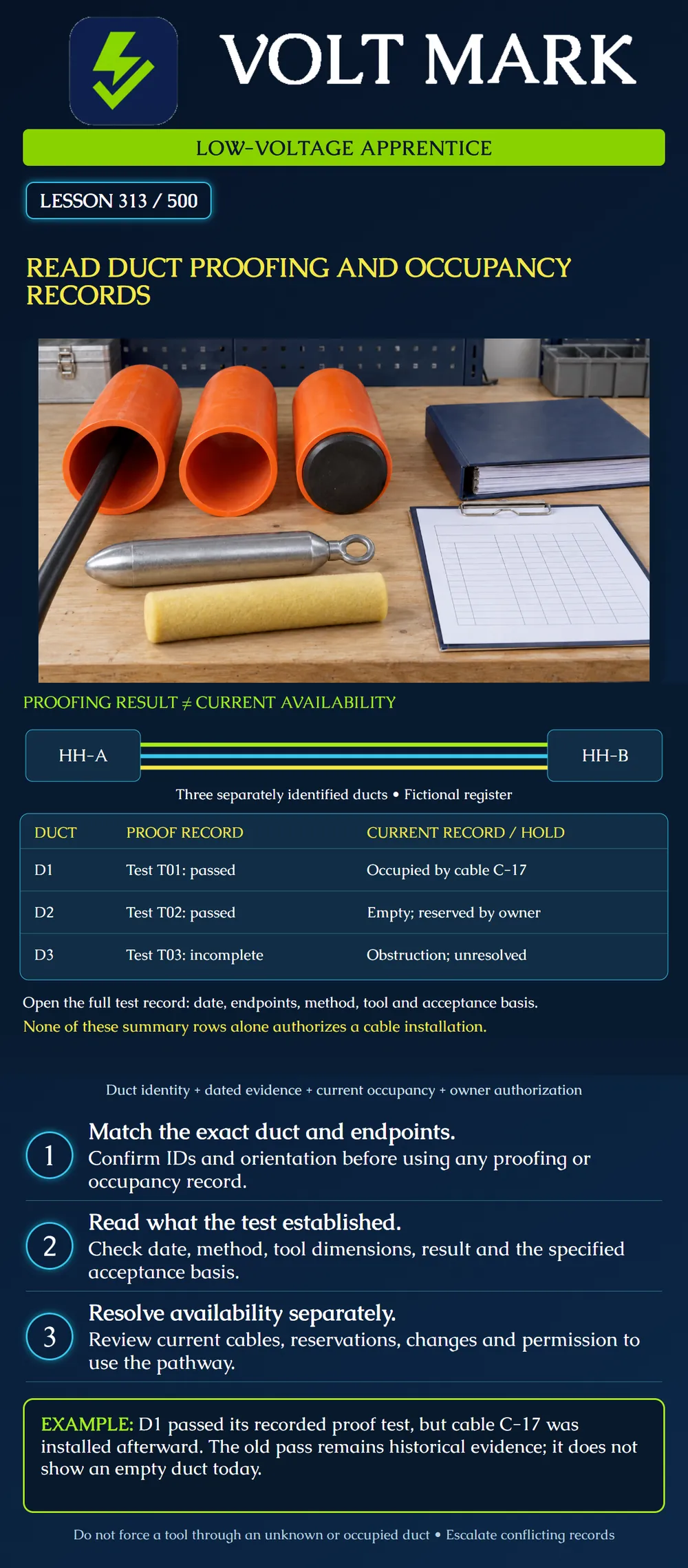
Read a duct register together with its underlying proofing and occupancy evidence, and explain why a past pass is not permission to install a new cable.
The poster shows three fictional ducts between handholes HH-A and HH-B. D1 passed test T01, but its current record identifies cable C-17. D2 passed T02 and is recorded empty, but the owner has reserved it. D3 has an incomplete test and an unresolved obstruction.
These rows summarize different kinds of information. Proofing describes a test on a specified pathway at a particular time. Occupancy records identify what is installed. Reservations and authorization describe whether the owner has assigned the pathway for the proposed work. A useful review keeps those categories separate.
The poster deliberately omits the full test detail to demonstrate why the summary cannot stand alone. Open the linked record rather than treating the word passed as a complete acceptance report.
Check both endpoint IDs, the duct ID and the orientation convention. A position described as upper-left can be ambiguous when two people view opposite ends. Use the project's defined labeling and orientation method; do not guess a matching opening.
Trace references through the route. Proof of HH-A to HH-B does not establish the condition of HH-B to HH-C. When a route contains several segments, each relevant segment needs its own evidence. Confirm whether the record describes a parent duct or an innerduct within it.
WHAT DID THE TEST SHOW? Read the date, procedure reference, test direction, tool type and dimensions, operator or witness information, result and exceptions. Compare these with the project-specific acceptance requirements. A test using the wrong tool or an unidentified duct cannot be made valid by a pass label.
Corning's air-assisted installation guidance distinguishes proofing from sponge passage: a sponge may pass a partial obstruction. The manufacturer also identifies duct cleanliness and integrity as relevant. This does not establish one universal mandrel size or test method. The actual system and approved specification determine the procedure.
A pull rope at both ends is not a complete proof record. A successful passage test also does not automatically establish every other property, such as leak tightness, suitability for a particular cable or permission for air-assisted installation. Read the test's scope.
Record installed cable IDs and associated work orders, spare or reserved assignments, and later repairs or changes. An empty status recorded before another crew's installation may now be outdated. Resolve contradictory dates and physical identification through the responsible records owner and authorized field-verification process.
Do not erase a historical pass simply because the duct was later occupied. Preserve the original evidence and add the later event. The useful question is what the combined record demonstrates now.
For fictional D1:
The day-5 crew cannot call D1 empty based on the day-1 result. Its review must include the day-3 installation. This timeline teaches evidence interpretation; it does not say whether a second cable could ever be designed for that duct. That requires a separate compatibility, capacity and installation review.
For D2, a reservation is not an obstruction, but it is still a constraint on use. Obtain the owner's disposition rather than treating empty as unassigned. For D3, incomplete is not passed. Record the unresolved issue and the responsible follow-up.
Use these fields on a training record: route segment; both endpoints; duct/innerduct ID; orientation; drawing revision; test record ID and date; method/tool; acceptance reference; result and exceptions; present cable IDs; reservation; subsequent work; owner decision; and unresolved questions.
Create a clear link to original test evidence. Keep corrections traceable and distribute approved updates to the people relying on the records. Do not replace detailed evidence with a single green status icon.
This lesson teaches document review. It does not authorize rodding, compressed-air proofing, opening a vault or entering an excavation. Do not force a tool into a pathway that may contain live services or whose identity is uncertain. Refer testing and obstruction investigation to the trained, authorized crew.
Review the fictional register for a proposed new cable on training day 5. D1 has a historical pass, but the later C-17 installation makes an empty-pathway conclusion unsupported. D2 is recorded empty and passed, yet its reservation requires the owner's disposition before assignment. D3 has no completed passing result and an unresolved obstruction. Therefore none of these three summary rows alone establishes a released pathway for the proposed installation. Keep the original test links, add the relevant occupancy or reservation evidence, and list the unresolved decision for each duct. This is a records conclusion, not a declaration that all three ducts are physically unusable.
Corning AEN049, Air-Assisted Cable Installation Techniques, Revision 9, 2022: https://www.corning.com/catalog/coc/documents/application-engineering-notes/AEN049.pdf Used for duct condition and the distinction between proofing and sponge passage. No product-specific mandrel percentage, pressure or field procedure is generalized.
FOA, Outside Plant Fiber Optic Network Design, Project Documentation and Documentation Process: https://www.thefoa.org/tech/ref/OSP/design.html Used for route/component identification, linked test records and controlled record updates. The register and timeline are original teaching examples, not a mandatory industry form.
Texas journeyman, 15 questions, scored by topic against the 70% mark. No card, and no account needed to start.
Free study material for low-voltage apprentices. This is a national foundation course: requirements differ by state and by local jurisdiction, and a practice that is common in one place is not a rule everywhere. Nothing here is a licence, a certification, or authority to work unsupervised, and completing it does not count as apprenticeship hours or continuing-education credit. Check the codes adopted where you are working, the licensing authority for that work, and your employer's safety programme. VoltMark is not affiliated with, endorsed by, or sponsored by NFPA, OSHA, NICET, BICSI, FOA, or any state or local licensing authority.

Electrician licensing exam prep: practice questions, timed exam simulations, and step-by-step help finding every answer in the NEC.