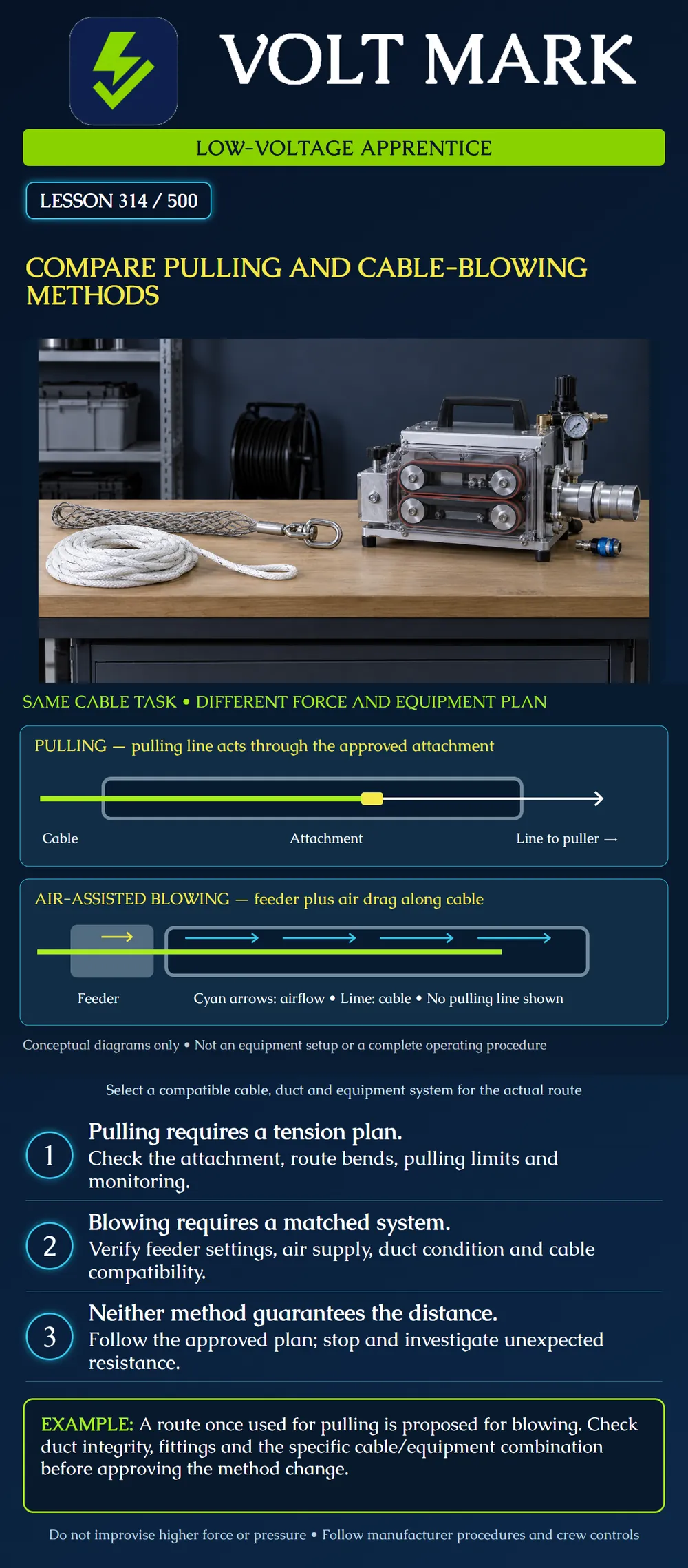
Explain the different ways pulling and air-assisted blowing move fiber cable, and identify the information needed to compare them for a route. This lesson is a method-selection overview, not equipment-operation training.
The upper diagram shows cable in lime, an attachment in yellow, and a white pulling line leading toward the puller. The attachment transfers force using the arrangement approved for the cable. The diagram does not show the puller's anchoring, rope routing, guards or other operating details.
The lower diagram shows a feeder at the duct entrance and cyan airflow arrows. It illustrates a blowing arrangement in which feeder action and distributed air drag help move the cable. No pulling line is shown. Air-assisted terminology varies among manufacturers, so identify the actual system rather than relying on a name alone.
Both drawings are straight for clarity. They do not predict how a real route's bends, offsets, elevation changes or restrictions affect installation.
Obtain the actual cable's pulling-load and bend limits. Confirm the specified pulling attachment, handling equipment, route and monitoring plan. Bends and offsets affect the pull; route preparation cannot be replaced by selecting a powerful winch.
The responsible team must plan intermediate handling where required. The cable's allowed load is not simply the machine's maximum capability. Do not substitute a generic force or bend multiplier from another cable product.
Confirm the cable, duct and installation equipment form a compatible system. Duct condition, leakage, bends, airflow and feeder action affect performance. Excessive pushing can buckle or damage cable. Air assistance does not eliminate mechanical limits.
Use the equipment manufacturer's settings and prescribed checks. Do not infer operating pressure from the duct's size or a previous job. A published demonstration distance does not guarantee the same result on a different route. Do not add an improvised pulling assist; use only the approved method and its instructions.
Create a comparison using cable identification and dimensions, duct identification and condition, route length and geometry, access points, available equipment, crew training, required monitoring and acceptance records. Keep unknowns visible.
A method cannot be selected reliably from cable length alone. If proofing or occupancy information is incomplete, resolve that gap. A prior installation proves only what its records show; it does not automatically qualify a changed cable, duct condition or technique.
A campus has an existing duct between two service areas. The owner proposes replacing the original pulling plan with blowing because another site's long cable installation went quickly.
The useful response is to compare evidence, not repeat the other site's result. List the exact proposed cable and blowing system. Locate duct condition and fitting information. Identify bends, access restrictions and the approved procedure. Ask the responsible team to document the method decision and any preparatory work.
Now add a complication: the route record shows a repaired coupling, but no updated verification. That creates an information gap for the proposed method. It does not prove the coupling leaks, nor does it justify assuming it is suitable. Resolve and document its status before treating the plan as ready.
Ask which parameters are monitored and what conditions require stopping. Record the responsible operator and communication arrangements. An apprentice should report unusual behavior promptly rather than encouraging more speed, pressure or force to overcome it.
This lesson supplies no settings or field test sequence. Keep clear of moving cable, pulling lines and equipment according to the site procedure. Before work on equipment or pressurized components, the trained crew must apply the manufacturer's shutdown and energy-control procedure. Do not attempt to release a blockage or disconnect equipment under stored pressure.
Retain the route and method record, cable identification, prescribed installation data, exceptions and required acceptance tests. A cable that reaches the far end is not, on that fact alone, accepted. Document any abnormal event for the responsible reviewer.
For the campus case above, build two comparison columns. In the pulling column, link the actual cable's handling limits, attachment and route plan. In the blowing column, link the proposed cable/duct/equipment combination and its specified preparation and controls. Put the repaired coupling with missing verification in the unresolved-items column for the method review. The other site's fast installation supplies no missing evidence about this coupling or this route. The defensible decision is to leave the proposed method change unresolved until the responsible team evaluates the missing information; the record does not justify calling the coupling defective or declaring either method ready.
A fictional method-comparison sheet contains three entries: "winch capacity copied as cable limit," "blowing selected from another site's elapsed time," and "coupling repaired after the last verification record." For each entry, write the specific evidence you would request before calling the plan ready. Do not propose operating settings or perform field tests.
Answer guide: Request the actual cable specification and approved pulling arrangement for the first entry. For the second, request this route's cable/duct/equipment compatibility and route-condition comparison. For the third, request the repair details and the responsible team's required post-repair verification and disposition. None of these entries alone establishes readiness.
Corning AEN049, Air-Assisted Cable Installation Techniques, Revision 9, 2022: https://www.corning.com/catalog/coc/documents/application-engineering-notes/AEN049.pdf Used for feeder/air assistance, duct condition, compatibility and method-specific controls. Field-trial distances, pressures, ratios and broad compatibility claims are not generalized.
Corning SRP005-011, Duct Installation of Fiber Optic Cable, Issue 17, June 2019: https://www.corning.com/content/dam/corning/catalog/coc/documents/standard-recommended-procedures/005-011.pdf Used for pulling-plan considerations and product-specific handling limits. No universal pulling force or bend radius is supplied.
Texas journeyman, 15 questions, scored by topic against the 70% mark. No card, and no account needed to start.
Free study material for low-voltage apprentices. This is a national foundation course: requirements differ by state and by local jurisdiction, and a practice that is common in one place is not a rule everywhere. Nothing here is a licence, a certification, or authority to work unsupervised, and completing it does not count as apprenticeship hours or continuing-education credit. Check the codes adopted where you are working, the licensing authority for that work, and your employer's safety programme. VoltMark is not affiliated with, endorsed by, or sponsored by NFPA, OSHA, NICET, BICSI, FOA, or any state or local licensing authority.
Electrician licensing exam prep: practice questions, timed exam simulations, and step-by-step help finding every answer in the NEC.