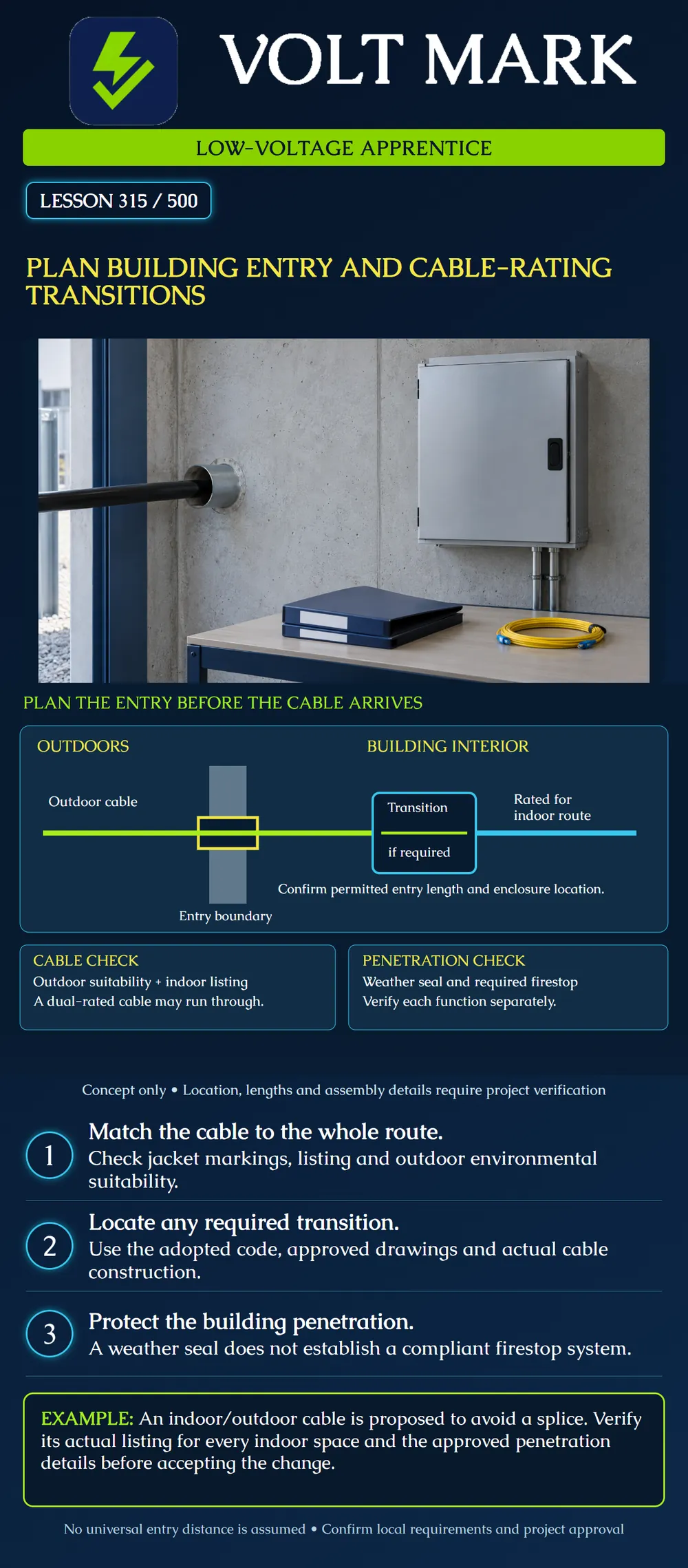
Given a fictional fiber entrance plan, identify the evidence needed to connect an outdoor route to an indoor pathway without assuming that one cable label or one seal answers every question.
The building entrance is a coordination point. The outside route, the cable construction, the interior spaces and the wall penetration must agree with the approved design. Start with the actual cable model and jacket markings, then trace the proposed route from outside to the termination. “Fiber” describes the transmission medium; it does not identify all the installation permissions of its cable.
Corning explains that indoor/outdoor products combine outdoor environmental suitability with indoor flame-rating considerations and can eliminate a transition splice. That does not mean every outdoor cable can continue through every indoor space. Verify the particular product's listing and suitability against the spaces it will occupy. Do not substitute a general product-family description for the delivered reel's identification.
A transition may use an entrance enclosure where an outdoor cable is joined to a cable suitable for the interior route. The required location and permitted length of the incoming cable depend on the applicable adopted requirements and the actual installation. This lesson deliberately gives no nationwide entrance-distance allowance. Have the responsible designer identify the controlling provision, edition, conditions and measurement basis. A frequently repeated distance is not a substitute for those details.
Treat the penetration as another design item. Identify the wall or floor assembly and whether a fire-resistance rating applies. A weather or water seal does not, by itself, establish that the penetration meets a required firestop system. UL identifies differences in opening size, cable quantity or size, and penetration angle as possible departures from tested designs. Match the actual installation to an appropriate approved system and its instructions; do not choose material by color alone.
A campus drawing shows cable C-42 entering room ER-1 and continuing to a telecommunications room. The proposed material substitution says only “outdoor fiber, same fiber count.” The entrance detail shows a box, but the drawing does not identify the cable listing or explain the box's purpose.
Record the gap rather than approving the substitution. Ask for the exact model and listing, the indoor route classification, the relevant entry provision and the enclosure function. Compare the proposed material to the approved material schedule. Do not assume matching fiber count establishes equivalent installation suitability.
The designer then proposes a dual-rated cable and a continuous run. That may solve the cable transition question after review. It still leaves the penetration detail, cable support, routing and documentation to be resolved. Revise the drawing only after the responsible party has accepted the change.
An installer presents a water-seal product sheet for an entrance through a rated wall. The sheet describes resistance to water ingress. The request is to accept it as the entire penetration detail. Identify the missing evidence: the applicable firestop system, its compatibility with the actual wall and penetrants, and the installation conditions. A product can have more than one function, but each required function needs supporting evidence.
For a training drawing, record:
Use “unresolved” for missing evidence. Do not fill an unknown field from memory or from a similar project. This exercise is document review, not permission to open an enclosure or alter a building barrier.
Answer: No; verify the actual listing and route requirements.
Answer: Not necessarily; a suitable, permitted indoor/outdoor cable can avoid one.
Answer: No; verify the applicable system separately.
Answer: No; the drawing is conceptual and has no scale.
Answer: The responsible design/approval team using adopted requirements and project conditions, not an apprentice guessing a universal limit.
For C-42 entering ER-1, divide the substitution review into two decisions. First, the phrase "outdoor fiber, same fiber count" does not identify a product listing or establish suitability along the indoor route, so the cable decision remains unresolved. Second, neither a box on the drawing nor a water-seal sheet establishes the required penetration detail. Request the exact cable documentation and route requirements for the first decision, and the applicable wall/penetration system evidence for the second. If the responsible team later accepts a suitable continuous indoor/outdoor cable, update the transition decision accordingly while leaving any unresolved penetration item open. One accepted change cannot close an unrelated missing detail.
Accessed 2026-10-01. Corning, Indoor/Outdoor Fiber Optic Cables: https://www.corning.com/optical-communications/worldwide/en/home/products/fiber-optic-cable/indoor-outdoor-cables.html Used for combined environmental/flame considerations and possible elimination of a transition splice. No marketing shorthand is treated as blanket route approval. UL Solutions, Beyond Installation: Challenges in Passive Fire Protection Compliance: https://www.ul.com/thecodeauthority/knowledgecenter/beyond-installation-challenges-passive-fire-protection-compliance Used for the importance of actual penetration conditions matching tested systems. Exact adopted-code applicability remains project-specific.
Texas journeyman, 15 questions, scored by topic against the 70% mark. No card, and no account needed to start.
Free study material for low-voltage apprentices. This is a national foundation course: requirements differ by state and by local jurisdiction, and a practice that is common in one place is not a rule everywhere. Nothing here is a licence, a certification, or authority to work unsupervised, and completing it does not count as apprenticeship hours or continuing-education credit. Check the codes adopted where you are working, the licensing authority for that work, and your employer's safety programme. VoltMark is not affiliated with, endorsed by, or sponsored by NFPA, OSHA, NICET, BICSI, FOA, or any state or local licensing authority.

Electrician licensing exam prep: practice questions, timed exam simulations, and step-by-step help finding every answer in the NEC.