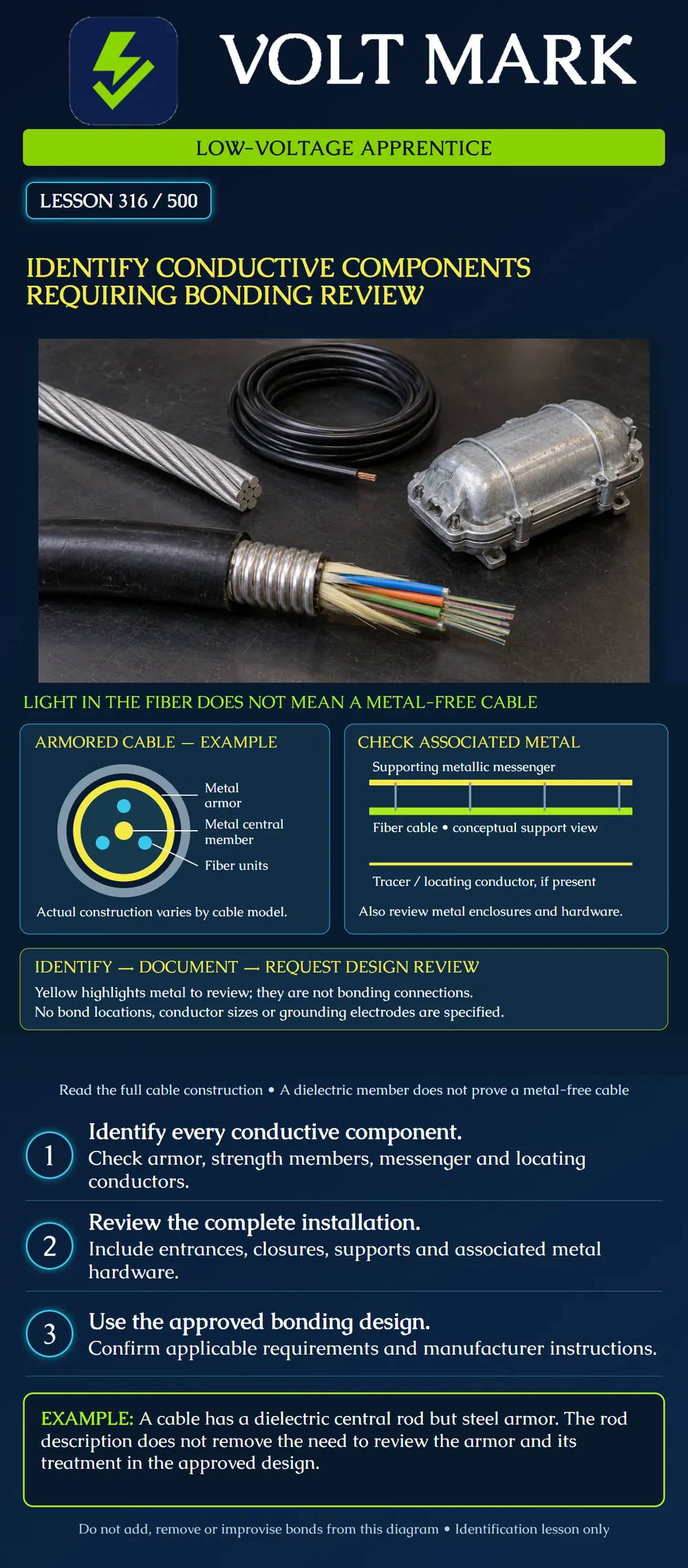
Read cable construction information, identify metal associated with a fiber route and prepare a clear bonding-review request. This lesson teaches recognition and documentation, not bonding installation or electrical testing.
An optical signal and the cable carrying it are different things. Glass fiber does not provide an electrical conductor, but its surrounding assembly can contain metal. Corning's aerial guidance identifies metallic cable components and supporting messengers as items requiring grounding and bonding attention; it also discusses induced voltage near power lines. Treat that as a reason to identify the construction and obtain the applicable design, not as a complete procedure.
Read more than the first line of a product description. Corning's PGS066 specification illustrates different constructions: an all-dielectric version, an armored version using steel, and a toneable version containing copper conductors. Those are examples of why similarly described fiber products can have materially different components. A nonmetallic central member does not establish that every other layer is nonmetallic.
Create an inventory of the actual assembly: armor or shield, central and other strength elements, any supporting metallic messenger, and any integral or separate locating conductor. Include associated metal enclosures and support hardware in the review. The inventory is a list of questions for the responsible designer; it does not mean every item receives an identical connection.
The required treatment depends on the installation, applicable adopted requirements and manufacturer instructions. A decision for one entrance or aerial segment cannot be copied automatically to another. Do not improvise a connection to a nearby pipe, add a separate rod, remove an existing bond, or assume a mechanical clamp supplies an electrical connection. Obtain the approved detail and the appropriate trained personnel for the work.
A material schedule describes cable A as “dielectric central member, outdoor fiber.” A second page shows steel armor. An apprentice marks the route “all dielectric” after reading only the first page.
Correct the record to identify the armor and cite the specific construction page. Leave its required bonding treatment unresolved until the design review is complete. Keep the original product model and revision with the request so the reviewer can distinguish the center member from the armor. Do not resolve the discrepancy by deleting one of the descriptions.
A documented all-dielectric cable is proposed on a route that includes a metallic support strand. The cable description answers the cable-material question; it does not describe all supporting infrastructure.
Add the strand to the route inventory and request the applicable support and bonding details from the responsible owner/designer. Record the revised route segment and the drawing reference. Do not use the cable's all-dielectric description as a sign-off for unrelated metal components.
A project has an all-dielectric cable in underground duct and separately specified locating wire. A closure detail shows only optical splices. The apprentice cannot find how the locating wire is handled at the next access point.
Write a focused question: identify the wire, endpoints and access point, then request its approved treatment and locating-system detail. Do not connect it to the closure, sever it, or use an optical test result to declare the separate conductor acceptable. The missing document is the task to resolve.
Use one row per component:
A blank row should remain unresolved rather than being guessed. For classroom practice use manufacturer drawings or identified training samples. This exercise does not authorize stripping installed cable, touching exposed metal, opening a live facility, or approaching aerial power infrastructure.
Answer: No. Review its construction.
Answer: Yes; identify each separately.
Answer: No. The messenger is a separate review item.
Answer: No. They highlight metal components only.
Answer: Document the component and request the approved treatment before work proceeds.
Using only the documents described in Cases A, B and C, prepare three review-request rows. For each, name the conductive component, state which existing description could hide it, and write one focused request for the responsible reviewer. Do not propose connection points or perform electrical tests.
Answer guide: Case A identifies steel armor overlooked because the center member was described as dielectric; request the approved armor treatment for the identified cable and route. Case B identifies the metallic support strand omitted from the cable-only description; request its applicable support/bonding detail. Case C identifies a separate locating conductor omitted from an optical-splice detail; request its treatment at the named access point. Keep each unresolved until its own documented disposition is received.
Accessed 2026-10-01. Corning AEN044, Grounding and Bonding of Optical Fiber Cable in Aerial Applications, revision 2, July 9, 2014: https://www.corning.com/catalog/coc/documents/application-engineering-notes/AEN044.pdf Used for identification of conductive components and aerial induced-voltage concerns. The document references older NEC/NESC editions. Its connection frequency and entry prescriptions are not presented here as current nationwide rules.
Corning PGS066, September 2017, revision 5: https://www.corning.com/catalog/coc/documents/generic-specifications/PGS066.pdf Used only for examples of differing cable constructions. Product dimensions and legacy standard references are not adopted as project requirements.
Texas journeyman, 15 questions, scored by topic against the 70% mark. No card, and no account needed to start.
Free study material for low-voltage apprentices. This is a national foundation course: requirements differ by state and by local jurisdiction, and a practice that is common in one place is not a rule everywhere. Nothing here is a licence, a certification, or authority to work unsupervised, and completing it does not count as apprenticeship hours or continuing-education credit. Check the codes adopted where you are working, the licensing authority for that work, and your employer's safety programme. VoltMark is not affiliated with, endorsed by, or sponsored by NFPA, OSHA, NICET, BICSI, FOA, or any state or local licensing authority.

Electrician licensing exam prep: practice questions, timed exam simulations, and step-by-step help finding every answer in the NEC.