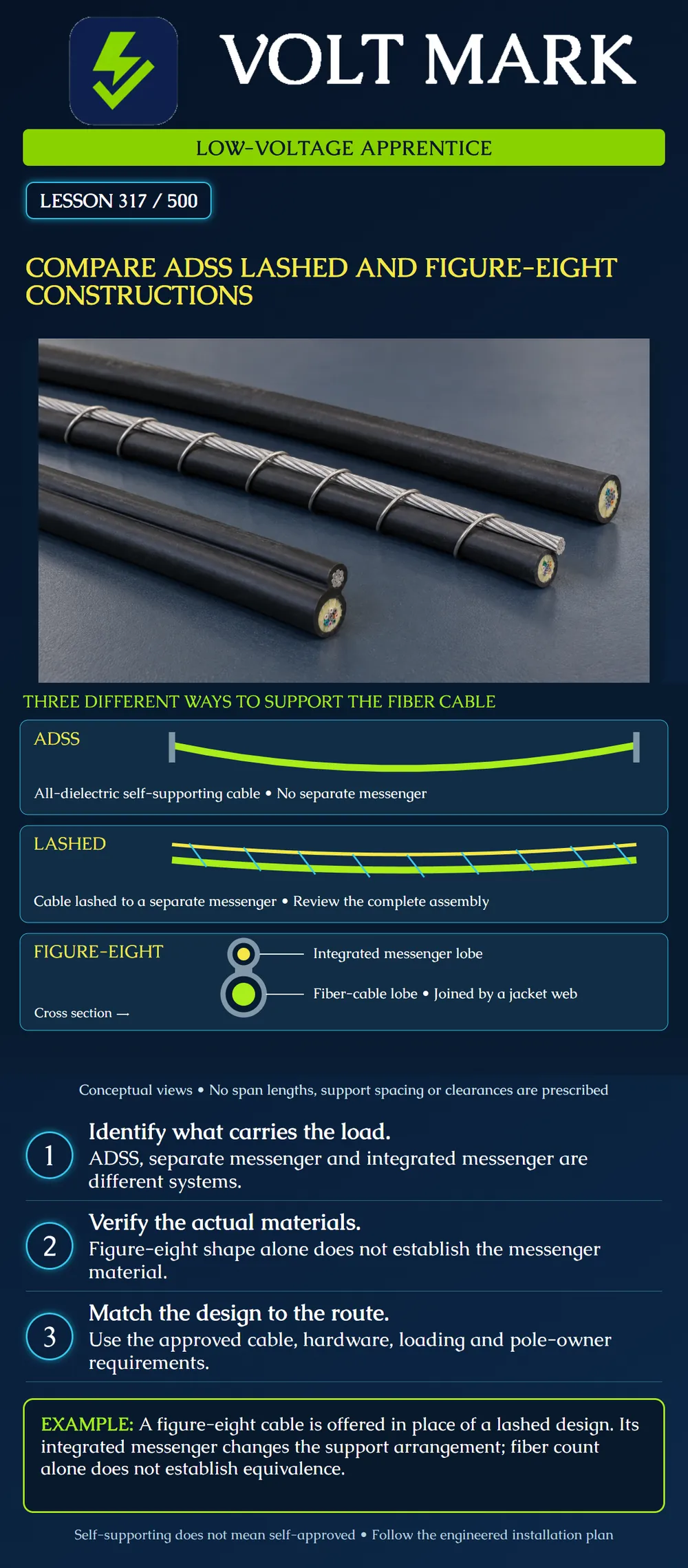
Identify the support arrangement in three aerial fiber constructions and explain why a substitution requires more than matching fiber count.
ADSS means all-dielectric self-supporting. The cable's nonmetallic strength system supports the cable between approved attachment points without a separate messenger. AFL describes its ADSS family as requiring no separate support or messenger wire. This describes the cable system, not permission to choose any span, attachment or route.
In a lashed installation, the fiber cable is secured to a separate supporting messenger with lashing wire. Figure-eight construction instead integrates a messenger alongside the fiber-cable portion, with a jacket web joining the two lobes. Corning distinguishes these arrangements and notes that figure-eight messengers are not always the same material. Verify the selected model rather than classifying the whole assembly from its silhouette.
The route design must account for the actual cable, support system, hardware and environmental conditions. “Self-supporting” is not an unlimited-span rating. Aerial construction also requires the applicable owner approvals and work controls. This lesson supplies no installation tensions, sag percentages, electrical clearances or pole-loading acceptance criteria.
For ADSS: Which exact cable and matching hardware are approved for this route? For lashed cable: Which messenger and complete cable bundle were evaluated? For figure-eight: Which integral messenger and attachment system are specified?
These questions distinguish systems without declaring one universally better. Existing infrastructure, route constraints and the approved engineering determine which option fits the project.
A purchase request calls for a cable suitable for lashing to an approved messenger. A supplier proposes a figure-eight cable with the same fiber count and optical category. The project team asks an apprentice to record the differences.
State that the proposed cable incorporates its own messenger and therefore changes the support arrangement. Record both model numbers and request review of the attachment and route design. Do not accept the substitute solely because the optical fibers match. Do not remove a messenger lobe to make the proposed cable resemble the specified product without explicit manufacturer and design authorization.
A training drawing labels a route “ADSS” but provides no product model or attachment detail. A note says the route is ready because there is no separate messenger to install.
Identify the missing documents. The construction name is not the product specification, and the absence of a separate strand does not establish the selected cable's suitability. Record the missing model, approved hardware detail and route-design reference. Send the question to the responsible project reviewer rather than inventing an allowable span.
A drawing proposes adding another cable to an existing aerial bundle. The only information available is the new cable's fiber count. The apprentice is asked whether the route can accommodate it.
The evidence is incomplete. Identify the existing support and cable assembly, proposed added product and approval reference. Escalate the missing review rather than using the appearance of the existing span as proof. No calculation from this lesson establishes spare structural capacity.
Using three manufacturer product drawings, record:
Keep product facts separate from assumptions. Use documents or identified training samples; this exercise does not authorize pole climbing, cable movement or work near electrical infrastructure.
Answer: ADSS.
Answer: Lashed construction.
Answer: The integrated messenger and cable lobes joined by a jacket web.
Answer: No; verify the product.
Answer: No; the support arrangement and approved design must also be reviewed.
Three fictional catalog sketches show: A, a cable supported by its nonmetallic strength system with no separate messenger; B, a cable attached by lashing wire to a separate strand; C, two jacket lobes joined by a web, with one lobe containing the messenger. Name each construction and identify one product or design detail still needed before a route decision.
Answer guide: A is ADSS; obtain the exact model and approved matching hardware/route design. B is lashed construction; identify the messenger and evaluated cable bundle. C is figure-eight construction; verify the integral messenger's material and specified attachment arrangement. Recognizing the construction does not establish route suitability or authorize installation.
Accessed 2026-10-01. Corning AEN014, Sag and Tension — General, revision 5, November 2002: https://www.corning.com/catalog/coc/documents/application-engineering-notes/AEN014.pdf Used for basic construction distinctions and the need for route-specific loading evaluation. Historical code references, example sag values and span calculations are not adopted as current nationwide requirements. AFL, introduction of gel-free ADSS cable, September 27, 2023: https://www.aflglobal.com/en/company/company-profile/news/2023/afl-introduces-gel-free-technology-to-its-all-dielectric-self-supporting-adss-fiber-optic-cable Used for the no-separate-messenger ADSS description. Marketing cost or speed claims are not generalized.
Texas journeyman, 15 questions, scored by topic against the 70% mark. No card, and no account needed to start.
Free study material for low-voltage apprentices. This is a national foundation course: requirements differ by state and by local jurisdiction, and a practice that is common in one place is not a rule everywhere. Nothing here is a licence, a certification, or authority to work unsupervised, and completing it does not count as apprenticeship hours or continuing-education credit. Check the codes adopted where you are working, the licensing authority for that work, and your employer's safety programme. VoltMark is not affiliated with, endorsed by, or sponsored by NFPA, OSHA, NICET, BICSI, FOA, or any state or local licensing authority.

Electrician licensing exam prep: practice questions, timed exam simulations, and step-by-step help finding every answer in the NEC.