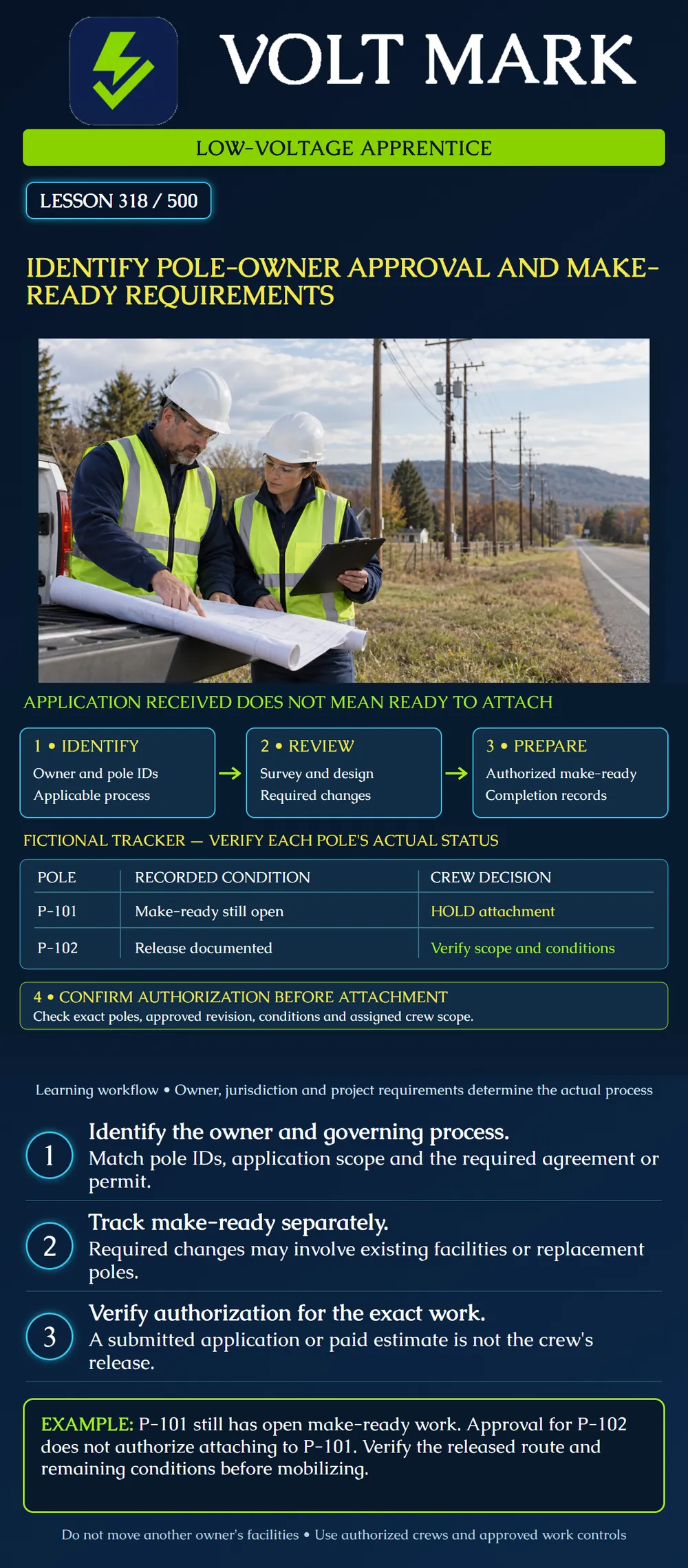
Read a fictional pole-attachment tracker and distinguish an application, engineering review, required make-ready work and authorization for the proposed attachment.
A pole along the route is not automatically available for a new fiber cable. Identify the owner and exact pole IDs before interpreting project status. Follow the applicable agreement, application and review process. OG&E, for example, requires approval before third-party installations and an executed license agreement before access to its application portal. That is an owner example, not a universal portal or contract sequence.
Make-ready means preparing the existing infrastructure to accommodate additional facilities. The federal definition includes modifying or replacing the pole, lines or equipment. The same regulation distinguishes simple and complex work, with service-outage and facility-damage considerations. An apprentice should identify the assigned scope and responsible parties; the label “simple” does not authorize an unapproved crew to move existing facilities.
The governing process varies. Federal pole-attachment provisions do not apply identically to every owner or location. The federal definition excludes certain owner categories, including cooperatives and government-owned entities; state regulation can also matter. Maine's commission maintains its own pole-attachment rules and describes its implementation of one-touch make-ready. Determine the actual jurisdiction and owner process rather than copying a deadline from another project.
Separate the administrative records. An application receipt shows submission. A review response may identify required changes or conditions. An accepted estimate addresses an agreed scope and payment stage. Completion records document performed work. The authorization relevant to the crew must cover the actual poles, design revision and proposed activity. None of these records should silently stand in for another.
A training folder contains a paid make-ready estimate for twelve poles. A scheduling note says “payment processed,” and a crew is assigned to start the new fiber installation. No completion or release record appears in the folder.
Record what is known: the payment stage has evidence. Record what is missing: confirmation of the required work and the authorization applicable to attachment. Request those documents through the project lead. Do not relabel the entire route “ready” because money was paid.
A route list contains P-101 and P-102. The release document lists only P-102. The construction drawing shows both poles.
Mark P-101 unresolved. Ask whether a partial route can be constructed under an approved plan, rather than deciding independently to attach to the omitted pole. Keep the release list with its revision and conditions. If the route changes, obtain the corresponding review instead of extending an old approval by assumption.
A campus approach route crosses from one owner's poles to another owner's poles. The project folder contains the first owner's agreement but no record for the second owner.
Split the tracker by owner and pole IDs. Ask the responsible coordinator to identify the second process and the evidence needed. The fact that the route is one fiber project does not make it one approval system. Track other applicable access or right-of-way permissions separately; an attachment record should not be assumed to grant unrelated property rights.
For each pole or approved group, record:
Use precise status words: submitted, under review, changes required, work open, or released subject to listed conditions. Avoid an unexplained green check mark. Retain the source document behind every important status. This is a classroom document exercise, not a pole survey, legal filing or authorization to work.
Answer: Submission, not authorization for all construction.
Answer: Changes to a pole or its existing lines/equipment, including replacement where required.
Answer: No; match the actual list and scope.
Answer: No; determine the applicable process.
Answer: No; use the authorized process, qualified crews and assigned scope.
In a fictional tracker, pole A has an application receipt, pole B has a paid make-ready estimate, and pole C has a release that names its design revision and conditions. Write an evidence-based status for each and identify the next document check. Do not assign a field crew from this exercise.
Answer guide: A is submitted; identify the required review response and authorization steps. B has documented payment; obtain required completion and attachment-authorization evidence. C is released subject to the stated scope and conditions; match those to the planned activity, pole ID and current drawing revision. Do not collapse these three records into one unrestricted route-ready status.
Accessed 2026-10-01. 47 CFR 1.1402, definitions; eCFR displayed title current through September 25, 2026: https://www.ecfr.gov/current/title-47/chapter-I/subchapter-A/part-1/subpart-J/section-1.1402 Used for make-ready definitions and federal owner-category scope, not scheduling deadlines or self-help procedures. OG&E, Pole Attachments: https://www.oge.com/web/portal/label_ord/who-we-are/what-we-do/pole-attachments Owner-specific example of prior approval, license agreement and application tracking. Maine Public Utilities Commission, Pole Attachments in Maine: https://www.maine.gov/mpuc/regulated-utilities/telecom/programs/pole-attachment State-specific example; its rules are not generalized nationally.
Texas journeyman, 15 questions, scored by topic against the 70% mark. No card, and no account needed to start.
Free study material for low-voltage apprentices. This is a national foundation course: requirements differ by state and by local jurisdiction, and a practice that is common in one place is not a rule everywhere. Nothing here is a licence, a certification, or authority to work unsupervised, and completing it does not count as apprenticeship hours or continuing-education credit. Check the codes adopted where you are working, the licensing authority for that work, and your employer's safety programme. VoltMark is not affiliated with, endorsed by, or sponsored by NFPA, OSHA, NICET, BICSI, FOA, or any state or local licensing authority.

Electrician licensing exam prep: practice questions, timed exam simulations, and step-by-step help finding every answer in the NEC.