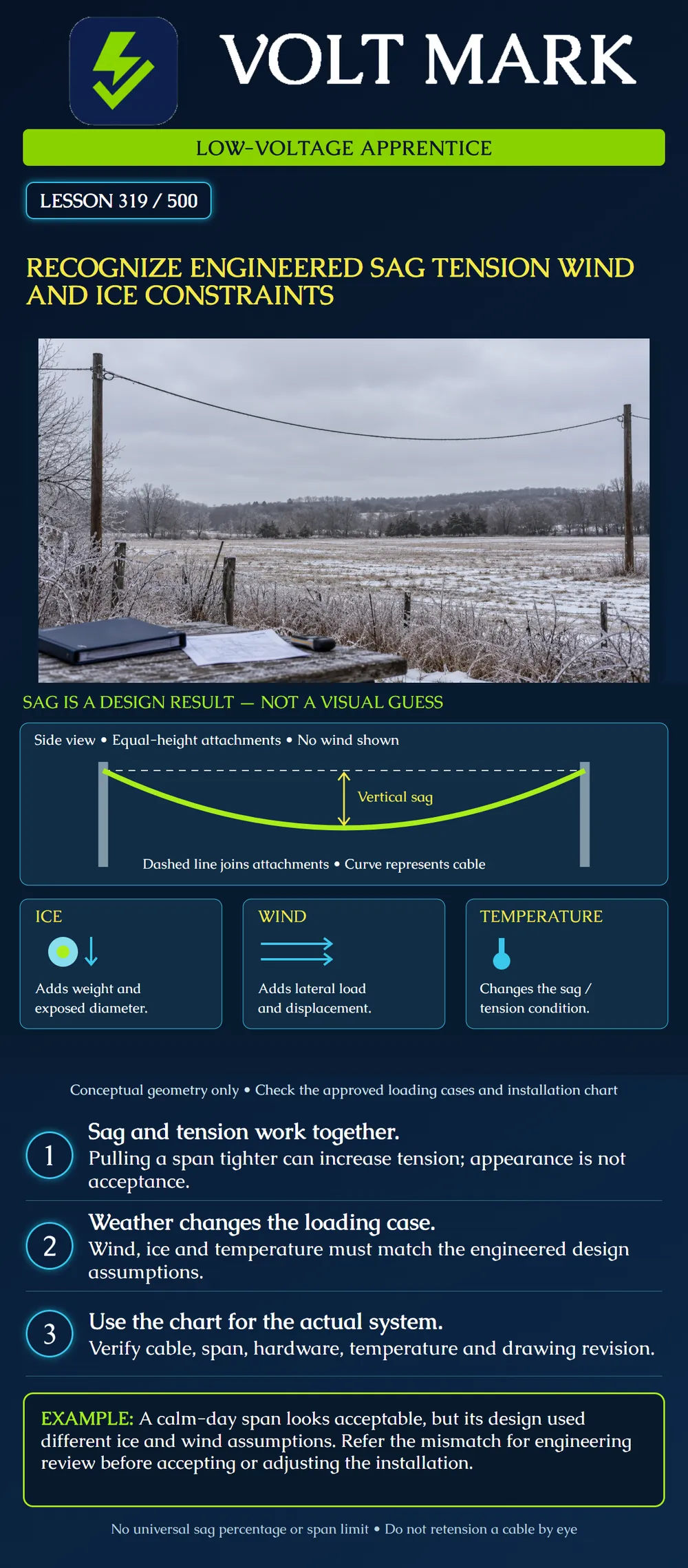
Recognize the inputs behind an aerial cable's sag and tension design and identify when the field record does not match the approved assumptions.
Sag describes a cable's displacement below its attachment reference in the simplified equal-height, no-wind side view used here. Tension is a force along the cable or supporting system. A flatter-looking span is not automatically a better installation: tightening a span can increase tension. Clearance and strength must both be addressed by the approved design.
Corning's engineering note explains that aerial planning depends on cable properties, span geometry and environmental loading. Ice adds weight and increases exposed diameter; wind produces lateral loading and displacement. Temperature also changes the sag/tension condition. The important question is not simply whether a cable can reach the next pole, but whether the selected system meets the required conditions throughout the design cases.
AFL's installation reference directs installers to sag/tension charts and cautions against overtensioning. Use the appropriate chart and procedure for the actual cable and route. Product-specific instructions are not a national rule for every fiber cable. This lesson does not provide an allowable tension, sag percentage, span limit or electrical clearance.
Do not substitute breaking strength for an installation target. Record the exact kind of limit and its source rather than copying an unlabeled number. The responsible engineering and installation team must resolve ambiguous chart headings, changed conditions or missing information before an adjustment is made.
A crew folder contains a sag chart for cable model A. The delivered reel is model B with the same fiber count. An apprentice is asked to help organize the records.
Flag the model mismatch and provide the exact reel identification and chart revision to the lead. Matching fiber count does not establish matching mechanical behavior. Keep the incorrect chart identified as superseded or unresolved according to the project document procedure; do not silently relabel it for the new cable.
A fictional design package lists one environmental loading basis. A later route revision moves a segment to a location with a different documented design basis, but the old chart remains in the field folder.
Identify the route segment and the conflicting references. Request confirmation from the responsible engineer that the chart remains applicable or obtain a revised chart. A calm installation day does not remove the need for the specified environmental checks. The classroom exercise is to recognize the mismatch, not to calculate replacement loads.
Before using a training chart, identify:
If a field is missing, mark it unresolved. Do not borrow a value from a neighboring row, another product family or a visually similar span. This document exercise does not authorize aerial access or adjustments to installed facilities.
Answer: No; it may increase tension and still fail the approved criteria.
Answer: The line joining the equal-height attachment points.
Answer: No; it adds loading and changes exposed diameter.
Answer: No.
Answer: Resolve the mismatch with the responsible team before using that chart.
A fictional field folder contains a chart labeled model A, revision 2; a reel record labeled model B; and a route revision that changes the documented wind/ice basis. An observer suggests tightening the cable until it looks straight. List the three issues you would send to the lead, and state what evidence would resolve them. Do not calculate a replacement tension or adjust any cable.
Answer guide: First resolve the cable-model/chart mismatch with the applicable chart or engineering disposition. Second resolve whether that chart covers the revised route and environmental basis. Third refer the appearance concern for comparison with approved measurements, chart criteria and any authorized adjustment procedure. Neither matching fiber count nor visual straightness closes these issues.
Accessed 2026-10-01. Corning AEN014, Sag and Tension — General, revision 5, November 2002: https://www.corning.com/catalog/coc/documents/application-engineering-notes/AEN014.pdf Used for basic mechanics and design inputs. Historical code references and numerical examples are not adopted as current national requirements. AFL, Installing ADSS — Quick Reference Guide, marked 2.07.23: https://learn.aflglobal.com/_pfcdn/assets/preprocessed/11221/ed3aeb11-8720-415b-8fbc-b9a316d73037/ed3aeb11-8720-415b-8fbc-b9a316d73037.ff1f6592-6f05-4606-ac5c-8bef8e392c77 Used for chart-based sagging, compatible hardware and avoiding overtension. Specific installation percentages and equipment dimensions are not generalized.
Texas journeyman, 15 questions, scored by topic against the 70% mark. No card, and no account needed to start.
Free study material for low-voltage apprentices. This is a national foundation course: requirements differ by state and by local jurisdiction, and a practice that is common in one place is not a rule everywhere. Nothing here is a licence, a certification, or authority to work unsupervised, and completing it does not count as apprenticeship hours or continuing-education credit. Check the codes adopted where you are working, the licensing authority for that work, and your employer's safety programme. VoltMark is not affiliated with, endorsed by, or sponsored by NFPA, OSHA, NICET, BICSI, FOA, or any state or local licensing authority.

Electrician licensing exam prep: practice questions, timed exam simulations, and step-by-step help finding every answer in the NEC.