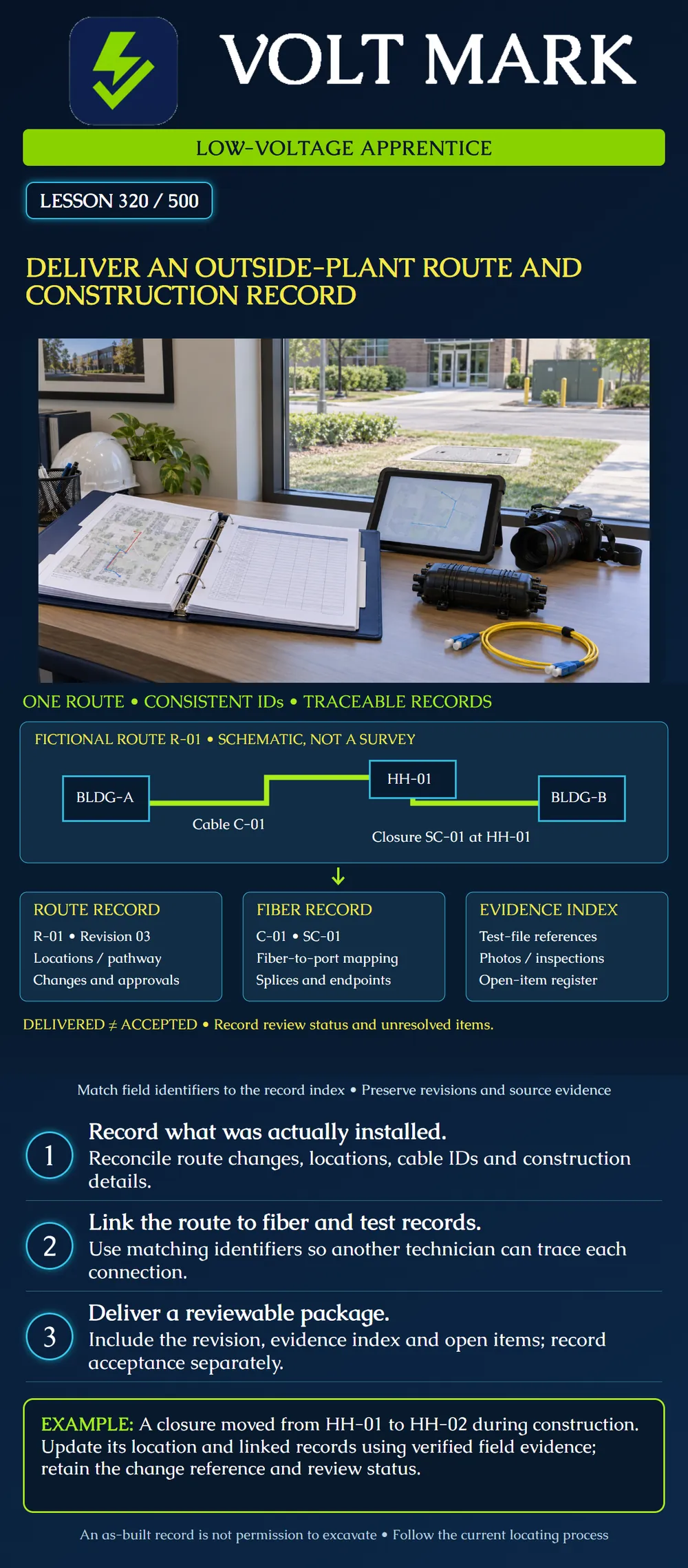
Assemble a traceable outside-plant handover package whose route, component identifiers, fiber mapping and supporting evidence agree.
A construction record must help the next person understand the installed plant. FOA describes OSP documentation as including the route and component locations, fiber paths and test results. It also emphasizes keeping records current and indexing digital test files. Start with the project's required deliverables and naming rules, then reconcile them against verified installation evidence.
The route drawing is only one part of the package. It should connect to the cable and closure register, fiber/splice mapping, test records and documented changes. A record that locates a handhole but cannot identify the cable inside it is incomplete for many restoration tasks. Conversely, a test report without an identifiable link cannot reliably establish which route it describes.
FOA's deliverables guidance calls for understandable documentation and knowledgeable review before sign-off. A large file count is not proof that the records are correct. Follow the agreed test plan and acceptance criteria; do not replace them with generic values from this lesson. The delivery transmittal, technical review and owner's acceptance should have distinct, accurate statuses.
The approved plan shows SC-01 at HH-01. A verified construction record and change authorization show the closure installed at HH-02. A draft handover still lists HH-01.
Flag the mismatch and reconcile the route drawing, closure register and any affected splice, slack or photo references. Preserve the evidence and change authorization. Do not move the map symbol alone and leave contradictory tables. Record the corrected revision and its review status so the superseded package cannot be mistaken for the current one.
A folder contains a report named “final-test.pdf.” Its summary says pass, but the report's link name cannot be matched to the cable and endpoint schedule.
Ask for the identifier mapping or corrected export from the responsible tester. Keep the original data intact. Do not rename an unrelated result to make the index appear complete. The missing linkage is an open item even if the displayed measurement seems plausible. Acceptance requires evidence that belongs to the actual installed link.
A training drawing shows a burial depth copied from the design. No verified field measurement or accepted construction evidence supports an as-built value at a changed segment.
Identify the value as unverified and request resolution through the responsible project team. Do not present a design requirement as a measured installation fact. Record measurement references, units and the depth reference surface when verified data are available. This lesson does not authorize excavation or substitute old records for the current utility-locating process.
Use the owner's required format. For this classroom exercise, prepare an index with:
This is an organizing example, not a nationwide mandatory file list. Preserve original measurement and test files when preparing readable reports. Avoid embedding essential information only in filenames that may later be changed.
Give a classmate a fictional route index and ask them to find SC-01, identify its associated cable, locate one endpoint record and open the corresponding test reference. Record every broken link or inconsistent ID. Resolve the actual source mismatch rather than merely making the index look tidy.
Then ask the classmate to distinguish a delivered record from an accepted record. If the distinction is unclear, revise the status language and identify who performs the review. The exercise ends with a traceable package and honest open items, not an invented approval.
Answer: No; link it to the fiber and termination records.
Answer: Reconcile all affected records and retain the change evidence.
Answer: Its relevance remains unresolved until the mapping is established.
Answer: No.
Answer: No; document delivery and acceptance separately.
Accessed 2026-10-01. FOA, Outside Plant Fiber Optic Network Design — documentation discussion: https://www.thefoa.org/tech/ref/OSP/design.html Used for route/component records, fiber paths, test-file indexing and updates. FOA, Fiber Optic Installation Deliverables: https://www.thefoa.org/tech/ref/install/deliverables.html Used for understandable handover documentation and review before sign-off. Its optical-loss examples and suggested limits are not adopted here.
Texas journeyman, 15 questions, scored by topic against the 70% mark. No card, and no account needed to start.
Free study material for low-voltage apprentices. This is a national foundation course: requirements differ by state and by local jurisdiction, and a practice that is common in one place is not a rule everywhere. Nothing here is a licence, a certification, or authority to work unsupervised, and completing it does not count as apprenticeship hours or continuing-education credit. Check the codes adopted where you are working, the licensing authority for that work, and your employer's safety programme. VoltMark is not affiliated with, endorsed by, or sponsored by NFPA, OSHA, NICET, BICSI, FOA, or any state or local licensing authority.

Electrician licensing exam prep: practice questions, timed exam simulations, and step-by-step help finding every answer in the NEC.