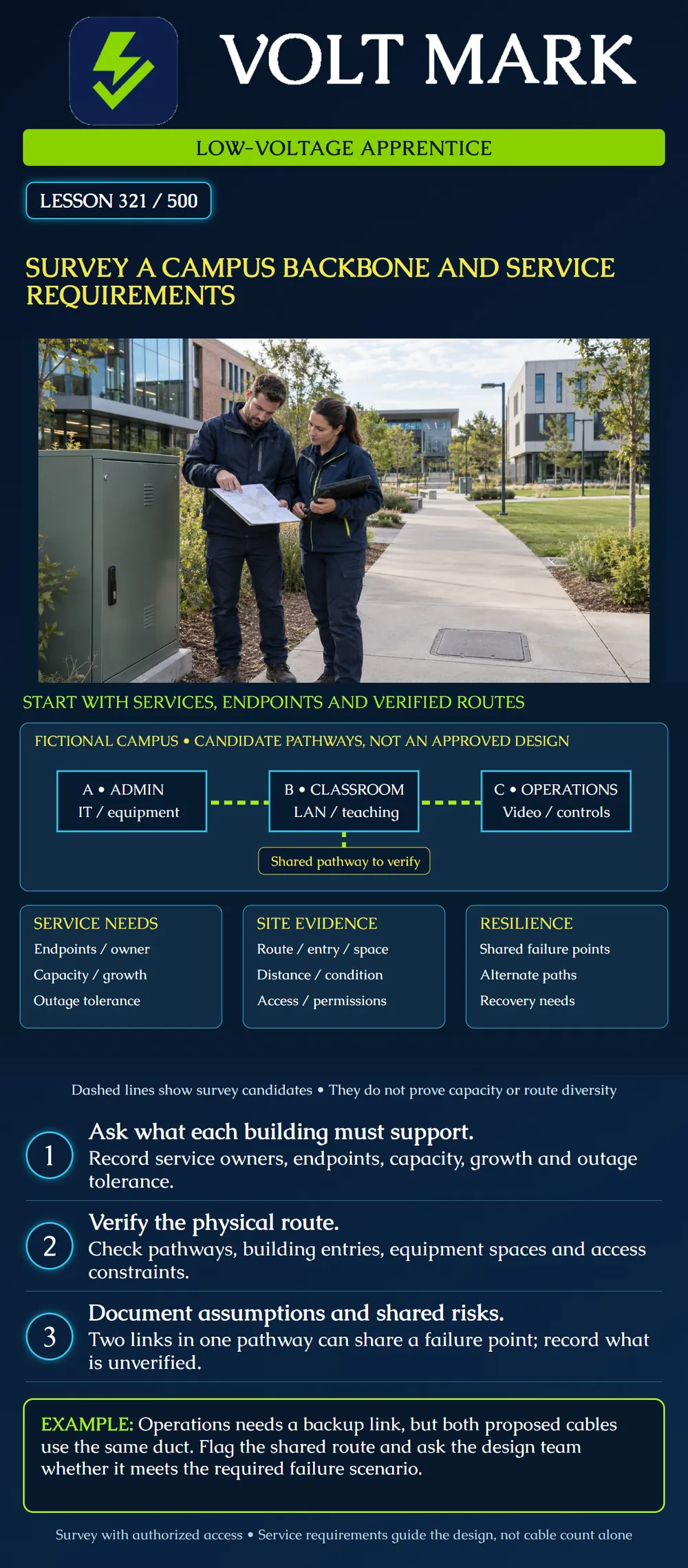
Collect a campus backbone survey that links each building's service needs to verified physical-route information and clearly identified unknowns.
A campus backbone connects buildings or sites. Corning describes campus fiber infrastructure as the connection among those locations and emphasizes planning for future connectivity. A backbone survey should therefore begin with the people and services it must support, not a shopping list of cable reels.
FOA's design guidance starts with the communications requirements, geographic layout and transmission needs. It also identifies permissions, installation planning, documentation and restoration as design considerations. Capture those inputs for the responsible design team. A service may need bandwidth, a particular interface, a recovery objective or separation from another system; fiber count alone does not describe the requirement.
Keep a physical-route survey distinct from a logical network diagram. A line joining two buildings on a screen does not establish a usable duct, accessible entrance or verified distance. Record evidence and its limitations. A candidate route remains a candidate until the required site, ownership and design questions are resolved.
Identify who can confirm each service's requirements. In this classroom exercise, ask the IT representative for network endpoints and growth expectations, the security representative for video or access-control needs, and the facilities representative for building-system requirements. Record required performance and dependencies in the owner's words, then seek clarification of ambiguous terms.
“Critical” is not a complete requirement. Ask which failure must be tolerated, how long interruption can last and what recovery process is expected. Specialized or life-safety systems need their own approved requirements and responsible designers; do not assume a general campus LAN is an acceptable transport merely because fiber is available.
Use authorized access and the project's survey procedure. Identify buildings, proposed termination spaces, entrances, pathway ownership and known route constraints. Record how distances were obtained and whether they are measured, estimated or taken from an existing drawing. Identify unknown duct condition or occupancy rather than reporting spare capacity from appearance.
For equipment spaces, document available records and conditions relevant to the design team, including access, rack space and environmental or power dependencies. Observation is not electrical approval. Do not open restricted facilities or perform testing outside the assigned survey scope.
Operations requests continuity after one route is damaged. A proposal shows two separate cables, but the route sketch puts both in the same trench.
Record the shared failure point and refer it to the design team. Two cables do not by themselves prove that a trench failure is survivable. The owner and designer must define the failure scenario and the complete recovery arrangement, including equipment dependencies. Do not mark the requirement satisfied simply because the drawing has two lines.
A classroom building is close to the administration building on a map. The actual approved pathway may go around a restricted area, enter on the far side and continue through an interior route.
Label the map distance as a preliminary estimate with its basis. Ask for the actual route and measurement evidence before equipment reach or cable quantity is finalized. Do not convert a short map line into a verified installed optical length.
A stakeholder says, “Leave room for the next building.” The survey has no planned location, target date or service estimate for it.
Keep growth as an open requirement. Ask for the intended phase, candidate location and expected services. The design team can then evaluate options and allowances. Choosing an arbitrary spare-fiber percentage is not a substitute for documenting what is known and what remains uncertain.
Prepare a row for every building pair or service connection:
Then have a classmate trace one requirement from its owner to the route evidence. Identify any statement that is only an assumption. Preserve the assumption as an unresolved item until it has an accountable answer.
Answer: Confirmed service and route requirements.
Answer: No.
Answer: No; they share that failure risk.
Answer: No; route geometry and installation details differ.
Answer: Record it and obtain the owner's requirements rather than inventing an allowance.
Accessed 2026-10-01. FOA, Fiber Optic Network Design: https://www.thefoa.org/tech/ref/basic/design.html Used for requirements-first planning and coordination. Legacy technology examples, broad entrance-distance statements and historical product economics are not adopted. Corning, Campus Backbone Infrastructure: https://www.corning.com/in-building-networks/emea/en/home/applications/local-area-networks/traditional-local-area-networks/campus-backbone.html Used for campus interbuilding scope and forward planning, not regional code requirements.
Texas journeyman, 15 questions, scored by topic against the 70% mark. No card, and no account needed to start.
Free study material for low-voltage apprentices. This is a national foundation course: requirements differ by state and by local jurisdiction, and a practice that is common in one place is not a rule everywhere. Nothing here is a licence, a certification, or authority to work unsupervised, and completing it does not count as apprenticeship hours or continuing-education credit. Check the codes adopted where you are working, the licensing authority for that work, and your employer's safety programme. VoltMark is not affiliated with, endorsed by, or sponsored by NFPA, OSHA, NICET, BICSI, FOA, or any state or local licensing authority.
Electrician licensing exam prep: practice questions, timed exam simulations, and step-by-step help finding every answer in the NEC.