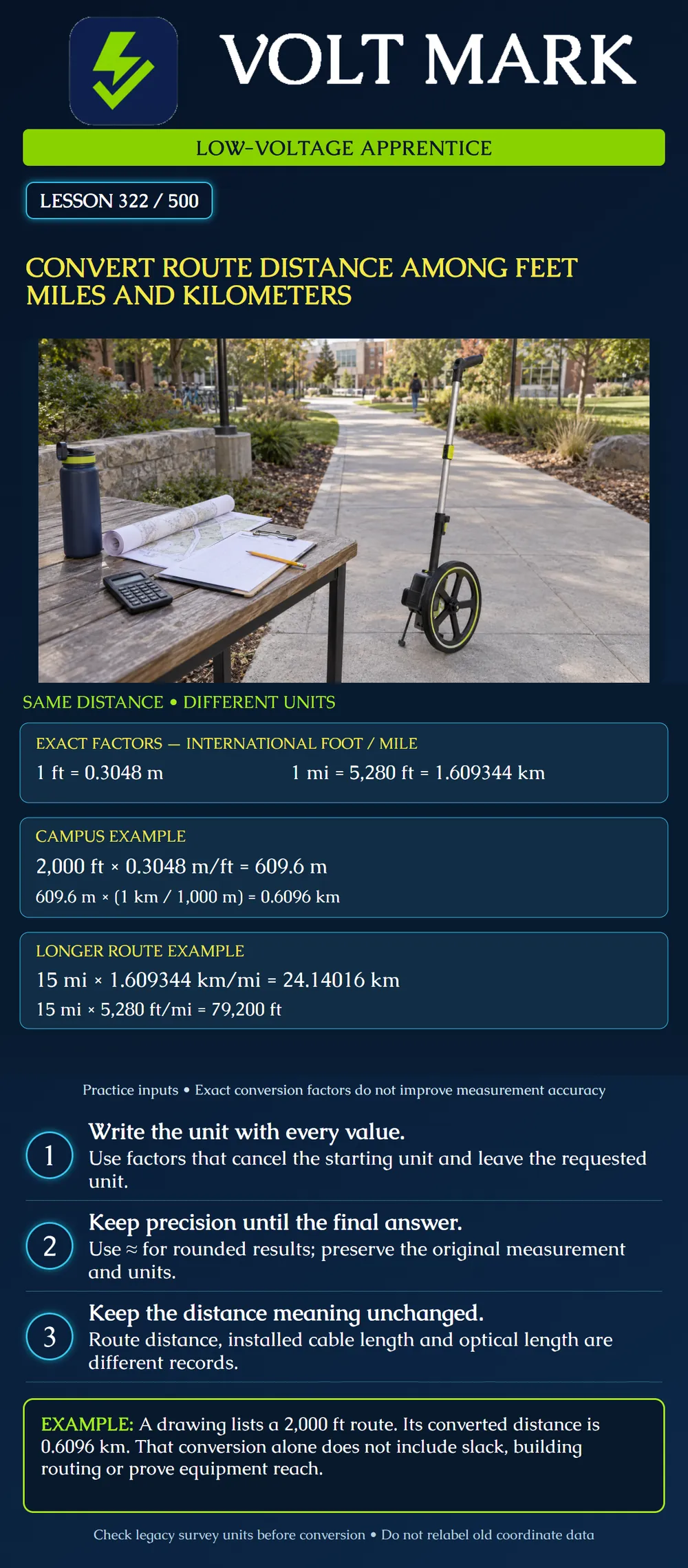
Convert a route distance accurately while preserving its units, measurement basis and distinction from installed cable or optical length.
This lesson uses the international foot and international mile: 1 ft = 0.3048 m exactly. 1 mi = 5,280 ft = 1,609.344 m = 1.609344 km exactly. 1 km = 1,000 m.
For feet to kilometers, multiply by 0.0003048. For kilometers to feet, divide by 0.0003048. For feet to miles, divide by 5,280. For miles to kilometers, multiply by 1.609344. For kilometers to miles, divide by 1.609344.
NIST distinguishes these definitions from legacy U.S. survey-foot measurements. Check the source metadata before converting old survey or coordinate files. Do not silently relabel them as international feet. A coordinate-system transformation can involve more than changing a distance unit.
Write the starting quantity and its unit. Choose a conversion ratio with that unit in the denominator. The starting unit cancels, leaving the desired unit. This makes the operation auditable instead of relying on a remembered number with no explanation.
A conversion changes how a distance is expressed, not what was measured. A map route, installed cable length and optically measured fiber length can represent different quantities. Keep the original description beside the result. The arithmetic does not add service loops, vertical sections, building routing or a loss budget.
Keep full conversion precision during calculation and round the final reported result according to the measurement and project needs. An exact factor does not make an approximate field measurement exact. The equals signs in the practice examples express arithmetic for the stated inputs; they do not claim surveyed accuracy.
2,000 ft × (0.3048 m / 1 ft) = 609.6 m. 609.6 m × (1 km / 1,000 m) = 0.6096 km. 2,000 ft × (1 mi / 5,280 ft) = 0.378787878... mi. Rounded to four decimal places: approximately 0.3788 mi.
Check the direction: one mile contains thousands of feet, so a 2,000 ft distance must be less than one mile. A result of hundreds of miles indicates a unit or operation error.
15 mi × (1.609344 km / 1 mi) = 24.14016 km. 15 mi × (5,280 ft / 1 mi) = 79,200 ft. As a display rounded to two decimal places, the metric result is approximately 24.14 km. Retain the unrounded value for subsequent calculations when appropriate.
If the original route estimate is only “about 15 miles,” report the converted quantity as approximate too. Do not imply that five decimal places came from an accurate survey.
3 km × (1,000 m / 1 km) ÷ (0.3048 m/ft) = 9,842.519685... ft, or approximately 9,842.52 ft. 3 km ÷ 1.609344 km/mi = 1.864113576... mi, or approximately 1.8641 mi.
A fictional route register contains one segment of 1,200 ft and another of 0.4 km. Convert before adding: 1,200 ft × 0.0003048 km/ft = 0.36576 km. 0.36576 km + 0.4 km = 0.76576 km.
Do not add 1,200 and 0.4 and label the answer feet or kilometers. The sum above describes those two stated route segments only. Any other cable-length allowances require separate documented inputs.
A hand-marked note says “distance 2000.” The file does not say feet, meters or another unit.
Mark the unit unresolved and obtain the source clarification. Neither the size of the campus nor the unit used on a neighboring drawing proves what the author meant. An accurate calculator cannot repair an unidentified starting quantity.
For one fictional route, write the original value, unit, source, measurement description, exact conversion factor, unrounded result and reported result. Add “estimated” or “measured” only when supported by the source. A second learner should be able to reproduce the arithmetic without guessing a unit or rounding rule.
Accessed 2026-10-01. NIST, U.S. Survey Foot: Revised Unit Conversion Factors; page updated February 3, 2026: https://www.nist.gov/pml/us-surveyfoot/revised-unit-conversion-factors Used for exact foot/mile factors and the distinction from legacy survey units. NIST, U.S. Survey Foot: https://www.nist.gov/pml/us-surveyfoot Used for the transition to the international-foot definition and preservation of historic/legacy context.
Texas journeyman, 15 questions, scored by topic against the 70% mark. No card, and no account needed to start.
Free study material for low-voltage apprentices. This is a national foundation course: requirements differ by state and by local jurisdiction, and a practice that is common in one place is not a rule everywhere. Nothing here is a licence, a certification, or authority to work unsupervised, and completing it does not count as apprenticeship hours or continuing-education credit. Check the codes adopted where you are working, the licensing authority for that work, and your employer's safety programme. VoltMark is not affiliated with, endorsed by, or sponsored by NFPA, OSHA, NICET, BICSI, FOA, or any state or local licensing authority.

Electrician licensing exam prep: practice questions, timed exam simulations, and step-by-step help finding every answer in the NEC.