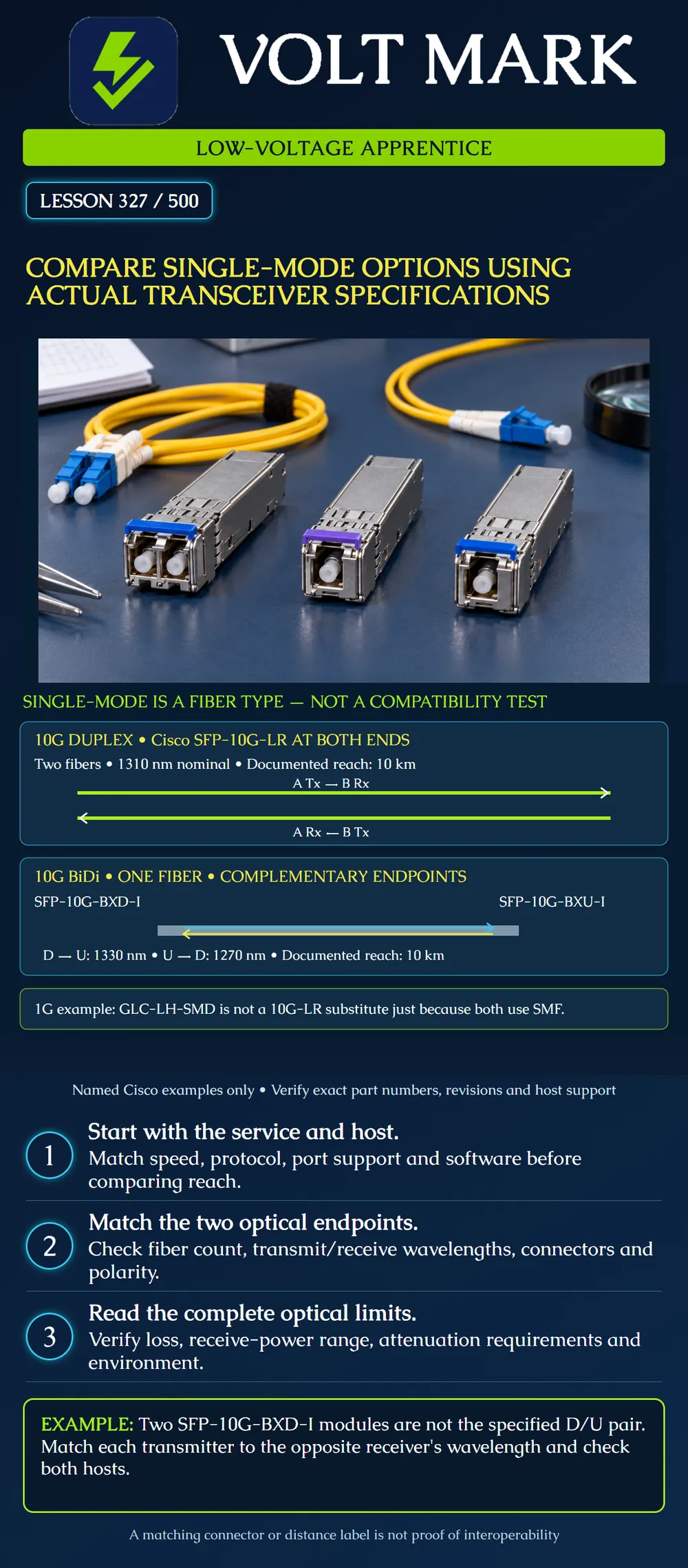
Compare exact transceiver specifications without treating single-mode fiber, a matching connector or an equal reach label as sufficient evidence of compatibility.
Cisco SFP-10G-LR is a 10GBASE-LR duplex example using two fibers, nominal 1310 nm and documented 10 km G.652 single-mode reach.
Cisco SFP-10G-BXD-I and SFP-10G-BXU-I are a complementary 10G single-fiber pair with documented 10 km reach. The D end transmits at nominal 1330 nm and receives 1270 nm; the U end reverses those wavelengths.
GLC-LH-SMD is a separate Gigabit LX/LH example. Its use of single-mode fiber does not make it a substitute for a required 10G interface. Confirm the exact host, port, software and supported operating mode for any selection.
These examples teach comparison, not a purchasing recommendation. No actual host platform or installation is qualified by this lesson.
For every candidate, record:
Keep each value attached to its source row. Similar names can hide different temperature ranges, wavelengths or protocol support. Do not combine a reach from one model with a receiver sensitivity from another.
For the two named 10G examples, Cisco lists average transmit power from -8.2 to +0.5 dBm and receive power from -14.4 to +0.5 dBm. Equal power ranges do not erase their different optical arrangements. Keep any calculation tied to the correct endpoints and channel.
A reach check, a channel-loss check and a receive-power check answer different questions. Read the complete conditions, including any footnotes, before deciding whether a candidate fits. Missing information should remain unresolved rather than being borrowed from a similar product.
A training inventory contains two SFP-10G-BXD-I modules and one available fiber. A learner proposes using the two modules because their labels and reach match.
The specified pairing is D with U. Two D transmitters do not create the complementary wavelength relationship shown in the diagram. Correct the proposed endpoint list and verify the other requirements before any test connection. Matching part numbers is appropriate for some duplex examples but is not a general rule for every optical system.
A project requires a 10 Gb/s service. A spare bin contains GLC-LH-SMD modules, and their fiber and distance descriptions appear suitable.
Record the rate mismatch. Do not downgrade the requirement to make available stock fit. The team must either select a supported solution for the requirement or obtain an explicit service-design change. The fact that a module can physically enter a port does not establish its supported operation.
A material schedule names a specific environmental variant. A supplier quote omits the suffix and says “equivalent SMF optic.”
Request the complete model and evidence for the claimed equivalence. Compare environment and host support along with optical parameters. Do not approve the substitution from a shortened description. Preserve the unresolved item in the submittal record.
Draw an A-end transmitter and B-end receiver, then reverse the direction. Write the exact model beside each endpoint and the documented wavelength information beside each arrow. Mark whether each direction uses its own fiber or shares one physical fiber.
Next, have a classmate identify the source for the rate, reach and host-support entries. A complete worksheet must make these references retrievable. If an entry cannot be tied to the correct model, return it for clarification.
Answer: No.
Answer: Two.
Answer: SFP-10G-BXU-I.
Answer: Complementary transmit/receive wavelengths.
Answer: No.
Answer: Obtain the exact specifications and compatibility evidence.
Mistake: Pairing two BXD-I modules because their model labels match. Correction: Match the documented complementary D and U endpoints, and trace transmit wavelength to the opposite receiver in both directions.
Mistake: Selecting GLC-LH-SMD for the required 10 Gb/s service because the distance fits. Correction: Check service rate before optical reach; retain the 10 Gb/s requirement unless its owner approves a change.
Mistake: Accepting an omitted suffix as a harmless purchasing abbreviation. Correction: Obtain the full part number and compare environment, host and software support with the approved requirement.
Accessed 2026-10-01. Cisco, 10GBASE SFP+ Modules Data Sheet: https://www.cisco.com/c/en/us/products/collateral/interfaces-modules/transceiver-modules/data_sheet_c78-455693.html Used for LR and BXD/BXU specifications and pairing. Cisco, SFP Modules for Gigabit Ethernet Applications Data Sheet: https://www.cisco.com/c/en/us/products/collateral/interfaces-modules/gigabit-ethernet-gbic-sfp-modules/datasheet-c78-366584.html Used for GLC-LH-SMD identification as a Gigabit LX/LH option.
Original diagrams and comparison cases. No numerical link-design calculation or host approval is claimed.
Texas journeyman, 15 questions, scored by topic against the 70% mark. No card, and no account needed to start.
Free study material for low-voltage apprentices. This is a national foundation course: requirements differ by state and by local jurisdiction, and a practice that is common in one place is not a rule everywhere. Nothing here is a licence, a certification, or authority to work unsupervised, and completing it does not count as apprenticeship hours or continuing-education credit. Check the codes adopted where you are working, the licensing authority for that work, and your employer's safety programme. VoltMark is not affiliated with, endorsed by, or sponsored by NFPA, OSHA, NICET, BICSI, FOA, or any state or local licensing authority.

Electrician licensing exam prep: practice questions, timed exam simulations, and step-by-step help finding every answer in the NEC.