Evaluate both ends of a receiver's power range and distinguish an operating boundary from a damage threshold.
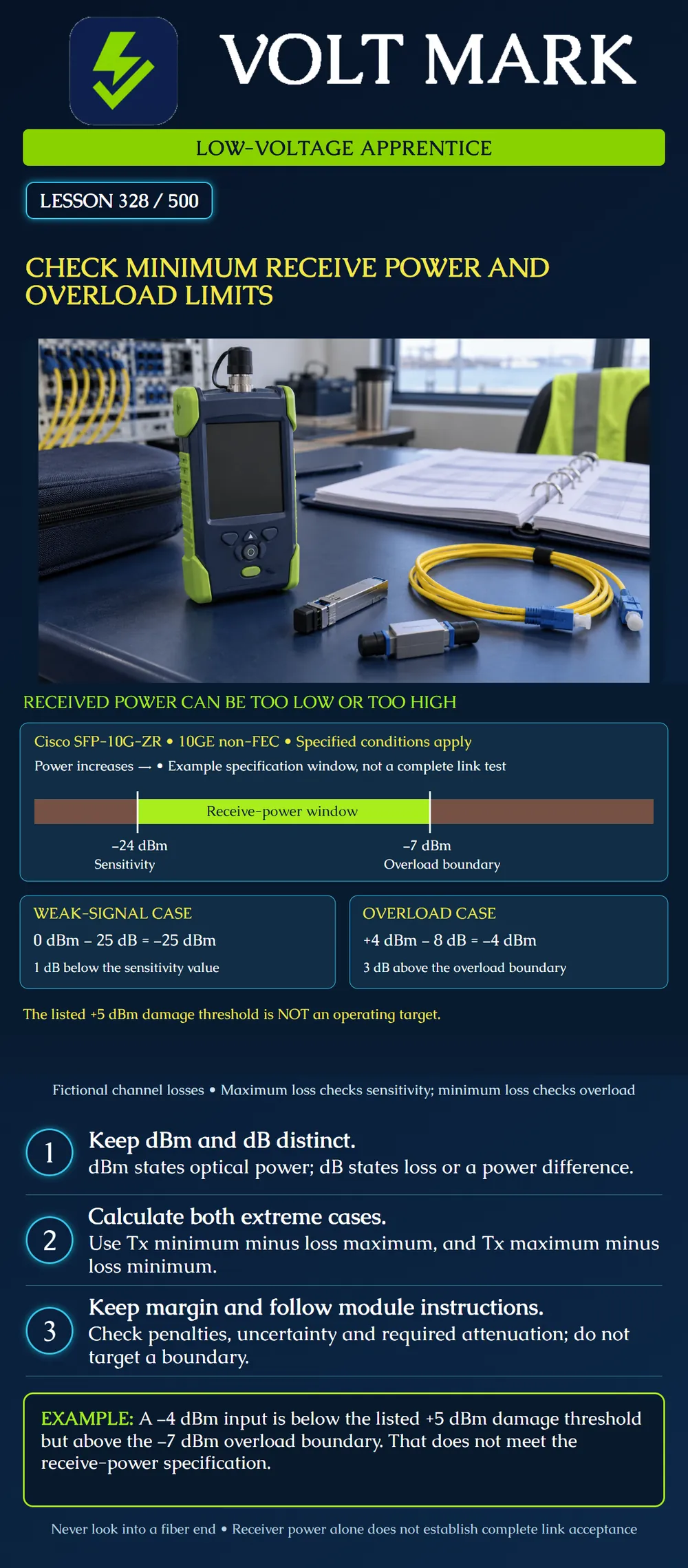
The named example is Cisco SFP-10G-ZR. Its data sheet lists average transmitter output from 0 to +4 dBm. For the specified 10GE non-FEC performance conditions, receiver sensitivity is -24 dBm and the overload value is -7 dBm. The table separately lists a +5 dBm receiver damage threshold.
Those numbers do not make a universal window for every optic, wavelength or operating mode. Read the exact model, wavelength conditions and test criteria. A different protocol or FEC setting can have a different sensitivity entry. The source also includes dispersion penalties and attenuation instructions; a basic power check does not replace them.
dBm expresses optical power relative to one milliwatt. dB expresses a ratio, attenuation or difference. For a passive channel, the screening equation is: Receive power in dBm = transmit power in dBm - channel loss in dB.
A less-negative dBm number means more power. For example, -4 dBm is higher power than -7 dBm. Do not reverse that comparison because both numbers have minus signs. Subtracting additional positive loss makes the received-power number lower.
Use minimum transmitter power and the largest credible channel loss, including appropriate design provisions.
Classroom case: Tx minimum = 0 dBm. Assumed maximum loss = 25 dB. Receive minimum = 0 - 25 = -25 dBm.
That result is 1 dB below the -24 dBm sensitivity entry. The scenario does not satisfy this basic check. Do not relabel the channel as acceptable because a typical transmitter might launch more power on a particular day.
Use maximum transmitter power and the smallest credible channel loss.
Different classroom case: Tx maximum = +4 dBm. Assumed minimum loss = 8 dB. Receive maximum = +4 - 8 = -4 dBm.
That is 3 dB higher than the -7 dBm overload boundary. The scenario fails this check even though -4 dBm is below the listed damage threshold. Being below a damage threshold is not proof of acceptable receiver performance.
These are separate loss scenarios designed to teach the two comparisons. Do not combine their values as measured bounds for an actual route.
Assume an independently supported minimum loss of 14 dB and maximum loss of 20 dB: Low received power = 0 - 20 = -20 dBm. High received power = +4 - 14 = -10 dBm.
The low end is 4 dB above sensitivity, and the high end is 3 dB below overload. This passes only the displayed power-window screening. Reach, dispersion, channel requirements, host support, tolerances and measured acceptance still need review. Do not turn this classroom interval into an attenuator-selection table.
An attenuator reduces power but also consumes available loss budget. Its tolerance and wavelength dependence matter. Recheck both extremes after adding it. Follow the exact manufacturer's short-link requirements rather than selecting a value from the overload arithmetic alone.
The Cisco example explicitly calls for attenuation on shorter single-mode links below 40 km. This lesson does not prescribe a replacement setup or approve a direct bench connection. The responsible qualified team must use the current complete instructions.
Record what supports each loss bound. An upper loss allowance does not establish a lower bound. Likewise, a monitoring reading at one moment does not prove the worst case across temperature, component variation or future changes.
A technician records receive power as “-4” and labels it pass because a nearby spreadsheet shows “damage +5.” The exact unit and operating mode are not recorded.
First identify the module and required operating specification. Confirm the unit and the applicable receiver boundary. For the named example, -4 dBm is outside the specified overload boundary. Preserve the original reading, correct the interpretation and resolve the setup through the authorized procedure. Do not test a damage threshold in the field.
Answer: -4 dBm.
Answer: Minimum transmit power minus maximum channel loss.
Answer: Maximum transmit power minus minimum channel loss.
Answer: No.
Answer: -20 dBm minimum and -10 dBm maximum.
Answer: No.
Mistake: Calling -4 dBm lower power than -7 dBm because four is smaller than seven. Correction: Compare signed values: -4 dBm is 3 dB higher, so it exceeds this example's -7 dBm overload boundary.
Mistake: Using the +5 dBm damage threshold as the operating pass limit. Correction: Use the applicable sensitivity and overload entries for normal performance; keep the damage threshold separate.
Mistake: Adding attenuation to fix overload without revisiting the weak-signal case. Correction: Recalculate minimum transmit power minus maximum total loss after the proposed change, including its tolerances.
Accessed 2026-10-01. Cisco, 10GBASE SFP+ Modules Data Sheet, table 5, SFP-10G-ZR/SFP-10G-ZR-S parameters: https://www.cisco.com/c/en/us/products/collateral/interfaces-modules/transceiver-modules/data_sheet_c78-455693.html Used for the named example's power values, non-FEC sensitivity, distinct overload/damage entries and short-link attenuation requirement. Full test conditions and penalties remain applicable.
Original scale and arithmetic exercises.
Texas journeyman, 15 questions, scored by topic against the 70% mark. No card, and no account needed to start.
Free study material for low-voltage apprentices. This is a national foundation course: requirements differ by state and by local jurisdiction, and a practice that is common in one place is not a rule everywhere. Nothing here is a licence, a certification, or authority to work unsupervised, and completing it does not count as apprenticeship hours or continuing-education credit. Check the codes adopted where you are working, the licensing authority for that work, and your employer's safety programme. VoltMark is not affiliated with, endorsed by, or sponsored by NFPA, OSHA, NICET, BICSI, FOA, or any state or local licensing authority.

Electrician licensing exam prep: practice questions, timed exam simulations, and step-by-step help finding every answer in the NEC.