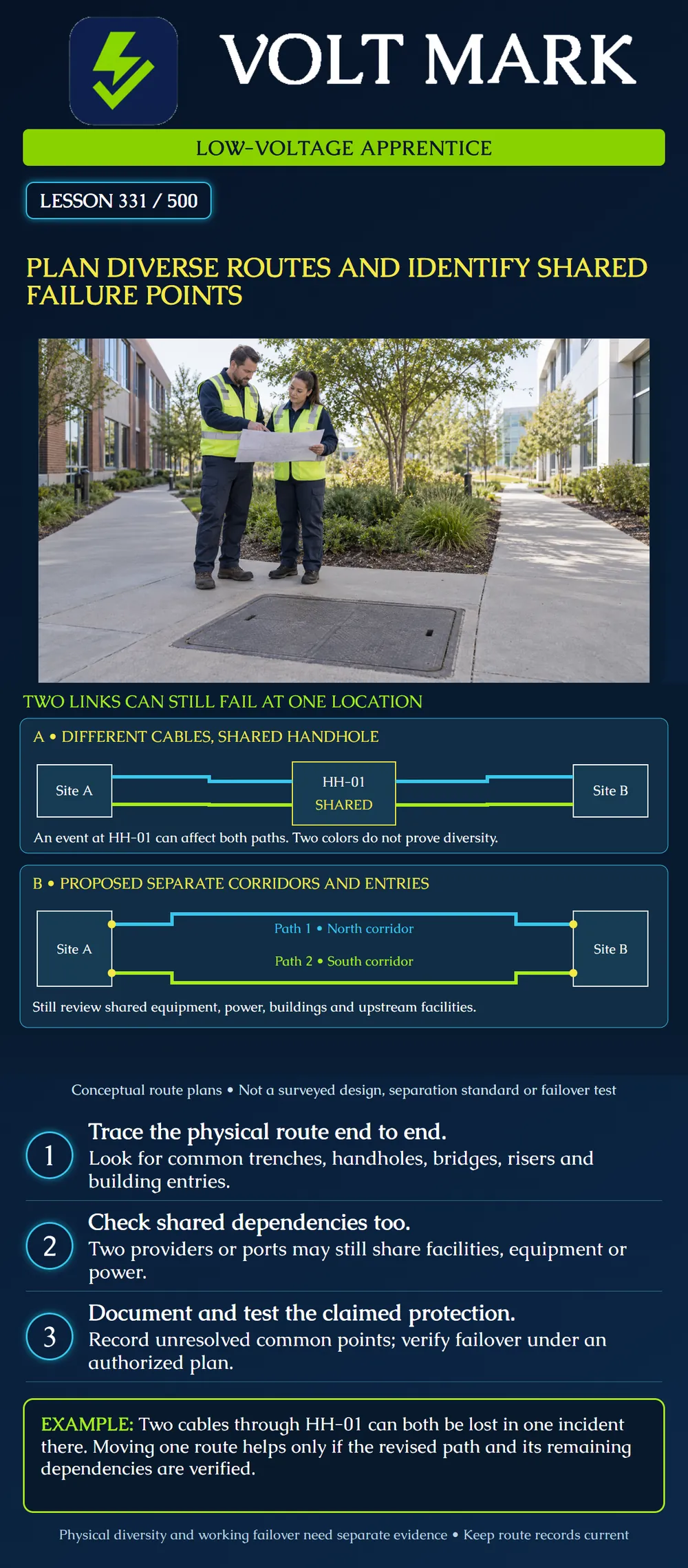
Trace two proposed fiber paths, identify where one incident could affect both, and describe what evidence would support a limited route-diversity claim. This is a planning lesson, not an instruction to alter or interrupt a live network.
Route diversity concerns physically different paths; redundancy concerns additional assets or backup capacity. CISA's published guidance treats these as related but distinct elements of communications resilience. Its guidance also warns that separate providers can use the same lines or facilities. A network diagram with two links therefore needs a corresponding physical-route record.
Define the scope before saying “diverse.” A comparison between two building entrances does not prove independence inside those buildings or throughout a provider network. Identify the service, endpoints, route segments and failure events being assessed. Avoid an unqualified promise that a system cannot fail.
The training inventory lists: Path 1: A north entry → north duct → HH-01 → B north entry. Path 2: A south entry → south duct → HH-01 → B south entry.
Different entries do not eliminate HH-01. Mark that location in both records, name the affected services and ask the designer to assess the relevant failure event. Do not count the two duct labels as proof that the paths remain separate between documented points.
A revised proposal replaces the second handhole segment: Path 2 revision: A south entry → south corridor → HH-02 → B south entry. This removes the named common handhole in the drawing. It does not establish that the two corridors avoid the same bridge, flood exposure, construction work zone or downstream facility. Keep those items unresolved until the supporting route evidence exists.
Imagine the two paths terminate on different switch ports but the same switch chassis. A single chassis failure may still interrupt both. Now imagine two chassis powered by the same unprotected supply. The shared power dependency remains. These examples show why a route review and a service-resilience review have different boundaries.
Likewise, two service-provider invoices do not identify the underground route. Request current route or diversity evidence through authorized project channels. This lesson itself sends no provider request. If detailed information cannot be disclosed, record the assurance actually received and its scope instead of inventing a map.
Use one row for each suspected common point:
Example row: HH-01; shown on drawings A-03 and B-04; damage to the common enclosure; both campus uplinks; assess reroute via HH-02; reviewer not yet assigned; evidence remains a fictional classroom drawing.
Do not assign a universal separation distance. The appropriate arrangement depends on the hazards, site constraints and design requirements. Geographical separation should be evaluated against the event being addressed, not simply measured between lines on a diagram.
A physically distinct cable path does not prove that networking equipment will detect a failure and restore the required service. The authorized commissioning plan should define which service is observed, the allowed interruption and the restoration behavior to verify. Record what was actually demonstrated. An apprentice should not unplug live fiber or remove power merely to test a classroom hypothesis.
Mistake: Claiming two routes are diverse because their cable or provider names differ. Correction: Trace the physical facilities and record shared handholes, entries and other dependencies within the stated scope.
Mistake: Declaring the revised HH-02 proposal independent without examining the rest of the route. Correction: Check crossings, shared hazards and endpoint facilities; retain unresolved segments in the shared-point register.
Mistake: Treating separate corridors as evidence that service failover works. Correction: Require the approved service-recovery evidence as a separate record from physical route review.
CISA/DHS, Public Safety Communications Resiliency: Ten Keys to Obtaining a Resilient and Route Diverse Local Access Network, July 2017: https://www.cisa.gov/sites/default/files/publications/07202017_10_Keys_to_Public_Safety_Network_Resiliency_010418_FINAL508C.pdf CISA/DHS, Public Safety Communications Network Resiliency Self-Assessment Guidebook: https://www.cisa.gov/sites/default/files/publications/DHS%20ECD%20Public%20Safety%20Communications%20Network%20Resiliency%20Self-Assessment%20Guidebook_11.29.18%20-%20FINAL.pdf CISA/DHS, Route Diversity Project Fact Sheet: https://www.cisa.gov/sites/default/files/publications/Route%20Diversity%20Project%20Fact%20Sheet%206-9-16%20Final%20508.pdf
Research note, October 1, 2026: relevant primary-source text was available in indexed search excerpts. Direct retrieval of the first two PDFs returned HTTP 403; no complete-PDF inspection is claimed. Used excerpts support distinctions between route diversity and redundancy, separate entries and paths, and shared-provider/facility concerns. Current program offerings and contact details are not asserted. Scenarios, register and diagram are original teaching material.
Texas journeyman, 15 questions, scored by topic against the 70% mark. No card, and no account needed to start.
Free study material for low-voltage apprentices. This is a national foundation course: requirements differ by state and by local jurisdiction, and a practice that is common in one place is not a rule everywhere. Nothing here is a licence, a certification, or authority to work unsupervised, and completing it does not count as apprenticeship hours or continuing-education credit. Check the codes adopted where you are working, the licensing authority for that work, and your employer's safety programme. VoltMark is not affiliated with, endorsed by, or sponsored by NFPA, OSHA, NICET, BICSI, FOA, or any state or local licensing authority.

Electrician licensing exam prep: practice questions, timed exam simulations, and step-by-step help finding every answer in the NEC.