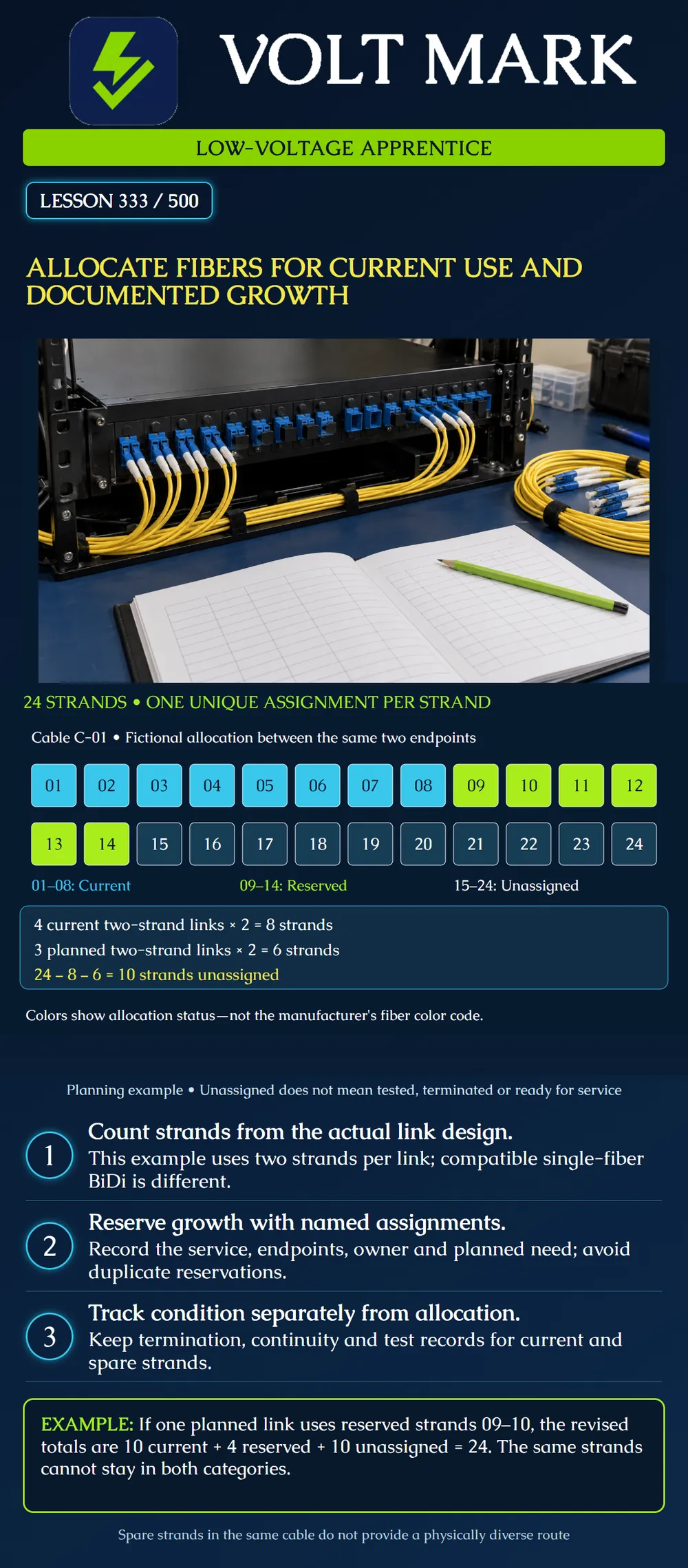
Create a strand allocation that reconciles to the installed count, separates current assignments from documented growth, and keeps allocation distinct from readiness for use.
Plan the fiber count from the services and optical architecture. A conventional two-strand duplex link uses separate transmit and receive strands; a compatible single-fiber bidirectional design can use one strand. The exact equipment matters. Cisco, for example, specifies paired SFP-10G-BXD-I and SFP-10G-BXU-I devices for bidirectional operation on one single-mode strand. That example does not authorize substituting one strand into a two-strand design.
FOA recommends planning spare fibers and interconnection capacity for growth and repair, documenting unused or unterminated fibers, and maintaining identification and records. This lesson does not set a universal spare percentage. A project must decide its growth and restoration provisions from its own requirements.
The range notation is compact. A real record still needs individual strand identities, both termination points and the end-to-end path. A pair in a worksheet does not by itself establish correct transmit-to-receive polarity.
When GROW-01 is commissioned under the approved project process, strands 09–10 change from reserved to current. They do not become an additional physical pair. Revised totals: 10 current + 4 reserved + 10 unassigned = 24. If someone records 10 current + 6 reserved + 10 unassigned, the sum becomes 26. The discrepancy identifies double counting. Preserve the change history and update affected copies.
Now suppose a new approved reservation GROW-04 needs two strands from the unassigned pool. Allocate 15–16 without disturbing the remaining GROW-02 and GROW-03 reservations. The totals become 10 current + 6 reserved + 8 unassigned = 24. Label this as a later revision, not an alternative baseline.
Assume the baseline's ten unassigned strands include strand 19 with a documented failed test and strand 20 awaiting termination. There are still ten unassigned strands administratively, but it would be wrong to call all ten service-ready. Record the failed or incomplete condition beside the allocation state. Do not silently erase a strand from the cable count because it has a defect.
For another arithmetic-only scenario, suppose all ten unassigned strands are verified usable and five compatible two-strand paths are possible between the required endpoints. Ten divided by two yields five additional links under those assumptions. This is not a promise that spare strand count alone provides switch ports, optical compatibility, reach, panel space or acceptable loss.
A useful reservation names the expected service, endpoints, strand requirement, responsible owner and planning milestone. “Save some fiber for later” is too vague to prevent another team from reserving the same capacity. If the future architecture is unknown, record that uncertainty and the review decision rather than presenting a precise demand as established.
Make sure the route segment being counted is clear. A 24-strand cable arriving at one building does not prove that 24 corresponding strands continue to every other building. Splice and patch schedules must establish that continuity. The next lesson develops those records.
For each strand, record cable ID and strand ID; current/reserved/unassigned state; circuit or reservation ID; endpoints; panel and port identifiers; intermediate splice references; fiber type; termination and test status; owner; revision date and change reference. Protect the register from conflicting edits.
Mistake: Leaving activated growth strands in both current and reserved totals. Correction: Move the same strand IDs between categories and reconcile the total to the unchanged 24-strand cable.
Mistake: Treating all ten unassigned strands as ready for service. Correction: Keep allocation status separate from termination and test condition; identify failed or unfinished strands explicitly.
Mistake: Using a spare pair's count as proof of another complete link. Correction: Trace both endpoints, intermediate continuity, compatible interfaces and optical limits before calling the pair usable for that service.
The Fiber Optic Association, Outside Plant Fiber Optic Network Design: https://www.thefoa.org/tech/ref/OSP/design.html Used for spare capacity, unused-fiber documentation, labeling and record maintenance; no historical code statement or universal spare percentage adopted.
Cisco, Cisco 10GBASE SFP+ Modules Data Sheet: https://www.cisco.com/c/en/us/products/collateral/interfaces-modules/transceiver-modules/data_sheet_c78-455693.html Used for the named complementary single-fiber BiDi example. Host compatibility, wavelength pairing and full optical requirements must be checked for an actual design.
Primary sources checked October 1, 2026. All allocations and changes above are original fictional exercises.
Texas journeyman, 15 questions, scored by topic against the 70% mark. No card, and no account needed to start.
Free study material for low-voltage apprentices. This is a national foundation course: requirements differ by state and by local jurisdiction, and a practice that is common in one place is not a rule everywhere. Nothing here is a licence, a certification, or authority to work unsupervised, and completing it does not count as apprenticeship hours or continuing-education credit. Check the codes adopted where you are working, the licensing authority for that work, and your employer's safety programme. VoltMark is not affiliated with, endorsed by, or sponsored by NFPA, OSHA, NICET, BICSI, FOA, or any state or local licensing authority.

Electrician licensing exam prep: practice questions, timed exam simulations, and step-by-step help finding every answer in the NEC.