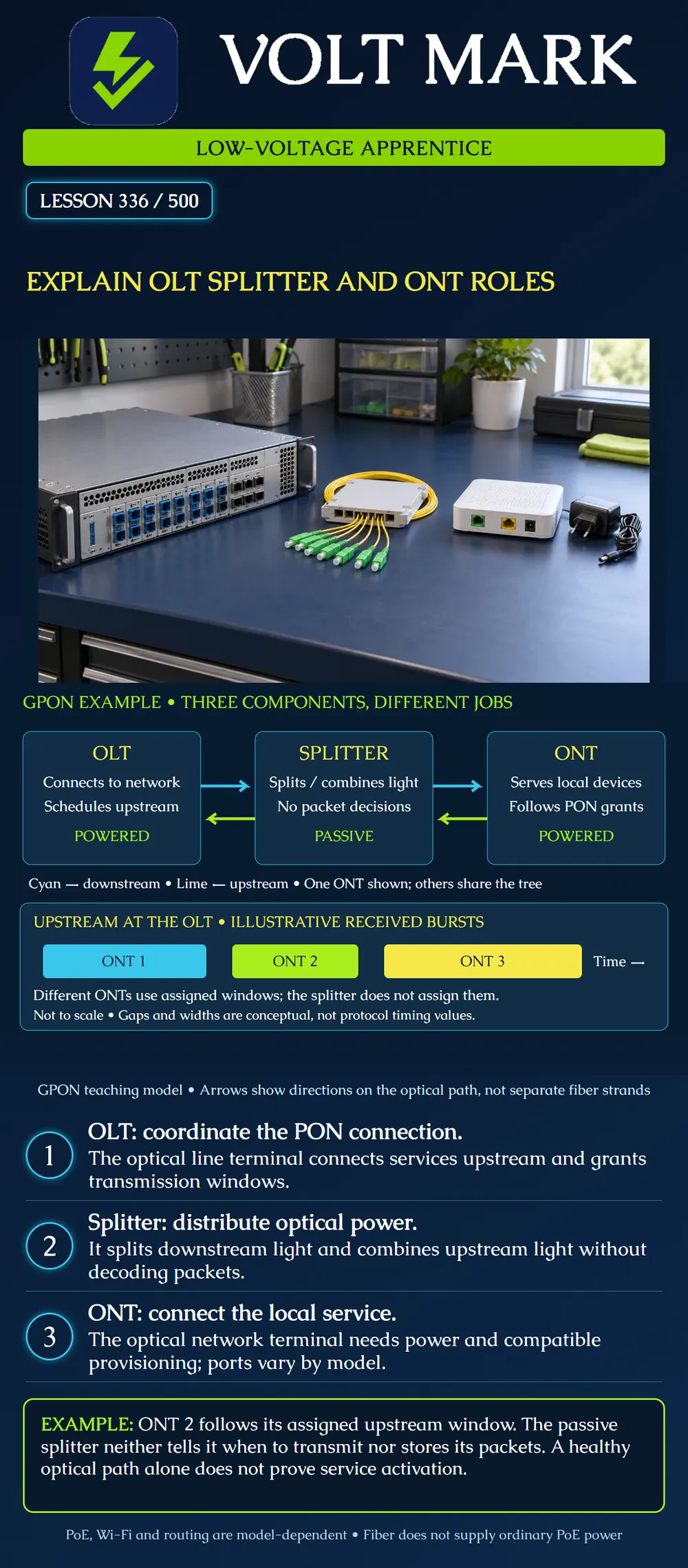
Explain the optical line terminal, passive splitter and optical network terminal roles. Use a GPON example to distinguish optical distribution from packet handling and upstream coordination.
The OLT is powered network equipment at the central end. In GPON it connects network services to the optical access system and coordinates upstream transmission grants. The ONT is powered equipment at the remote end, terminating the PON connection and presenting supported local service interfaces. A passive splitter divides downstream optical power and combines upstream signals; it does not inspect addresses or schedule transmissions.
Cisco's GPON explanation describes downstream distribution and upstream bursts in granted time windows. Its hardware overview supports the distinct equipment roles. These are architectural principles; the lesson does not prescribe a model, split ratio, wavelength, reach, service speed or command.
A workstation behind ONT 2 requests a file from a network service. For this simplified exercise, its service interface is Ethernet and all provisioning is assumed correct.
The request reaches ONT 2 through its local Ethernet interface. ONT 2 handles that traffic according to its configured service and transmits upstream under the GPON grant process. The splitter combines optical paths without reading the request. The OLT receives the upstream information and forwards the service traffic toward the appropriate network connection.
The response arrives through the OLT's network side and travels downstream through the splitter. The optical distribution reaches the connected branches. The ONT processes traffic associated with its configured service and delivers the appropriate information locally. Do not interpret optical distribution to multiple branches as permission for subscribers to access each other's traffic. Authentication, service mapping and security configuration require their own verified design.
WHO DOES THE JOB? Task: allocate upstream transmission opportunities. Responsible component in this GPON example: OLT and the PON control process, with ONTs following grants. Task: divide optical power into multiple branches. Responsible component: passive optical splitter. Task: present the example local Ethernet interface. Responsible component: the selected ONT. Task: supply electrical power to the ONT. Responsible item: its specified power arrangement, not the ordinary communications fiber.
An ONT may offer different interfaces or features depending on the model. Do not assume that every ONT provides Wi-Fi, routing, voice ports or PoE. If a model powers local devices through Ethernet, verify its actual power source, port capability and available budget separately.
Case A: One ONT has lost its electrical supply while others on the same tree remain available. The splitter does not provide replacement electrical power. Record the affected endpoint and approved power checks; the symptom is not automatic proof of a splitter failure.
Case B: The ONT reports acceptable optical levels but the requested service is unavailable. Optical evidence alone does not settle registration, authorization, service mapping, local interface or upstream network status. Record observed states and let the authorized operator reconcile those layers. Do not perform unapproved resets or replace equipment just to see what happens.
Case C: All branches become unavailable together. The common OLT, feeder, splitter path or shared support systems are candidates for investigation, but the shared symptom is not a diagnosis. Compare current alarms, service scope and records before deciding which component failed.
Read the illustrative timeline: ONT 1, then ONT 2, then ONT 3. No two blocks overlap at the OLT in this conceptual drawing. It does not assert that this order repeats or that each ONT always receives the same-sized grant. The lesson's point is coordinated access to a shared upstream channel, not a fixed schedule to configure.
Identify the actual OLT and its network uplink; the PON port; each splitter and branch; the ONT model and ID; the ONT power source; supported local interface; expected registration and service state; and the records needed to verify the optical and service paths. Mark anything not yet known.
Mistake: Assigning upstream transmission scheduling to the splitter. Correction: Trace the grant process to the OLT and participating ONTs; the passive optical path does not schedule traffic.
Mistake: Diagnosing splitter failure when one ONT loses electrical power. Correction: Record the affected ONT and power evidence, then follow the authorized checks for that endpoint.
Mistake: Calling service available from acceptable optical levels alone. Correction: Verify registration, service mapping, local interfaces and upstream service evidence for the intended ONT.
Cisco, Understand GPON Technology, document216230, updated December6,2023: https://www.cisco.com/c/en/us/support/docs/switches/catalyst-pon-series/216230-understand-gpon-technology.html Used for downstream handling, upstream grants and burst/ranging concepts. Its generic loss, rate and reach examples are not treated as universal rules. Cisco, Catalyst PON Series Hardware Installation Guide, Introduction to Passive Optical Network: https://www.cisco.com/c/en/us/td/docs/switches/lan/catalyst_pon/hardware/install/b_hig/overview.html Used for equipment roles and service-interface distinctions, not current purchasing advice.
Primary sources checked October1,2026. All diagrams, symptoms and classroom scenarios are original.
Texas journeyman, 15 questions, scored by topic against the 70% mark. No card, and no account needed to start.
Free study material for low-voltage apprentices. This is a national foundation course: requirements differ by state and by local jurisdiction, and a practice that is common in one place is not a rule everywhere. Nothing here is a licence, a certification, or authority to work unsupervised, and completing it does not count as apprenticeship hours or continuing-education credit. Check the codes adopted where you are working, the licensing authority for that work, and your employer's safety programme. VoltMark is not affiliated with, endorsed by, or sponsored by NFPA, OSHA, NICET, BICSI, FOA, or any state or local licensing authority.

Electrician licensing exam prep: practice questions, timed exam simulations, and step-by-step help finding every answer in the NEC.